Export a résumé, then read the file back through the checker
A résumé is judged as a file, and the file is not always what the text was. This chain checks the text, renders the export, reads the PDF back through the same extraction, and prints both scores.
— score the file, not the draft.
Most advice about applicant tracking systems is about the text of a résumé. The thing an employer's system receives is a file, and a file is written by a renderer, out of a layout, into a text layer nobody looks at. The gap between those two is where a good résumé quietly stops being readable.
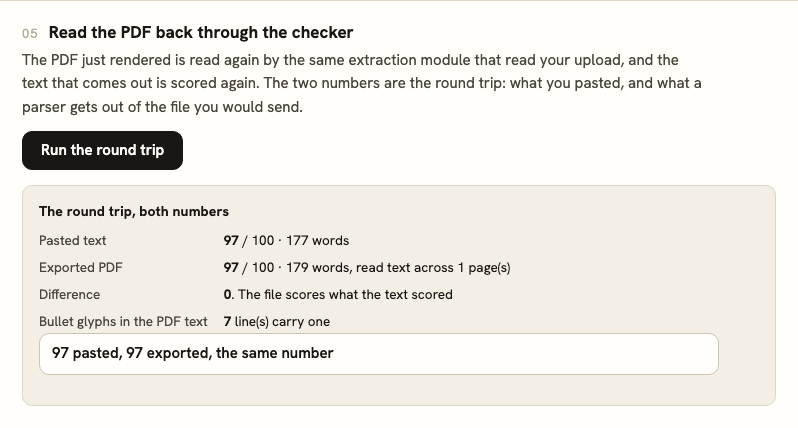
This chain closes the gap by measuring it. It scores the text, renders the export, reads the PDF back through the same extraction module that reads your uploads, and scores that. Two numbers, on your own document, printed side by side.
Do it here
Read it in, check the text, choose a layout, export both files, then score the PDF you just made.
- 01Read it in
- 02Check
- 03Layout
- 04Export
- 05Round trip
- 06Into the tools
Why the two numbers can disagree
The check's first dimension is parseability: whether the text comes out in the order it was written, whether the headings carry evidence under them, whether the characters are ones a parser handles. A two-column layout is the usual culprit, because a column pair is one visual object and two text flows, and the extractor has to guess which is which. The column guide covers what actually goes wrong.
Tables and text boxes are the other common cause, and they fail in a way that is invisible on screen. The guide on tables and the step-by-step repair both cover the fix. Pulling the text back out of a PDF is the piece that shows you the same thing on a document you already have.
Decorative glyphs are the quiet one. A bullet drawn as a private-use character, a ligature the font substitutes, an em-dash written as three pieces: each of them lands in the text layer as something that is not the character you typed. Repairing a broken text layer covers what to look for.
Choosing the layout, from the registry rather than from taste
The chain offers the designs the product's own registry marks as ATS-safe, and prints how many of the full set that is. The number is read from the registry as the page loads, so it is the product's answer rather than a figure typed into an article that will be wrong the next time a design ships.
An ATS-safe design is a single readable text flow with real headings. That is a narrower constraint than it sounds, and several of the designs inside it are handsome. The design showcase shows every one at full size. One résumé in four designs is the piece that shows the same content wearing several of them.
Switching design in the résumé builder never touches your content, so this is a decision you can revisit without cost. A design is not a rewrite covers why that separation is worth keeping.
What the export step actually does
The PDF is rendered by the same route the builder's download button calls, with the same document data and the same theme. The DOCX is written here in the browser as a zip of three XML parts, which is the same thing the tool does. The DOCX article explains why that matters for privacy and for speed.
Then the round trip. The PDF just rendered is handed back to the extraction module as though you had uploaded it, and the text that comes out is scored again. The receipt prints both scores, the word counts on each side, how the browser read the file, and how many lines in the extracted text begin with a bullet glyph. That last count is the cheap tell for whether the bullets survived. The cost of a bad extraction covers what it means when they do not.
Which file to send
When the posting names a format, send that one. When it does not, the two formats fail in different ways: a PDF preserves the layout and risks the text layer, a DOCX preserves the text and risks the layout. The comparison piece is honest that neither is universally safer.
Name the file so a human can find it in a folder of two hundred. The file name guide covers the convention. And keep the exported file, not only the draft: the file is the thing that was sent, and the export is the document makes the case for treating it that way.
What this does not tell you
It does not tell you what an employer's system will do. Nothing here has access to one, and a score from this checker is a readability estimate on extracted evidence. Parsing versus screening separates the two things most articles run together, and the checker guide sets out what the score can and cannot mean.
When the file is settled, the bundle chain is the letter and the check in one sitting, and the Germany chain adds the country conventions on top of the same reading. The portfolio chain reads the same document into a page rather than a file.
Do the editing in the builder
21 of 37 designs are marked ATS-safe in the registry, and the builder switches between them without touching your content.
Open the résumé builderOr run the check on its own pageQuestions
- What does the round trip actually prove
- That the text an extractor gets out of the file you send scores the same as the text you checked. It is measured on your own document each time you run it, and the difference between the two numbers is printed whichever way it falls.
- Why would an export score differently from its own text
- Because a PDF's text layer is written by the renderer, and a layout with columns, tables or decorative glyphs can put the words back in an order nothing reads cleanly. That is what the parseability dimension measures.
- Where does the ATS-safe count come from
- From the product's own design registry, read by this page as it loads. A design marked ATS-safe there is one drawn as a single readable text flow. Changing the registry changes the number here with no edit to this page.
- Is the DOCX made on your server
- No. It is written in this browser, which is why it appears instantly and why it carries no watermark. There is nowhere for a watermark to come from. The PDF is rendered on the server and streamed back.
- Does a high score mean the résumé is good
- No. It means the document is readable and its evidence is present. A readable résumé with nothing in it scores badly for exactly that reason, and a readable one with strong evidence still has to be the right document for the job.
- Do the exports cost anything
- No. Both formats are free, with no account and no watermark on either. The rate limits on the render route are saturation guards rather than a usage meter.
Conxfolio is a free set of four career tools: a résumé builder with 37 rendered layouts, an ATS résumé checker that prints its own arithmetic, a cover letter builder that traces every proof paragraph back to the line it came from, and a portfolio builder with 20 authored designs. There is no account to create, nothing is held back for a paid plan, and no language model is used anywhere in the product, so the readers, the score and the letter are deterministic code you can check.