What an ATS résumé checker measures, and what it cannot
A checker is a measurement, not a verdict. Here is exactly what this one measures, how the number is built, and where its authority stops.
— the number is only the headline.
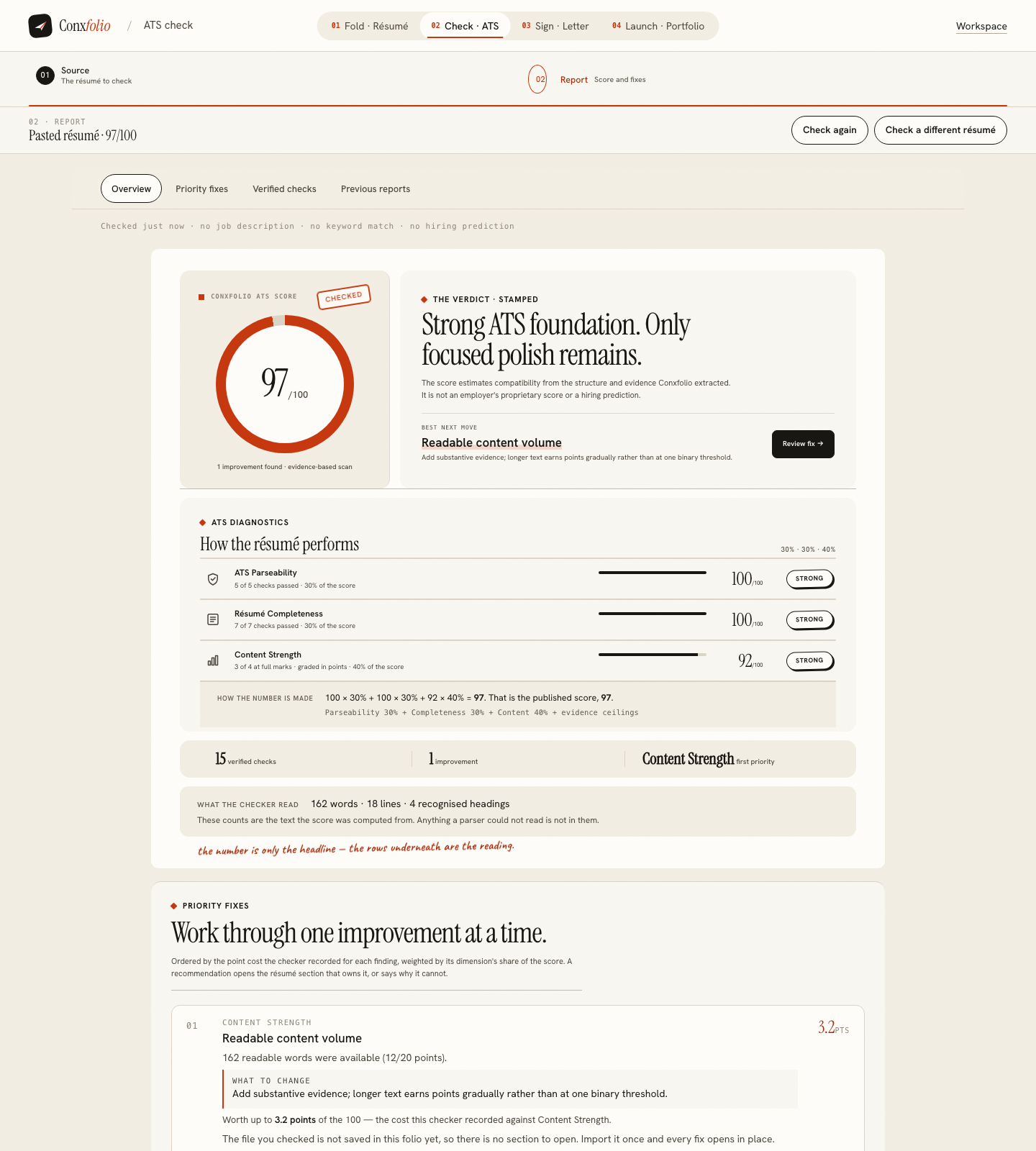
A résumé checker is a measurement of a document. Used that way it is genuinely useful. Used as a verdict on your chances it is worse than nothing, because no public tool has the access that verdict would require.
The two steps
First extraction: the text is pulled out of the file, the same step an employer's parser performs. Then scoring: a set of rules runs over the extracted text. Everything in the report is about that text, which is why a file that extracts badly scores badly no matter how the page looks.
Three dimensions with fixed weights
Parseability, 30 per cent. Starts at a hundred and loses points for a detected table or multi-column pattern, for sections without readable content, for decorative characters, for unreadable glyphs in the text layer, and for inconsistent or shortened dates.
Completeness, 30 per cent. Seven checks whose point values sum to a hundred: identity ten, email address fifteen, phone number five, experience thirty, education fifteen, skills fifteen, summary ten.
Content, 40 per cent. Four graded rules: action-led achievements up to thirty, measurable evidence up to twenty-five, evidence depth up to twenty-five, readable volume up to twenty.
The ceilings
After the weighted sum, four caps apply to documents with very little in them. Under twenty-five words, the score cannot exceed fifteen. With nothing found for experience, education or skills, twenty-five. With no experience and no education, forty. With no experience and content below thirty, fifty-five. They exist so an empty but tidy page cannot present itself as a strong one, and the report says when one has been applied.
The arithmetic is printed
Under the three rows the report shows the multiplication: each dimension's score times its weight, summed, and the published number. On the report above, a hundred and a hundred and ninety-two produce ninety-seven. You can check the arithmetic rather than trusting it, which is the point of printing it.
What the checker read
A line under the score gives the words, lines and recognised headings in the extracted text. This is the most useful line on the page. If it says sixty words and you sent two pages, the extraction lost your document, and the format is the whole job.
Fixes ordered by what they cost
Each finding carries the points it cost, weighted by its dimension. A fix worth 3.2 points and one worth 0.4 look identical on most checkers; here the cost is printed beside the fix, so you can stop when the remaining work stops being worth it. Where the file you checked is not saved in this browser, the report says plainly that there is no section to open, rather than offering a link that would go nowhere.
Where its authority ends
It is not an employer's applicant tracking system. It uses no job description and performs no keyword match; the keywords guide covers why a match percentage cannot be honest. It predicts nothing about an interview. And no language model is involved: the rules above are the whole method, which is why they can be written down on a page like this one.
Run it on the file you actually send, in the checker, and then fix the top item on the list. The résumé builder is where most of the fixes happen, and a recommendation opens the section that owns it.
Reading a report in the right order
Start at the line reporting what was read, then look for a ceiling, then read the three rows, then work the priority list. The score itself is the last thing to look at, because on its own it tells you nothing about which of four quite different problems you have. The guide to a low score walks that order with a real report.
The report also keeps previous runs, so you can see whether a change moved anything. That is the part most people skip and the part that turns a checker into a tool: make one change, re-export, re-check, and read the difference rather than the number.
Why the arithmetic is on the page at all
Because a score without its method is an opinion with a number attached. Printing the multiplication, the weights, the counts and the point cost of each finding means every claim on the report can be checked against the document you supplied. It also means the rules can be written down in public, as they are on these pages, which is only possible because there is no model involved and nothing to keep vague.
Run it on your own file
Upload a PDF, DOCX or text résumé, or paste the text. The report prints the score, its arithmetic and the fixes in point order.
Open the ATS checkerRead what an ATS readsQuestions
- How is the score calculated
- Parseability at 30 per cent, completeness at 30 per cent and content at 40 per cent, then evidence ceilings for very thin documents. The report prints the multiplication.
- What are the evidence ceilings
- Four caps applied after the sum: under twenty-five words caps the score at fifteen; nothing found for experience, education or skills caps it at twenty-five; no experience and no education caps it at forty; no experience with content under thirty caps it at fifty-five.
- Does it use a job description
- No. It never takes one, runs no keyword match and makes no prediction. All three are printed on the report.
- Is it the same as an employer's system
- No. No public checker has access to those. This reads your file the way a parser does and reports what came back.
- What does the priority-fix ordering mean
- Each finding carries the points it cost, weighted by its dimension's share of the score, so the list is ordered by what the fix is actually worth.
- Is there a limit on how often I can check
- The route allows sixty checks in five minutes from one address, which is a saturation guard rather than a usage meter. A person working on a résumé will not meet it.
Conxfolio is a free set of four career tools: a résumé builder with 37 rendered layouts, an ATS résumé checker that prints its own arithmetic, a cover letter builder that traces every proof paragraph back to the line it came from, and a portfolio builder with 20 authored designs. There is no account to create, nothing is held back for a paid plan, and no language model is used anywhere in the product, so the readers, the score and the letter are deterministic code you can check.