Why an ATS score comes back low, and what to do first
A low score has a small number of causes, and the report names which one applied. Here is how to read it, in the order that saves the most work.
— read what it read, before you read the number.
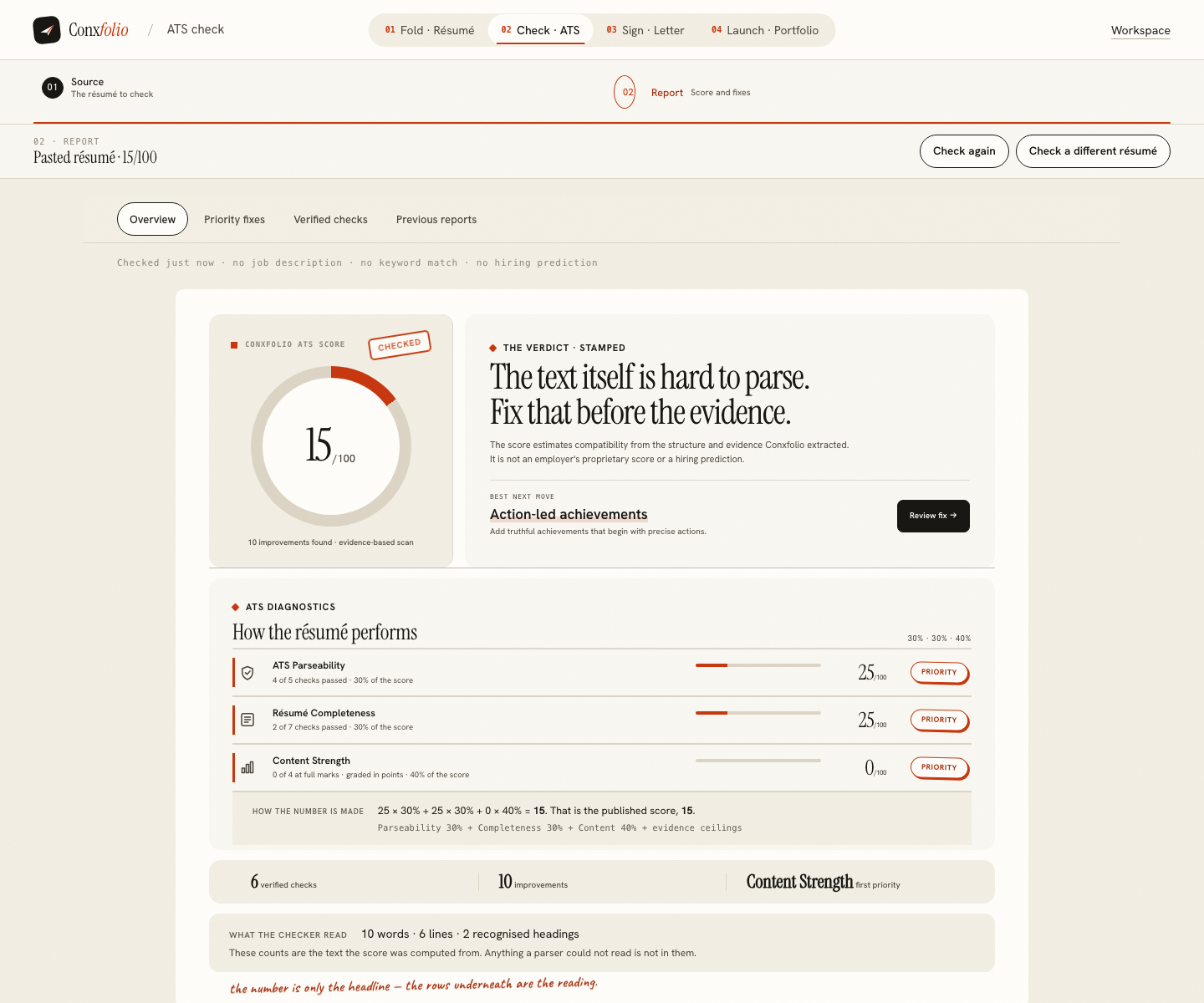
A low score usually has one cause rather than ten, and the report names it. The trick is to read the page from the bottom up: what was read, then whether a ceiling applied, then the three rows, and only then the number.
Start with what the checker read
Under the score there is a line giving the words, the lines and the recognised headings in the extracted text. On the report above, a deliberately thin invented résumé produced ten words, six lines and two recognised headings. If your own two-page document reports sixty words, the extraction lost it, and no rewriting will help until the file changes. The format guide lists what causes that.
Then check whether a ceiling applied
Four caps sit after the arithmetic. Under twenty-five words holds the score at fifteen. Nothing found for experience, education or skills holds it at twenty-five. No experience and no education holds it at forty. No experience with content below thirty holds it at fifty-five. A score sitting exactly on one of those numbers is a capped score, and the report shows both the calculation and the cap.
Then read the three rows
Parseability tells you whether the file can be read. Completeness tells you whether the expected information is present. Content tells you whether the evidence is written as achievements. In the report above, parseability and completeness sat at twenty-five each and content at zero, giving 25 × 30% + 25 × 30% + 0 × 40% = 15.
The common causes, in order of how often they apply
- Nothing extracted. A scanned or photographed PDF has no text layer at all. The scans guide covers the recovery.
- Headings not recognised. Creative section names leave whole sections unread. See the headings guide.
- Columns or tables. The order is scrambled, so sections dissolve into each other.
- Thin experience evidence. Duties instead of achievements, no figures, too few lines.
- Missing contact details. Usually because they sit in the page header, which is often skipped.
Work the list, not the number
The priority list orders each finding by the points it cost, weighted by its dimension's share of the score. Do the top item, re-export, check again. Two or three passes usually exhausts the meaningful work, and the point cost printed beside each fix tells you when to stop.
What a low score does not mean
It does not mean you will be rejected, and nothing here claims to know that. The checker takes no job description, runs no keyword match and makes no prediction, and it prints all three of those facts above the score. What a low score means is that a document you control is harder to read than it needs to be, and that is worth an hour. Most of the fixes happen in the résumé builder, and a recommendation opens the section that owns it.
When the score is high and the page is still weak
The opposite case is worth naming. A document can score well and still be a poor application: accurate, readable, complete, and describing duties nobody asked about. The check measures structure and evidence, not relevance or judgement, so a strong number means the page is readable rather than persuasive.
The relevance work is a separate pass, and the tailoring guide covers it: read the posting twice, move the matching evidence up, use their words for work you have actually done.
Checking again, and what counts as progress
Re-export after every change and check the exported file rather than the draft. Progress is a finding disappearing from the list, not a number moving by a point, and some fixes move nothing at all while making the page better for a person. Where two or three passes have exhausted the list and the remaining items are worth a fraction of a point each, the document is done, and the rest of the application is where the remaining effort belongs.
What to do when the number will not move
Sometimes the remaining findings are all small and the document is genuinely finished. Other times the score is held by a ceiling that no formatting change can lift, because the page is short of evidence rather than short of structure. In that case the work is not on the résumé at all: it is writing up the projects, the volunteering or the study that the page has not yet mentioned, which the no-experience guide covers.
Read your own report
The score, the arithmetic behind it, what the checker read, and the fixes ordered by the points they cost.
Open the ATS checkerRead how the checker worksQuestions
- What is the first thing to look at
- The line that says what the checker read: the words, the lines and the recognised headings. If those counts are far below your page, text is being lost and the layout is the whole job.
- Why is my score exactly 15, 25, 40 or 55
- Those are the evidence ceilings. A number sitting exactly on one of them means a cap was applied after the arithmetic, and the report shows both numbers.
- My résumé looks fine. Why did it score badly
- Because the check reads the extracted text rather than the page. A two-column layout, a sidebar or a damaged text layer can produce a clean-looking page and an unreadable stream.
- Does a low score mean I will be rejected
- No. It is a measurement of your document, not a prediction. The check is not an employer's system and does not model one.
- Which fix should I do first
- The one at the top of the priority list. Each finding carries the points it cost, weighted by its dimension, so the order is by value rather than by severity language.
Conxfolio is a free set of four career tools: a résumé builder with 37 rendered layouts, an ATS résumé checker that prints its own arithmetic, a cover letter builder that traces every proof paragraph back to the line it came from, and a portfolio builder with 20 authored designs. There is no account to create, nothing is held back for a paid plan, and no language model is used anywhere in the product, so the readers, the score and the letter are deterministic code you can check.