The whole arithmetic behind an ATS score, printed on the page
Most résumé checkers hand you a number. This one prints the sum that produced it. Here is the whole calculation, photographed on a real report.
— a score you cannot check is a rating, not a measurement.
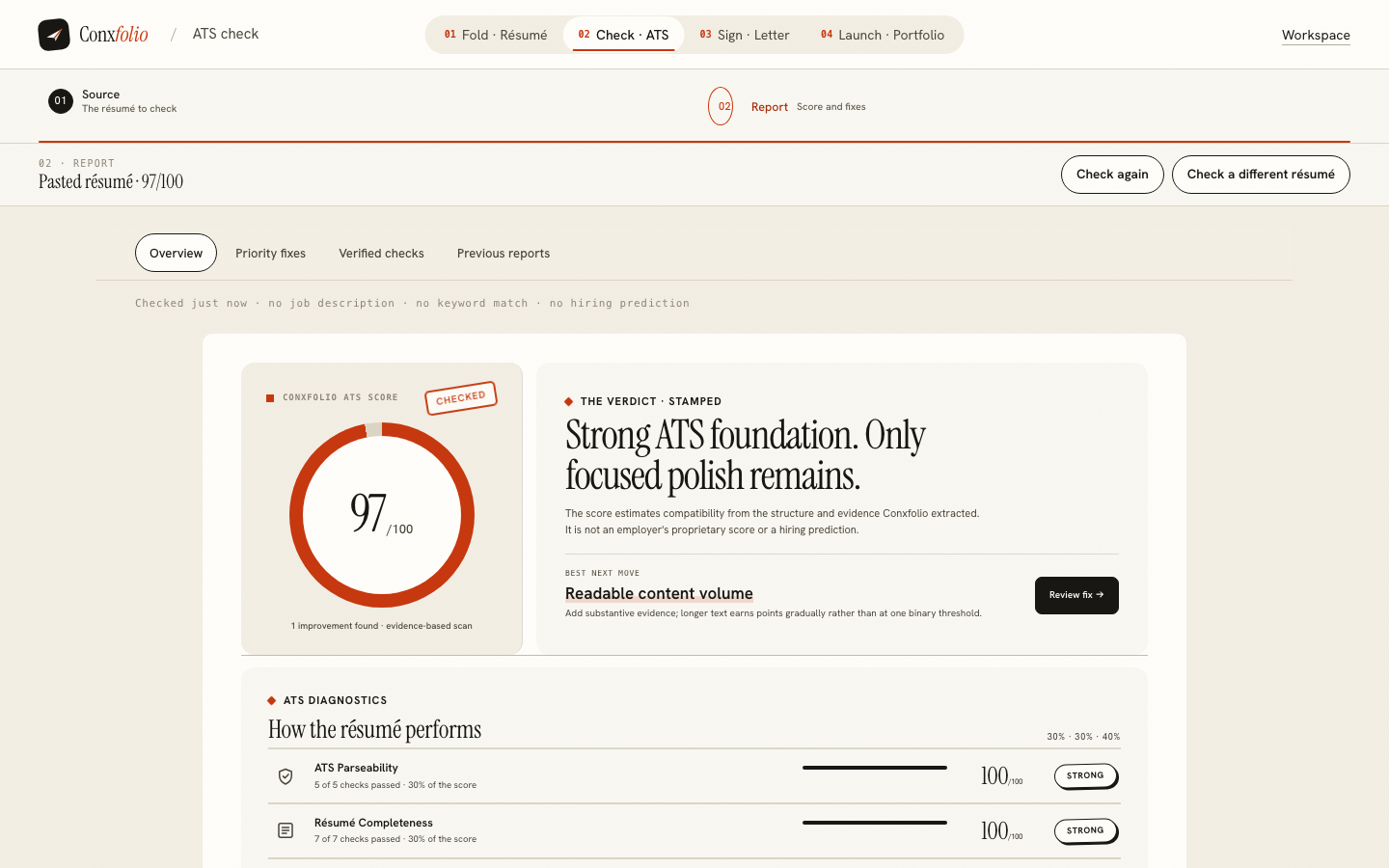
A résumé checker that gives you 68 out of 100 and a list of tips has told you almost nothing. You cannot tell whether 68 is a formatting problem or an evidence problem, whether the missing 32 points sit in one rule or thirty, or whether the number would move at all if you did the work. The number is doing the job of a verdict while carrying none of a verdict's obligations.
So the ATS résumé checker here prints its own sum. We ran it, on an invented candidate, and photographed what came back.
The source step asks one thing
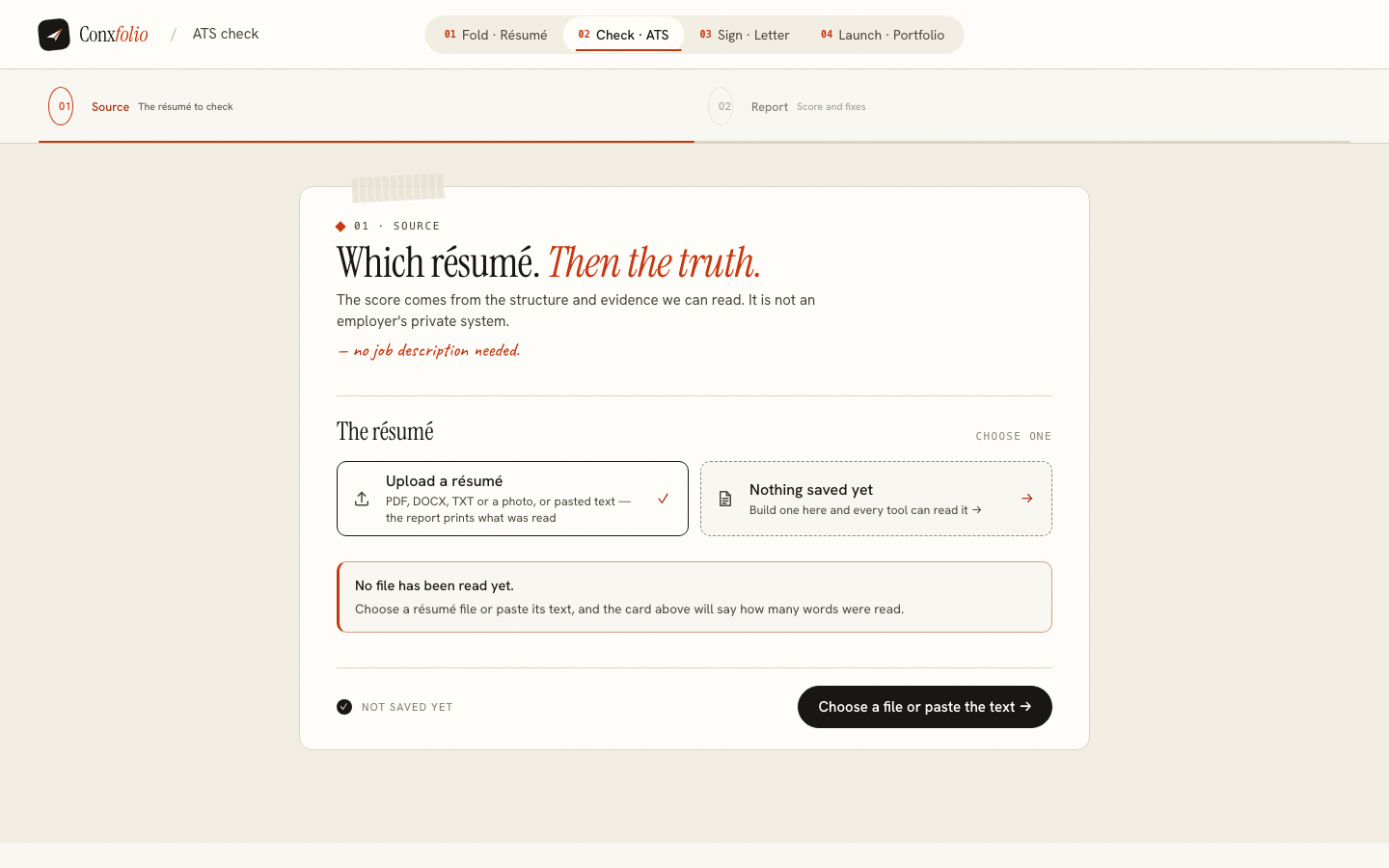
We pasted a 162-word résumé for a backend engineer: two roles, seven achievement lines, one degree, nine skills. It took four minutes to write and it is not remarkable. That matters for reading the number that follows.
Three dimensions, three fixed weights
The engine scores three things and weights them the same way on every document it sees.
| Dimension | Weight | What it measures |
|---|---|---|
| Parseability | 30% | Whether the text comes out in the intended order, with headings that have real content under them, readable characters and consistent dates. |
| Completeness | 30% | Whether the seven recruiter-facing essentials are present as evidence rather than as empty headings: identity, email, phone, experience, education, skills, summary. |
| Content | 40% | A graded measure of achievement quality: action-led lines, measurable evidence, depth, and readable volume. |
Completeness is not a checklist of seven equal boxes. The seven checks carry their own point values inside the dimension, and experience carries the largest share of them, because a résumé with no experience section is missing the thing the document is for.
Content is graded, not passed or failed
The content dimension is four rules with their own maxima: 30 points for action-led achievement lines, 25 for lines carrying measurable evidence, 25 for evidence depth across roles, and 20 for readable volume. Each awards partial credit. One measurable line earns 12 of its 25 rather than nothing, and 120 readable words earn 12 of the volume's 20 rather than falling off a threshold. A binary rule would tell you that you failed; a graded one tells you how far along you are.
Then the sum, printed

Our candidate scored 100 on parseability, 100 on completeness and 92 on content, and the report showed the multiplication rather than the conclusion. The line beneath it is not our paraphrase of the method. It is the string the scoring engine returns with every response, so the sentence on the page and the code that produced the number come from the same place.
The ceilings, and why they exist
After the weighted sum, four ceilings apply. Under 25 readable words the score is capped at 15. If no experience, education or skills can be found, 25. If experience and education are both missing, 40. If there is no experience and the content dimension is under 30, 55. A blank page with a beautiful header can otherwise score respectably on parseability and completeness, which would be a measurement telling a flattering lie.
When a ceiling applies, the report says so and shows both figures. That is the whole difference between a capped score and a low one, and it changes what you should do next.
What the checker read, in counts
Under the diagnostics the report states the extraction: 162 words, 18 lines, 4 recognised headings. Those are the counts the score was computed from, and anything a parser could not read is not in them. If your page is two dense sides and that line says 90 words, the scoring is a distraction. The extraction is the problem, and the format guide is the fix.
Fixes with prices on them
Our candidate had one improvement left, worth up to 3.2 points of the 100. The report says so on the row. A checker that lists eleven suggestions in a uniform typeface has quietly made every suggestion equally urgent, and the reader's afternoon disappears into the cheapest one. Ordering by cost is the difference between a list and advice.
Ninety-seven is not a compliment
The candidate does not exist and the résumé took four minutes. That is what a high readiness score means: the document is readable and evidenced, and nothing about it is broken. It says nothing about whether the work behind it is any good, and the report says so on its face, beside the ring. A score you can check is worth having. A score that flatters you is worth exactly what you paid for it, which here is nothing.
Run it on your own résumé
The same report, on your file, with your arithmetic. No job description, no account, nothing held back.
Open the ATS checkerRead the format guideQuestions
- Where do the three weights come from
- They are fixed in the scoring engine and declared in every response it returns, as the string "Parseability 30% + Completeness 30% + Content 40% + evidence ceilings". The report prints that string under the sum, so the page and the engine cannot disagree.
- What is an evidence ceiling
- A hard cap applied after the weighted sum, so a document with almost nothing in it cannot look ready. Under 25 readable words the score is held at 15. With no experience, education or skills found, it is held at 25. With no experience and no education, 40. With no experience and weak content, 55.
- Why did the report show a lower number than the sum
- Because a ceiling applied. When that happens the report says so in words and shows both figures, the weighted total and the published score, instead of quietly printing the smaller one.
- Does a high score mean the résumé is good
- It means the document is readable and evidenced. Our invented candidate scored 97 on a page that took four minutes to write. A score is a floor to clear, not a ranking of your career.
- Is a language model involved anywhere in this
- No. The scorer is a set of rules in ordinary code, and the specialist readers that parse your document are deterministic functions. Nothing in Conxfolio calls a model, which is part of why it can be free.
- Can I see my previous reports
- Yes. Reports are kept, so you can run the check again after a fix and open an earlier report to see what the change was worth.
Conxfolio is a free set of four career tools: a résumé builder with 37 rendered layouts, an ATS résumé checker that prints its own arithmetic, a cover letter builder that traces every proof paragraph back to the line it came from, and a portfolio builder with 20 authored designs. There is no account to create, nothing is held back for a paid plan, and no language model is used anywhere in the product, so the readers, the score and the letter are deterministic code you can check.