Résumé, ATS report and cover letter for one job, in one sitting
One document, read once, then checked, then used as the evidence for a letter about one specific posting. About twenty minutes, free, no account.
— one source. everything else reads it.
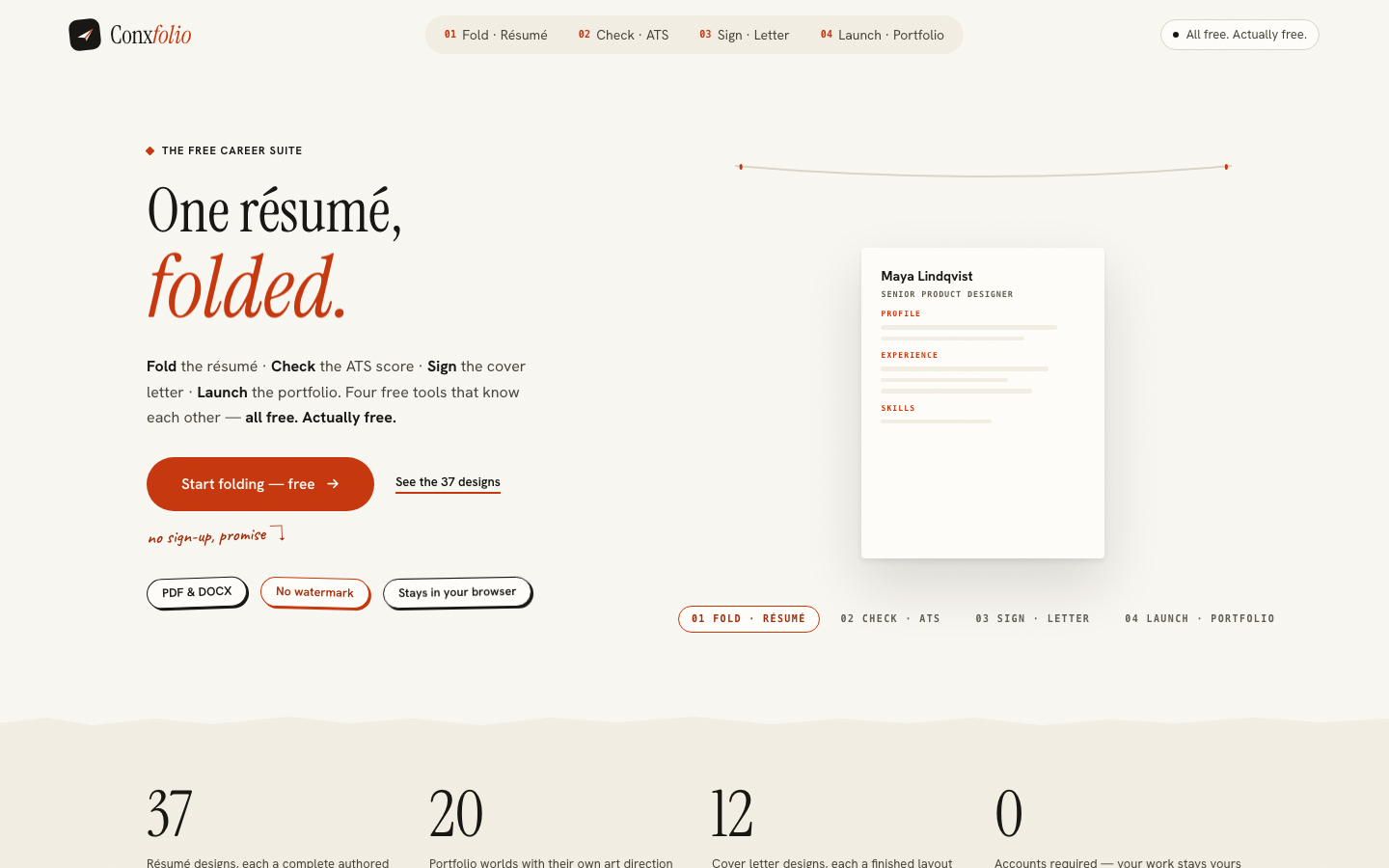
An application is three documents that have to agree with each other: a résumé, a readable version of that résumé, and a letter that only claims what the résumé can back. Most people build the three separately, in three different programs, and discover the disagreements after sending. This page is the order that avoids that, walked end to end with the tools that do each part.
You need one thing to start: a résumé that already exists, in PDF, DOCX or plain text. If you do not have one, begin at step one anyway and build from scratch instead of importing.
Step one: read the résumé in, and correct the reading
Open the résumé builder and import the file. What comes back is not an editor full of your text. It is a review: every field that was read, shown beside the source it came from, with the questions the readers could not settle.
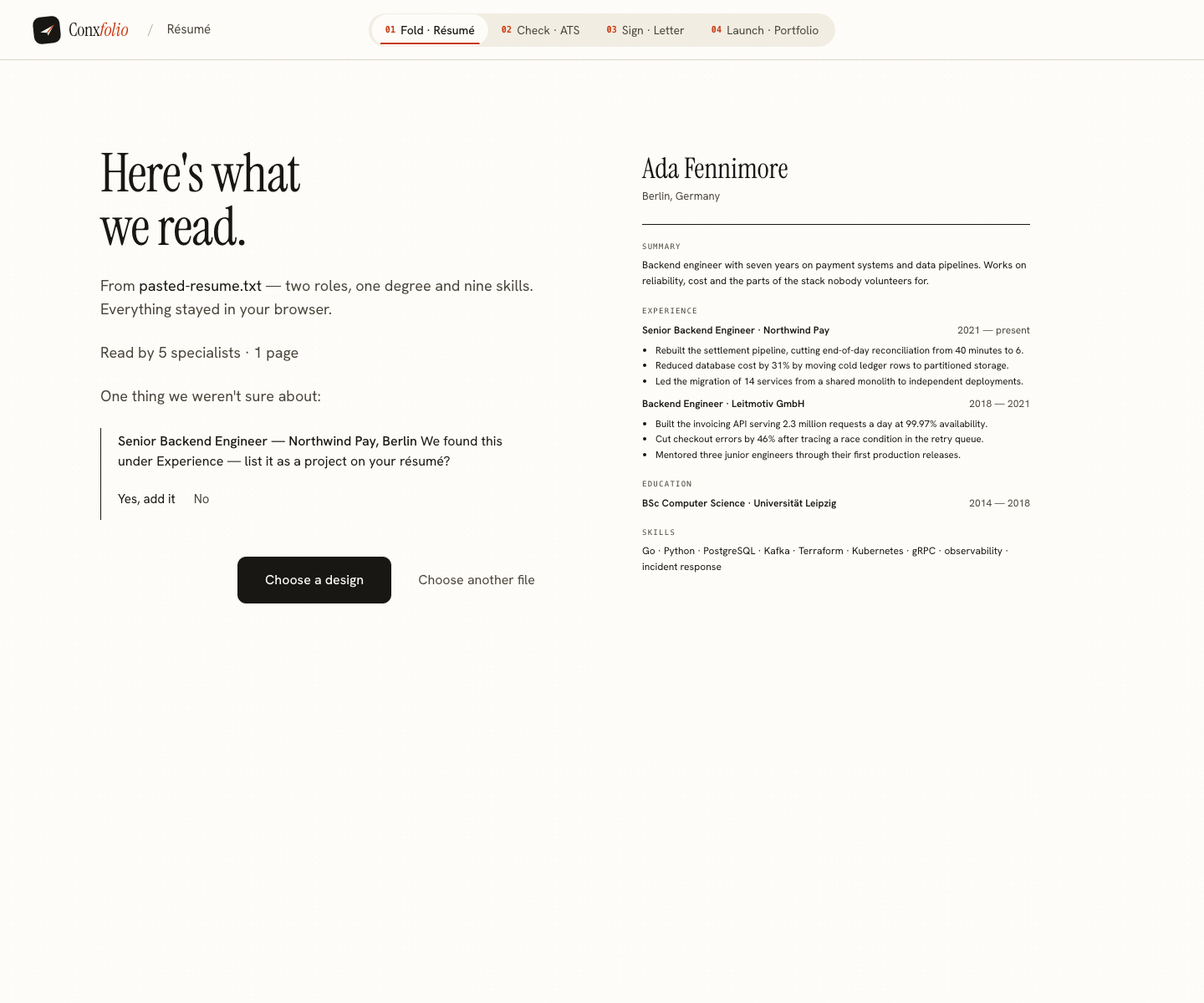
Spend your time here. Every later step reads this material, so a company name that landed in the wrong field costs you three times if you let it through. A field the readers could not read stays empty rather than being filled with a guess, and a value that fails their own check that it is a span of your document is dropped and counted rather than kept.
Step two: check it, and fix from the top
Take the same résumé to the ATS checker. It needs no job description. What comes back is a score with the sum that produced it, then the findings ordered by the points each one costs, then the checks that passed.
Work down the list and stop when the next fix stops being worth the evening. The cost is printed on each row precisely so you can make that judgement instead of treating eleven suggestions as eleven emergencies. Each row opens the section of the builder that owns it, so a fix and its consequence sit in the same place. The arithmetic article covers what each dimension is measuring if a number surprises you.
Run the check again afterwards. The previous report is kept, so you can see what the work was worth rather than assuming.
Step three: write the letter from the same evidence
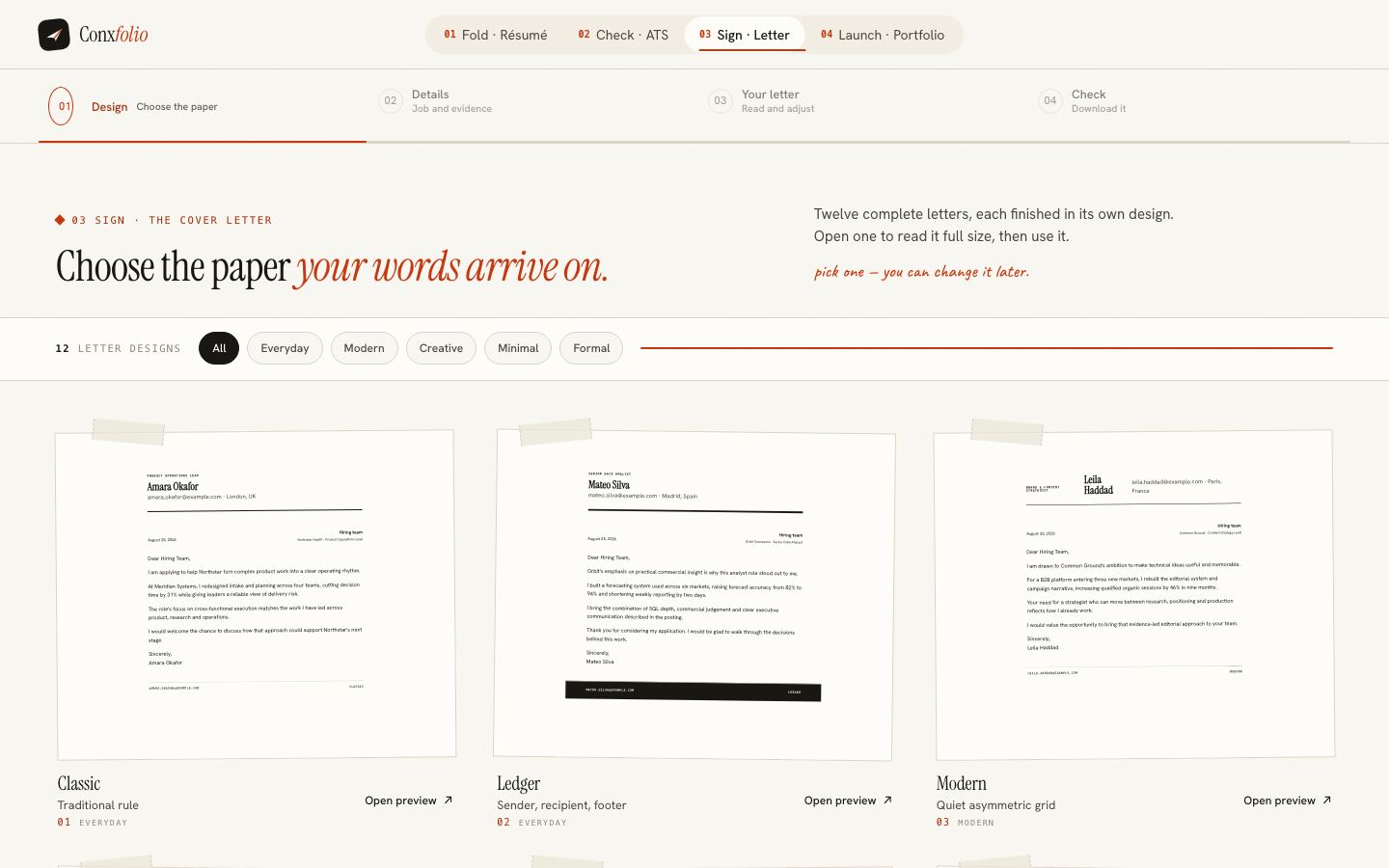
Open the cover letter builder and choose the paper first, from 12 designs across 5 families, each shown as a complete letter rather than a thumbnail.
Then the details step: the role, the company, and the real posting pasted in. The page tells you honestly how much job context it actually has rather than pretending the three words you gave it were a brief. Choose the saved résumé as the evidence source, and pick a voice from the three, each shown as the opening sentence it will actually write for this role and this company.
What comes back is a letter beside its own paragraphs. Every proof paragraph carries a trace line naming the résumé line it came from, or saying the words are your own. Read those traces. A claim with no trace is a claim you wrote and should stand behind; a claim with a trace is one your document already supports.
Step four: read the gaps before you export
The letter's check step lists the requirements in the posting that your evidence cannot support, as gaps, rather than asserting them on your behalf. That list is the most useful paragraph in this whole sequence. It is the interview you are about to have, written down in advance, and you can answer it in the box marked what only you know, which is used exactly as you wrote it.
Then download. DOCX is written in your own browser; PDF is rendered and streamed back. Neither carries a watermark and neither costs anything.
What to do with the leftovers
You now have a corrected, structured version of your work sitting in this browser. The portfolio builder reads the same roles and projects and turns them into a page in one of 20 authored designs, which is worth an extra ten minutes if the job would look at one. And the next application starts at step three, because steps one and two are already done.
Start with the document you have
Import a PDF, DOCX or text résumé. Everything read out of it is shown for review before it enters the editor.
Open the résumé builderOr check a résumé firstQuestions
- Do I have to use all four tools
- No. Each one has its own address and works on its own. The bundle is an order that saves repetition, because the same source document feeds the check and the letter.
- Do I need the optional workspace for this
- No. The hand-offs work from the tool pages themselves. The workspace is one place that holds the four tools around a single application, and it is there if you want it.
- What if the letter claims something my résumé does not show
- It will not. Evidence paragraphs are selected from your own résumé lines and carried with the index of the line they came from. Requirements in the posting that your evidence cannot support are listed as gaps in the check step instead of being asserted.
- Can I do this for a second job without starting again
- Yes. Keep one master résumé, save a targeted version beside it, and write a second letter against the second posting. Earlier versions can be restored.
- How long does it take
- About twenty minutes on a résumé that already exists, most of it spent correcting the import review and doing the two or three fixes the check prices highest.
- Is a language model writing any of this
- No. The readers, the score and the letter engine are deterministic code. The letter selects sentences you wrote rather than generating new ones, and says so in its own response.
Conxfolio is a free set of four career tools: a résumé builder with 37 rendered layouts, an ATS résumé checker that prints its own arithmetic, a cover letter builder that traces every proof paragraph back to the line it came from, and a portfolio builder with 20 authored designs. There is no account to create, nothing is held back for a paid plan, and no language model is used anywhere in the product, so the readers, the score and the letter are deterministic code you can check.