A Lebenslauf and an Anschreiben, checked against the German conventions
Read your document in, run seven checks against the Bundesagentur für Arbeit's published guidance, then write the Anschreiben from the same evidence. Every check names the page it came from.
— conventions, with a source each.
A German application is a set rather than a document: an Anschreiben, a Lebenslauf, and the Zeugnisse, with an optional Deckblatt in front. The conventions around the Lebenslauf are specific enough that a document written for a British or American reader will look wrong even when its content is strong. This page runs the conventions as checks against the document you already have, and each check carries the public page it came from.
Start with the file. Everything below reads it once. The résumé builder is where you will do the editing afterwards; the chain here is for finding out what needs editing.
Do it here
The document, the checks, and the letter. The convention checks run on the text you read in, and each one links the public page it is taken from.
- 01Read it in
- 02Check
- 03German conventions
- 04The posting
- 05The letter
- 06Into the tools
What the seven checks are
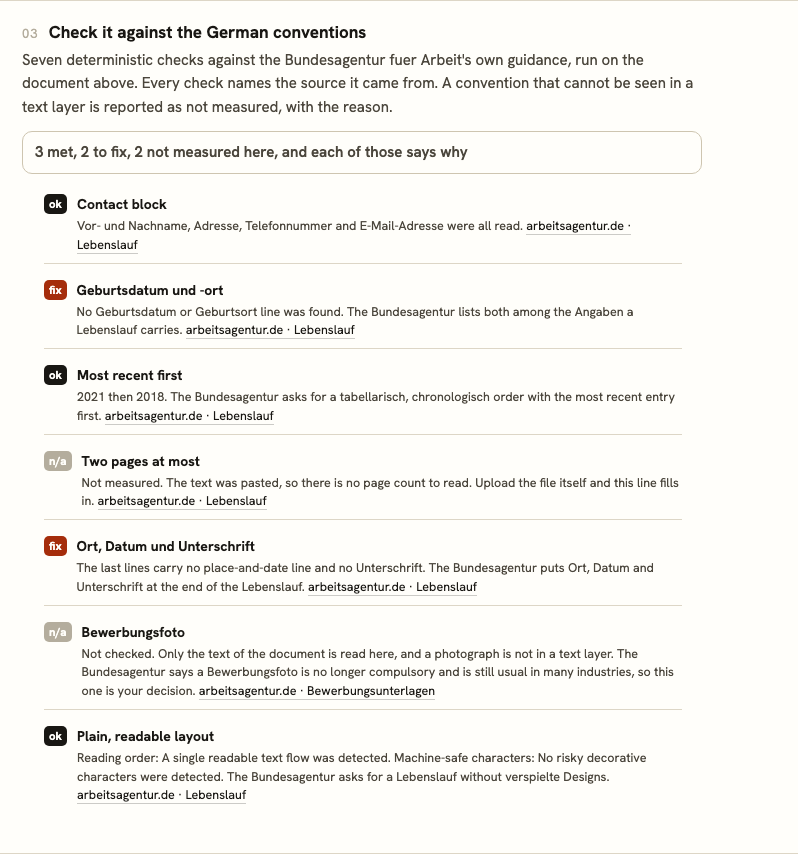
The first is the contact block. The Bundesagentur lists Vor- und Nachname, Adresse, Telefonnummer and E-Mail-Adresse among the details a Lebenslauf carries, so the check asks whether the readers found each of them in your document. A field the readers left empty is reported as empty, not filled in from somewhere else.
The second is Geburtsdatum und -ort, which the same page lists. Many applicants leave the date of birth out because Alter is one of the protected grounds in the Allgemeines Gleichbehandlungsgesetz. The check reports what your document contains and links the guidance; it does not tell you which way to go. The country comparison covers the same tension for photographs.
The third is the order of your roles. The guidance asks for a tabellarisch, chronologisch Lebenslauf with the most recent entry first, so the check reads the years the specialists extracted and prints them in the order they appeared. When fewer than two roles carried a year it can read, it says the order could not be measured rather than passing the document by default.
Length, signature, and the two it will not judge
The fourth check is length. The Bundesagentur gives two pages as the maximum. A page count exists only for a file this browser read, so an uploaded PDF fills the check in and a pasted text leaves it marked as not measured. That distinction matters more than it looks: a word count is not a page count, and a tool that converts one into the other is inventing a measurement. The length guide covers the wider question.
The fifth is the signature. The guidance puts Ort, Datum und Unterschrift at the end of the Lebenslauf, and the check reads the last lines of your document for a place-and-date line or the word Unterschrift. It is the single convention most often missing from a document written for another market, because no English-language template has a place for it. The header and date guide covers where the same information sits on a letter.
The sixth is the photograph, and the check refuses to judge it. Only the text layer is read here, and a photograph leaves no trace in a text layer. Saying a document has no photograph because no photograph appeared in its text would be a measurement of the wrong thing.
The seventh is the layout, and it is answered by the checker rather than by an opinion. The guidance asks for a Lebenslauf without verspielte Designs. The two checks that actually bear on that are the reading order and the machine-safe characters, both of which the ATS check returns with its own wording, so the chain prints those two results rather than restating them. The column guide explains why reading order is the one that matters most.
The Anschreiben, written from the same evidence
The Anschreiben sits beside the Lebenslauf and the Zeugnisse in the set, and the Bundesagentur says it should be cut to fit the specific position. That is exactly what the letter step does: it reads the posting, selects from the lines you already wrote, and carries the index of each line it used. The receipt prints how many requirements it read and which of them your evidence cannot support.
The gaps list is the useful half. A German process is often slower and more document-led than a British or American one, so the things your papers do not say are the things you will be asked about in writing. The documents guide covers what else belongs in the set, and the piece on applying from abroad covers the parts of the process no document can settle.
What this page does not do
It does not translate. It does not tell you whether to include a photograph or a date of birth. It does not check your Zeugnisse, because nothing here reads them. And it makes no claim about what any German employer will do with the result. Every check is a published convention, tested against the text of your own file, with the link to the page it came from beside it.
When the checks are answered and the letter reads honestly, the doors at the end hand the document into the builder, the checker or the letter for the editing itself. Nothing already saved in this browser is touched by that. The general bundle chain is the same sequence without the country checks, and the UK conventions guide is the comparison most people want next. If the move is also a change of field, the career-change chain sorts which of your existing lines still count before you translate any of them.
Start with the document you have
Import a PDF, DOCX or text Lebenslauf. Everything read out of it is shown for review before it enters the editor.
Open the résumé builderRead the conventions firstQuestions
- Where do these seven checks come from
- From two published Bundesagentur für Arbeit pages: the one on the Lebenslauf and the one on the Bewerbungsunterlagen. Each check on this page links the page it is taken from, and a convention we could not source is not checked here at all.
- Does a passing check mean a German employer will accept the document
- No. These are conventions published by a public employment service, tested against the text of your document. They are not a rule set any employer runs, and no tool on this site predicts a hiring decision.
- Why is the photograph check marked as not measured
- Only the text of the document is read here, and a photograph is not in a text layer. The Bundesagentur says a Bewerbungsfoto is no longer compulsory and is still usual in many industries, so the decision stays yours and the check says so rather than guessing.
- Why does the two-page check sometimes say nothing
- Because a pasted text has no page count. When you upload the file itself, the browser reports how many pages it read and the check fills in. It never estimates a page count from a word count.
- Can I write the Anschreiben in German
- You can paste a German posting and German résumé text, and the engine will select from the lines you wrote. The connective sentences it assembles are English, so a German letter needs your own wording in the editor. The letter builder keeps every paragraph editable.
- Is the date of birth required
- The Bundesagentur lists Geburtsdatum und -ort among the details a Lebenslauf carries, which is why the check looks for one. German anti-discrimination law names Alter among its protected grounds, so many applicants leave it out. The check reports what is there and links the source; the judgement is yours.
Conxfolio is a free set of four career tools: a résumé builder with 37 rendered layouts, an ATS résumé checker that prints its own arithmetic, a cover letter builder that traces every proof paragraph back to the line it came from, and a portfolio builder with 20 authored designs. There is no account to create, nothing is held back for a paid plan, and no language model is used anywhere in the product, so the readers, the score and the letter are deterministic code you can check.