Applying in Germany from outside it, with the conventions and where they come from
A German application is a set of documents with a published shape. Most of the shape is sourced, and the parts this product cannot produce are worth naming before you start.
— A4, two pages, and the documents you collect matter as much as the ones you write.
A German application is more prescriptive than a British or American one, and the prescription is published rather than folklore. That makes it one of the few places where a page like this can cite instead of assert. It also makes the gaps in what this product does easy to state, so they are stated first.
What the set contains
The Bundesagentur für Arbeit lists the components of a Bewerbung as the Anschreiben, the Lebenslauf and the Zeugnisse, with a Deckblatt as an optional addition (arbeitsagentur.de). Two of those you write. One you collect: references and certificates from previous employers and institutions, which no software can produce for you. The German documents guide goes through all four.
The Lebenslauf, with its published shape
The same source lists the personal details it carries: "Vor- und Nachname, Adresse, Telefonnummer, E-Mail-Adresse, Geburtsdatum und -ort" (arbeitsagentur.de). It describes the structure as "tabellarisch und chronologisch", a table rather than prose, most recent entry first. It gives a maximum of "zwei Seiten" on A4. And it asks for location, date and a signature at the end.
What this builder does with that
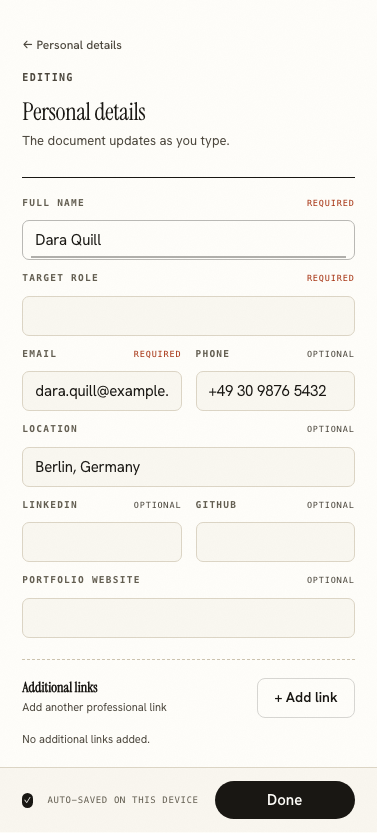
It gives you the reverse-chronological structure, the A4 page format and the two-page discipline. It does not give you a date-of-birth field, a photograph or a signature line. Where you want those, the additional section takes a heading you name and a list of lines under it, and a signature is something you add after export. Naming that limit is more useful than pretending the product covers a convention it does not.
The page format switch
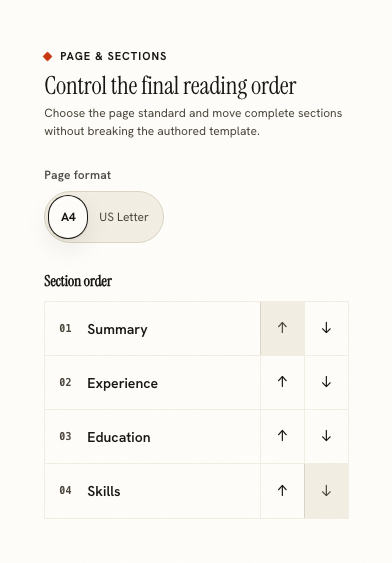
A4 against US Letter sits in the page and sections panel of the design step, beside the section order. An application posted to Hamburg on US Letter paper announces where the file was made, and the switch costs one click. The same panel moves whole sections without disturbing the design.
The photograph, and why it stopped being required
The Bundesagentur addresses it twice: "Dies ist kein Muss mehr" on the Lebenslauf page, and on the application documents page "keine Pflicht mehr, jedoch in vielen Branchen weiterhin üblich", no longer an obligation but still customary in many sectors (arbeitsagentur.de). The legal background is the Allgemeines Gleichbehandlungsgesetz, whose §1 names race or ethnic origin, sex, religion or belief, disability, age and sexual identity among the grounds on which disadvantage is to be prevented (gesetze-im-internet.de). This builder has no photograph field, so the customary version is one you assemble elsewhere.
The Anschreiben
The Bundesagentur says of the Anschreiben's text that it "sollte daher passgenau auf die Stelle zugeschnitten sein", that it should be cut precisely to the position (arbeitsagentur.de). The cover letter builder works that way by construction: you paste the posting, and the engine selects proof paragraphs from your own résumé and lists the requirements your evidence cannot support as gaps rather than claiming them. Motivation letter against cover letter covers the naming.
Language, plainly
The letter engine selects sentences from your résumé, so it writes in whatever language your résumé is in. It does not translate and it never will, because nothing in the product calls a language model. If you need a German Lebenslauf, write the résumé in German and the letter follows. The import handles either.
What is not promised
Nothing here is legal or immigration advice, and nothing predicts what any German employer will do. The checker is a readability and evidence measurement with no job description and no connection to any applicant system. The conventions above are quoted with their publishers named, and the Lebenslauf conventions page carries the rest. Everything in the product is free, including the 37 designs and both export formats.
One more practical matter, which is the file itself. A German application is usually sent as one PDF, and where a system asks for a single document the parts are combined outside this product. The résumé export is a PDF or a DOCX with no watermark, named after you rather than after a template, and the letter exports the same way in any of the 12 designs. What is assembled from them is your job.
Zeugnisse are the part most international applicants underestimate. They are collected rather than written: references and certificates from previous employers and institutions, in a form German employers expect to see attached. No software produces them, this product included, and starting to request them early is worth more than another pass over the wording of the Lebenslauf.
Build the Lebenslauf
Set the page to A4, put the sections in order, and export a PDF. Free, no account, no watermark.
Open the résumé builderRead the German documents guideQuestions
- What does a German application contain
- The Bundesagentur für Arbeit describes the set as an Anschreiben, a Lebenslauf and Zeugnisse, with a Deckblatt as an optional extra (arbeitsagentur.de).
- How long may a Lebenslauf be
- The Bundesagentur gives a maximum of "zwei Seiten" on A4 (arbeitsagentur.de).
- Is a photograph required
- No. The Bundesagentur says of the photo "Dies ist kein Muss mehr", and its application documents page adds that it is "keine Pflicht mehr, jedoch in vielen Branchen weiterhin üblich" (arbeitsagentur.de). This builder has no photograph field.
- Can this product produce the whole set
- No. It builds a Lebenslauf and a letter. It has no photograph field, no signature field and no date-of-birth field, and Zeugnisse are documents you collect rather than write.
- Does the letter write in German
- The engine selects sentences from your own résumé, so the letter comes out in the language your résumé is written in. It does not translate.
Conxfolio is a free set of four career tools: a résumé builder with 37 rendered layouts, an ATS résumé checker that prints its own arithmetic, a cover letter builder that traces every proof paragraph back to the line it came from, and a portfolio builder with 20 authored designs. There is no account to create, nothing is held back for a paid plan, and no language model is used anywhere in the product, so the readers, the score and the letter are deterministic code you can check.