A résumé for remote work has one extra job, and it is a two-line job
Remote postings collect hundreds of applications from a dozen time zones. The document that answers the location question early is doing the reader a favour.
— one line: city, country, and the hours you actually overlap.
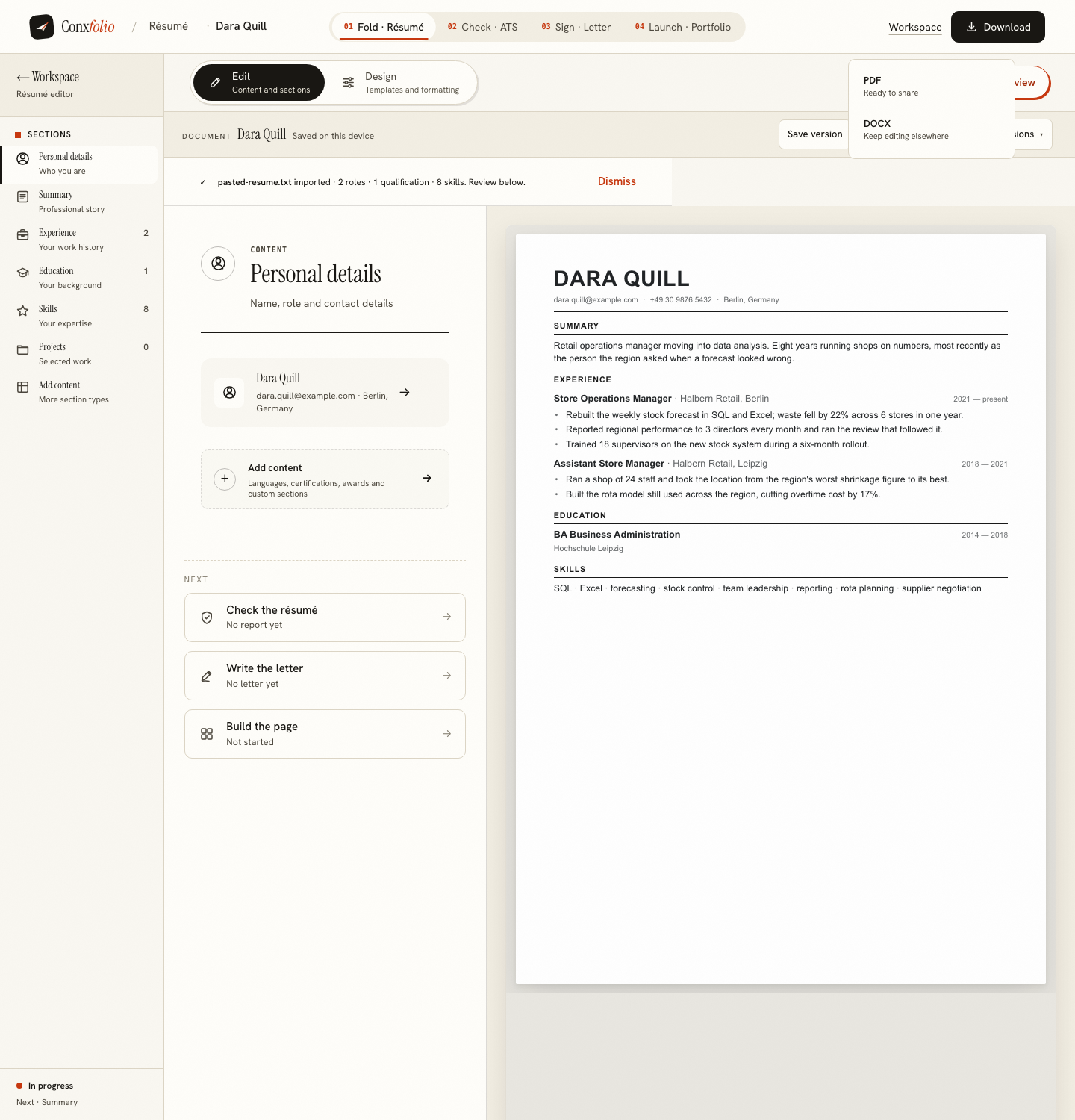
A remote posting is read by somebody with two hundred applications and one practical question: can this person work with us at the hours we work. Everything else on the page is the usual argument. The résumé builder has the fields for the location half, and the evidence half is writing.
The location line, and what it should say
The identity section has an optional location field that renders into the header only when it has a value. For a remote application, the useful content is a city and a country, and where the overlap matters, the hours. Lisbon, Portugal. Berlin, Germany, four hours overlap with US Eastern. That answers the question in one line instead of leaving it to be inferred from a phone prefix.
What the builder does not have
A time zone field, a right-to-work field, a relocation flag or a visa status. None of those exist, and nothing in the product will invent them. Where they belong on the page, they are lines you write into the summary or into an additional section you name yourself. Where they belong in the application at all is a judgement, and this page is not going to make it for you.
The evidence half
Remote-readiness is not a skill to list. It is an achievement line about work you have already done at a distance: an asynchronous handover you wrote, a release you ran across two countries, a team you led from another one. The checker's content rules reward exactly that shape, because they count lines that open with something you did and lines that carry a figure. A skills entry reading Remote collaboration earns nothing and costs a slot.
What the checker does with any of it
Nothing special. The ATS résumé checker has no remote rule. It grades whether the text comes out in order, whether the seven completeness essentials are present, and whether the content carries action, figures, depth and volume. Location touches it only through the identity and contact checks. The whole arithmetic is in how the ATS score is calculated.
Applying across borders changes the paper
A remote role is often in another country, and the conventions follow the employer rather than you. The page and sections panel carries an A4 and US Letter switch for that reason. Applying in Germany sets out one country's published conventions with sources, and UK CV conventions and US résumé conventions carry two more.
The letter, and the availability sentence
The cover letter builder selects its proof paragraphs from sentences already in your résumé and will not invent a claim about availability, relocation or notice. The optional field for what only you know, in your own words, is where an availability sentence goes. Requirements the posting asks for and your evidence cannot support come back as gaps rather than assertions.
The portfolio, when the work is online anyway
Remote applications are often for work that already lives on the internet. The portfolio builder turns the projects in your résumé into a page with an address in three steps, and the third step renders it at desktop and phone width before anything is published. The link on a designer's résumé walks the same journey.
Nothing predicted
No page on this site claims a document gets anyone hired, and the checker says on its own face that it is not a hiring prediction. What is here is a free set of tools with nothing held back, no account, no watermark, and the work kept in this browser rather than in a database somebody else owns.
One caution about the location line, which is the only part of this that can go wrong quietly. A city that is obviously outside the posting's stated region is information the reader needs, and putting it in the header is more honest than leaving it to be discovered from a phone prefix at the interview stage. Where the role is advertised as remote within a country you are not in, that is a question to ask before applying rather than a detail to soften on the page.
The rest of a remote application is an ordinary application. The evidence rules are the same, the format rules are the same, and the document is read by a person who has the same ninety seconds they always had. What is different is only that one line at the top is load-bearing, and it costs nothing to get right.
Write the location line
Import what you have and put the location and the evidence where a reader will find them. Free, in this browser.
Open the résumé builderRead the header guideQuestions
- Is there a time zone field
- No. The identity section has an optional location field, and that is where a line such as Lisbon, Portugal, or the overlap hours, goes. There is no dedicated time zone field and nothing invents one.
- Should I put a full postal address
- For a remote role there is rarely a reason to. A city and a country answer the question the posting is actually asking, which is which hours you are awake for.
- What counts as remote evidence
- Work you have already done at a distance, written as an achievement line. A distributed team, an asynchronous handover you wrote, a release you ran across two countries.
- Does the checker have a remote rule
- No. It measures parseability, completeness and content. Location appears in it only through the completeness check on identity and contact details.
- Does the letter know where the company is
- Only from what you paste. It selects evidence paragraphs from your own résumé and will not invent a claim about relocation or availability.
Conxfolio is a free set of four career tools: a résumé builder with 37 rendered layouts, an ATS résumé checker that prints its own arithmetic, a cover letter builder that traces every proof paragraph back to the line it came from, and a portfolio builder with 20 authored designs. There is no account to create, nothing is held back for a paid plan, and no language model is used anywhere in the product, so the readers, the score and the letter are deterministic code you can check.