The link on a designer's résumé, and the three steps that make the page behind it
A designer's résumé is a reference to a page. The page is the argument, and most of the time it is the part that never gets built.
— the address is the whole reason the page exists.
Most designers' résumés carry a line with a web address on it. That line is doing more work than anything else on the page, and it is usually the last thing anyone builds. The portfolio builder exists for the gap between having the work and having somewhere to send people.
Three steps, and publishing is inside the third
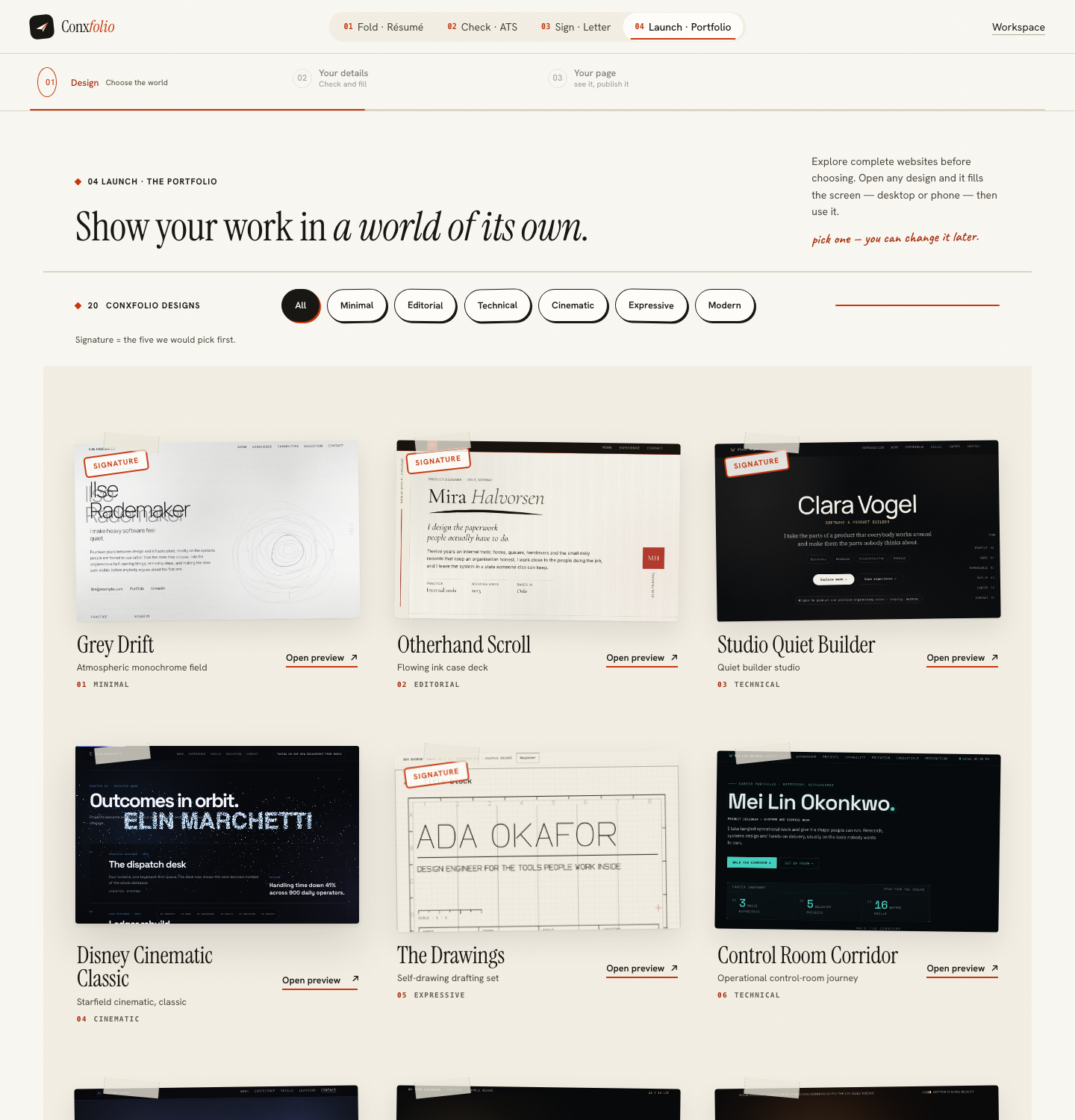
01 Design, choose the world. 02 Your details, check and fill. 03 Your page, see it and publish it. That is the whole sequence. The third step opens the real page over the builder with a desktop and a phone switch, so the last thing you look at before anything is public is the page itself rather than a preview of it.
The material is already written
The details step is filled from the roles, projects and outcomes in your résumé. You switch on what belongs on the page and correct each entry: a name, a year, one line about what changed, and optionally a description, a link, an image and tags. Nothing is invented for you, and an entry you have not written stays absent. If the résumé is thin, the page will be thin, which is the honest behaviour and also the annoying one.
The designs are pages, not themes
There are 20 of them across 6 directions, and each one is hand-built rather than generated from a template engine. That matters for a designer more than for anyone else, because a page assembled from cards announces itself immediately. What an authored design means sets out the difference, and designing twenty portfolio worlds goes through the directions.
The page that actually gets opened
A portfolio link in an email signature is opened on a phone far more often than on a desktop. Step three renders the real page at both widths before publishing, which is the whole reason that switch is there rather than a device frame drawn around a screenshot. Phone width is the page that publishes covers what that check catches.
What the résumé line should say
The identity section of the résumé builder has an optional portfolio website field, rendered only when it has a value, alongside LinkedIn and GitHub. One address, spelled out, is worth more than three half-links. Linking a portfolio from a résumé covers where the line goes, and choosing a portfolio address covers what to call it.
Publishing, and the one email
Publishing claims an address of the form the product shows you at that step, and it does it by sending a one-time code to an email address so the address can belong to somebody. That is the only place in Conxfolio that asks for an email at all, which is explained in why there is no account. A published page can be unpublished again from the same session.
How many projects to show
Fewer than you want to. A portfolio that opens with eleven things has asked the reader to do the editing, and the reader will not. How many projects to show and case studies in a portfolio go through the selection, and what to put in a portfolio covers the rest of the page.
What it does not do
It does not write your case studies, invent a project, or claim an outcome you have not recorded. It does not host anything until you publish, and nothing on this site makes a claim about what a portfolio does to an application. What it does is turn material you already wrote into a page with an address, in three steps, free, with no watermark and no account.
A note on images, because they are the part designers ask about first. Each portfolio entry takes an optional image alongside its description, link and tags, and the page renders what you give it. What the product does not do is generate, retouch or arrange imagery for you, and it does not fill an empty entry with a placeholder. An entry with no image is an entry with no image.
The other decision worth making early is how much of the page is work and how much is you. A portfolio that opens with a paragraph about your philosophy has spent the reader's attention before showing anything. The designs here vary in how much room they give an introduction, which is one of the things worth looking at in the gallery rather than reading about; designing twenty portfolio worlds covers the range and case studies in a portfolio covers what goes inside each entry.
Build the page the link points at
Three steps: choose a design, correct your details, look at the page. Publishing is on the third step when you want it.
Open the portfolio builderRead the designer portfolio guideQuestions
- How many designs are there
- 20 authored designs across 6 directions. Each is a complete hand-built page rather than a theme, and each renders at desktop and phone width.
- Where does the material come from
- From the roles, projects and outcomes already in your résumé. You switch on what belongs on the page and correct each entry: name, year, one line about what changed, and optionally a description, a link, an image and tags.
- Do I have to publish it
- No. The third step renders the real page for you to look at, and publishing is a separate action on that step. A page you never publish stays in this browser.
- What does publishing ask for
- An address and a one-time code sent to an email address. That is the only part of the whole product that asks for an email. A published page can be taken down again.
- Will it write my case studies
- No. It does not write your entries and it will not add projects you have not done. The words are yours.
Conxfolio is a free set of four career tools: a résumé builder with 37 rendered layouts, an ATS résumé checker that prints its own arithmetic, a cover letter builder that traces every proof paragraph back to the line it came from, and a portfolio builder with 20 authored designs. There is no account to create, nothing is held back for a paid plan, and no language model is used anywhere in the product, so the readers, the score and the letter are deterministic code you can check.