Nothing to sign up for, one storage key, and one place that asks for an email
An account exists so that a product can keep your work and later charge you for access to it. This one keeps your work where you are.
— no account is also no recovery; export what you cannot lose.
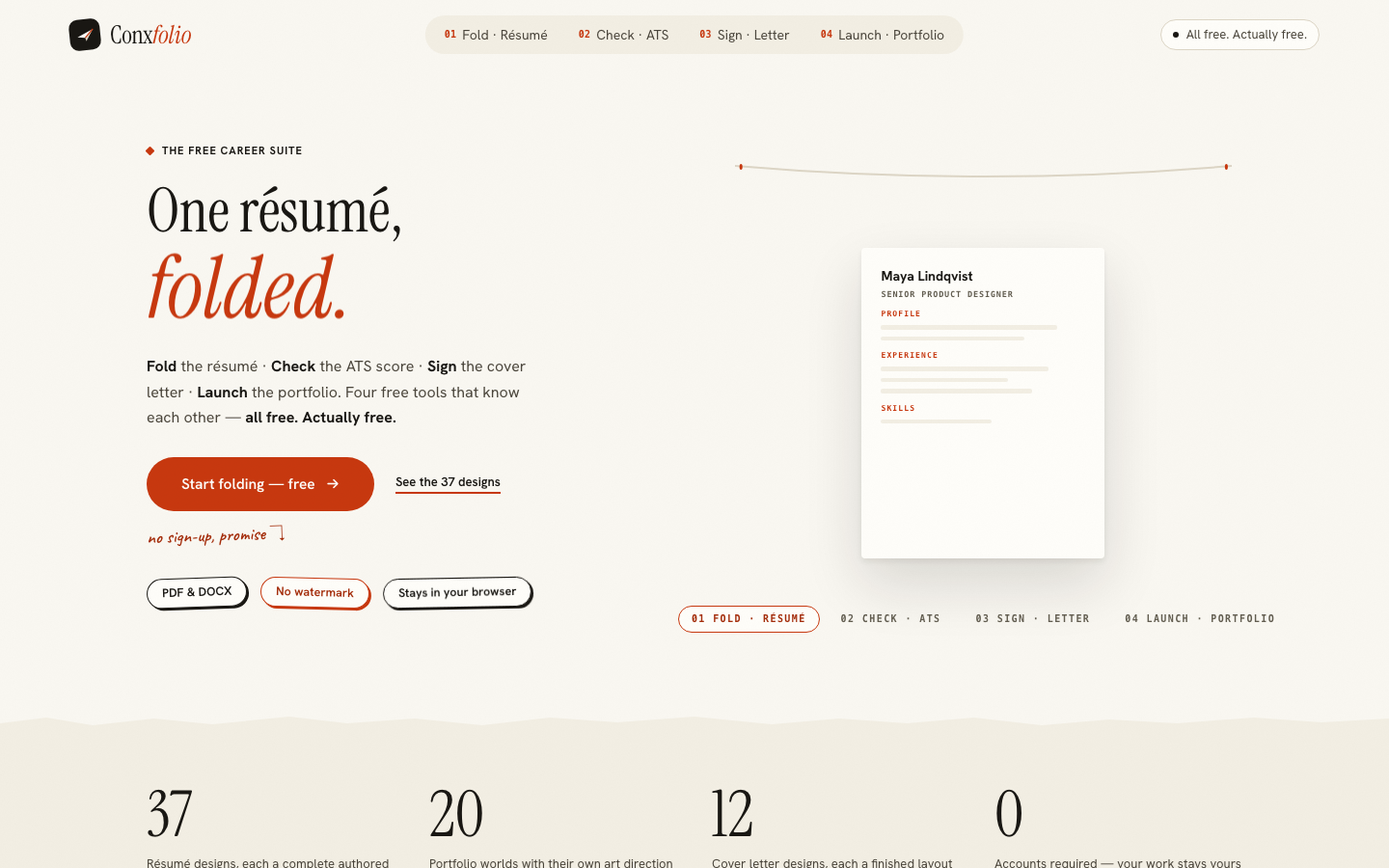
Accounts are not neutral. An account is the mechanism by which a free tool becomes a tool that holds your work hostage: build the document, then verify an email, then discover that the export is on the paid plan. The account exists to make the second step possible.
The résumé builder has none, and the four tools are free with nothing held back: every design, PDF and DOCX export, no watermark.
Where the work actually lives
In this browser, under a single storage key. The save routine writes the state and then reads the bytes back out before it reports that it saved, so the confirmation you see is a check rather than an assumption. That is also why the document bar in the editor says saved on this device rather than saved, which is a different claim.
The list of things that are sent
Short enough to print. The text of a document you import, so it can be sorted into fields. The file itself, only when this browser could not read it. The résumé text when you run the ATS check or ask for a letter draft. The document data when you export a PDF, because a PDF has to be rendered. The design previews. And the addresses involved in saving, publishing and claiming a portfolio. Nothing else.
The one place an email is asked for
Publishing a portfolio claims an address, and an address has to belong to somebody. That step sends a one-time code to an email address and verifies it, and publishing or unpublishing afterwards requires that session. It is the only part of the product that asks, and it asks because the alternative is anyone being able to take down your page.
What this costs you, said plainly
There is no recovery. Clear your browser data and the résumé, its versions and its reports go together, because none of them exist anywhere else. No password reset will bring them back, and there is no support queue that can look them up. The mitigation is the export, which for a Word file does not even involve the network, as measured in your DOCX is built in your browser.
What you get in return
You can use every tool in the first ten seconds. Your contact details, employment history and salary-adjacent evidence are not sitting in a table waiting for the company that owns it to be acquired. And nothing can be moved behind a plan later without you noticing, because there is no plan to move it behind, and no list to email about one.
What an account would buy, and what it would cost
It would buy three real things: your work on a second device, recovery after a cleared browser, and a way for the product to email you when something changed. Those are genuine, and losing them is the cost of the design rather than a feature nobody wanted.
What it would cost is the rest. A database of contact details, employment histories and, in the letters, motivations, which is a liability from the day it exists and an asset to whoever buys the company later. A sign-up step in front of a tool that currently starts in ten seconds. And the mechanism by which a free product later discovers that exports belong on a plan. The trade was made the other way round here, and the mitigation is the export, which for a Word file does not even involve the network, as measured in your DOCX is built in your browser.
What replaces the account's useful half
Two histories, both local. Versions of the résumé, up to twelve, taken when you ask, described in versions and restoring a draft. And previous ATS reports, kept so a fix can be measured against the check before it. Neither needs a login, and neither of them can be lost by a server you do not control. The limits that do exist are on the shared endpoints rather than on you, and they are set out in rate limits are not usage meters.
Start without signing up
Open the builder and begin. Nothing is created, nothing is verified, and the document stays in this browser until you export it.
Open the résumé builderRead how versions workQuestions
- Is anything sent to the server at all
- Yes, and the list is short: the text of an imported document so it can be sorted into fields, the file itself only when this browser cannot read it, the résumé text when you run the ATS check or ask for a letter draft, the document data when you export a PDF, and the design previews.
- Where is my work kept
- In this browser, under one storage key. The save routine writes the data and then reads the bytes back before the product tells you it saved.
- Does anything ask for my email
- One thing: claiming a portfolio address sends a one-time code to an email address so the address can be yours. It is the only place in the product that asks.
- What happens if I clear my browser data
- The work goes. There is no account to restore it from, which is the cost of the trade. Export a PDF or a DOCX of anything that matters.
- Can I move a résumé to another device
- By exporting it and importing it there. The file is the transport, and importing a DOCX or a PDF puts the content back into fields.
Conxfolio is a free set of four career tools: a résumé builder with 37 rendered layouts, an ATS résumé checker that prints its own arithmetic, a cover letter builder that traces every proof paragraph back to the line it came from, and a portfolio builder with 20 authored designs. There is no account to create, nothing is held back for a paid plan, and no language model is used anywhere in the product, so the readers, the score and the letter are deterministic code you can check.