A freelance résumé has to answer one question the format was never built for
The reverse-chronological résumé assumes one job at a time. Freelance work is several at once, with edges that do not line up.
— one practice, many clients. that is the line that fixes it.
A freelance career is continuous. The document that describes it usually is not. Eleven clients over four years become eleven entries of one line each, the dates overlap, and a reader who wanted to know what you do comes away with a list of who you did it for. The résumé builder does not solve that for you, and no tool can, because it is a writing decision. It does make the shape easy to try.
One practice, clients underneath
Write the practice as the role: your own trading name or Independent Consultant, with the span of years beside it. Then put the clients inside the achievement lines, where they belong as evidence rather than as headings. The page stops fragmenting, the dates stop overlapping, and the reader gets the thing they wanted, which is what you do.
What that does to the check
The ATS résumé checker grades evidence depth by counting achievement lines under experience: five or more earns the full 25 points of the rule, three or four earns 18, one or two earns 10. Eleven single-line entries can produce fewer countable lines than one practice with six lines under it. The full grading is in how the ATS score is calculated.
Dates, and the rule that punishes inconsistency
Parseability deducts for a mixed date format and for shortened years. Freelance pages attract both, because entries are added over time in whatever shape the week suggested. Pick one form, 2021 to present or 2021–present, and use it on every line including education. Date formats on a résumé has the detail.
The gap that is not a gap
A quiet quarter between contracts is not a career break and does not need explaining on a résumé written as a practice, because the practice did not stop. Where there is a real break, the honest place for it is the letter rather than the document, which is covered in returning to work and in how to explain a career gap.
Two files, because clients ask differently

An agency wants a Word file it can put its own header on. A direct client wants a PDF that looks the way you made it. Both are here and both are free. The DOCX is built in this browser without a network call at all, which is measured in your DOCX is built in your browser, and and the naming of the file is covered in résumé file name and format.
The portfolio does the part the résumé cannot
Freelance evidence is usually visual or specific, and a résumé line cannot carry it. The portfolio builder takes the same projects and makes a page with an address, in three steps. A portfolio website from a résumé covers the route, and when a portfolio beats a résumé covers when to lead with it.
The summary is doing more work here than usual
A freelance page is read by somebody trying to work out what you are for. The summary answers that in two sentences before the client list starts, and on a practice-shaped document it is the only place where the shape of the career is stated in plain words. Independent backend engineer, seven years, payments and data pipelines, mostly with teams of under twenty is a scope, a length and a market in one line.
The checker has a completeness check for a summary carrying ten of that dimension's hundred points, and on our own measured examples a fourteen-word line was reported as no substantive summary detected. Its own advice on the fix is roughly twenty to sixty words. The full measurement is in summary or no summary, and the writing shapes are in the summary guide.
What is not promised
Nothing here tells you which shape wins work, because nothing here can know. The checker measures a document's readability and evidence, uses no job description and predicts nothing. The rest of this page is a writing argument, and the fastest way to test it is to put both versions through the checker and read the counts each one produced.
Put the practice on the page
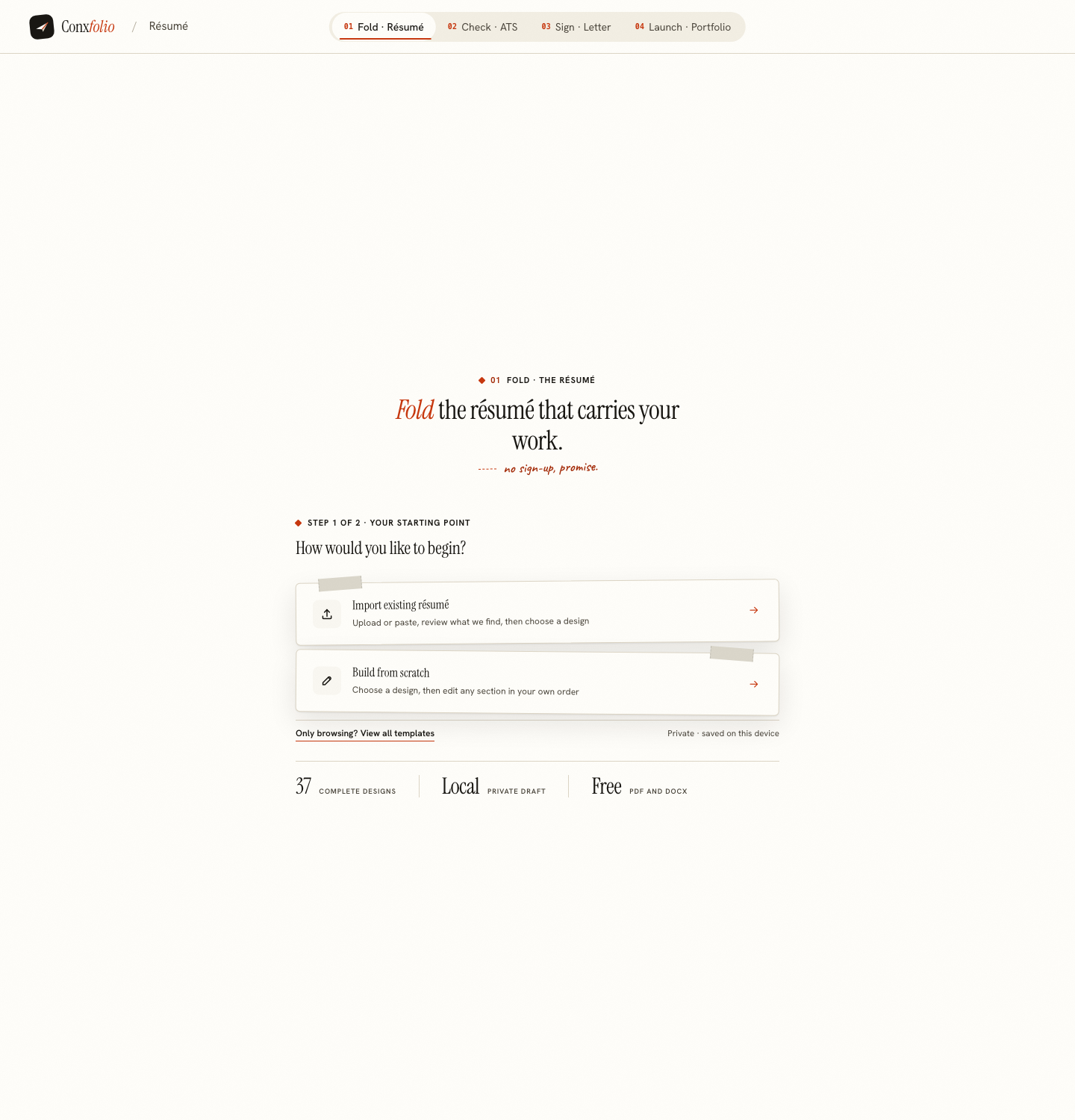
Import what you have, or start from scratch. Free, no account, and the file stays in this browser.
Open the résumé builderRead the freelance work guideQuestions
- One entry per client, or one entry for the practice
- One entry for the practice, with clients named in the lines under it, keeps the dates continuous and gives the checker's evidence-depth rule something to count. Eleven separate entries of one line each read as fragmentation.
- What dates do I put
- The span of the practice. The parseability rule deducts for mixed date formats and for shortened years, so whatever you choose, use the same shape everywhere on the page.
- Does the checker understand self-employment
- It reads text. Its completeness rule looks for an experience section with a role, dates and achievement evidence under it, so a practice written as a role with dates registers the same way a job does.
- Should I list rates or day rates
- That is a separate decision, covered on its own page. A résumé is not the usual place for it and the product has no field for it.
- Can I keep several versions for different kinds of client
- Yes. The builder keeps versions of a draft when you ask for one, and the export gives you a file. There is no account, so both live in this browser.
Conxfolio is a free set of four career tools: a résumé builder with 37 rendered layouts, an ATS résumé checker that prints its own arithmetic, a cover letter builder that traces every proof paragraph back to the line it came from, and a portfolio builder with 20 authored designs. There is no account to create, nothing is held back for a paid plan, and no language model is used anywhere in the product, so the readers, the score and the letter are deterministic code you can check.