Summary or no summary, and the three points a fourteen-word one cost on our own test
The argument about summaries is usually about taste. There is a measurable part of it, and we ran into it by accident while checking a teacher's résumé.
— twenty to sixty words, or none at all.
Half the advice on this subject says every résumé needs a summary. The other half says it is three lines of adjectives nobody reads. Both are describing real documents. There is a narrower question underneath, which is what the ATS résumé checker counts, and we answered that one by accident.
The measured case
We checked an invented teacher's résumé. It had a SUMMARY heading with a sentence under it: fourteen words, perfectly ordinary. The report listed among its findings that no substantive professional summary was detected, and priced it at three points of the hundred. The document scored 89 on the day, and 94 when it was re-measured on 13 September after an unrelated rule was widened; the completeness dimension scored 90 rather than 100 on both occasions, for exactly this reason. The whole report is in a teacher's résumé.
What the rule wants
Substance rather than a heading. The report's own advice on the fix says roughly twenty to sixty words, and that is a checker's guidance rather than a convention with a publisher behind it. The completeness dimension weights the summary check at ten of its hundred, which becomes three points of the published score once the dimension's thirty per cent share is applied.
Three points is not the argument
It is worth saying plainly, because a page that ends with add a summary to gain three points has taught you to write for a machine. The reason to have one is that a reader scanning twenty applications reads the top of the page and then decides. Two specific sentences about scope, strengths and direction do that work. Four lines of adjectives do not, and cost you the space where an achievement line would have gone.
When to leave it out
When the page is already full and the evidence is strong, when the role you are applying for is obvious from the last job title, or when the honest version would be two sentences of filler. A one-page junior résumé with three roles on it usually gains more from a fourth achievement line than from an introduction. The section can be left empty and the order changed in the design step.
What a summary that earns its place contains
What you do, at what scope, and where you are going. Backend engineer with seven years on payment systems and data pipelines is a scope. Reliability, cost and the parts of the stack nobody volunteers for is a direction. Neither sentence contains a word like passionate. The summary guide has the shapes, and objective or summary covers the other version of this decision.
The letter reads it too
The cover letter builder selects its proof paragraphs from sentences in your résumé. A summary carrying real evidence is a candidate for selection; a summary of adjectives is not, and the engine will return fewer paragraphs rather than pad with it. That behaviour is described in why a cover letter only claims what the résumé shows.
Where it sits, and whether it moves
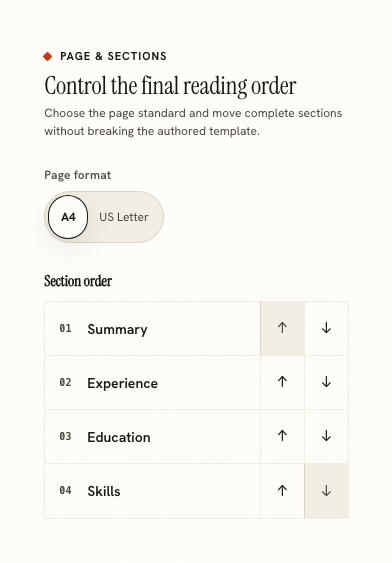
Summary is first in the default section order, above experience, education and skills, and the page and sections panel in the design step moves it or leaves it. There is no version of the document where a summary sits usefully below the experience section, so in practice the decision is to keep it first or to have none at all.
The one case where it earns more than usual is a career change or a return after a break, where the reader's first question is what this document is for. Two sentences answering that question before the history starts saves a reader from deducing it from a job title that no longer applies. Both cases are covered elsewhere: career changers and transferable lines and returning after a career break.
The decision
Write twenty to sixty words that a stranger could use to place you, or write none. What the measurement shows is that the middle option, a heading with a short line under it, is the one that satisfies nobody: it takes the space, it does not answer the reader's question, and the checker reports it as absent anyway. Everything in the builder is free, and no page here claims a summary changes an outcome.
One more thing the measurement showed, which is easy to miss. The check that failed on our teacher's page was reported in the verified and fixes chapters by name, with its own price attached, rather than as a general suggestion to improve the document. That is the behaviour that makes the decision possible: three points, named, against a section you may have deliberately kept short. A checker that told you only that the résumé could be stronger would have given you nothing to decide with, and this is the difference between a measurement and a rating.
Write the twenty-word version
Open the summary field, write two specific sentences, and look at the document beside it. Free, in this browser.
Open the résumé builderRead the summary guideQuestions
- Does the checker require a summary
- It has a completeness check for one, carrying ten of that dimension's hundred points. Missing it on our measured teacher's page cost three points of the whole score, which the report priced explicitly.
- How long does it have to be
- The report's own advice on the fix is roughly twenty to sixty words. A heading with a fourteen-word sentence under it was reported as no substantive professional summary detected.
- Is a summary the same as an objective
- No, and there is a guide on the difference. A summary says what you have done; an objective says what you want, which is rarely the reader's question.
- Can I leave it out entirely
- Yes. The product does not require one and the section order can be changed. You lose the completeness check's ten points inside that dimension, which is three points of the published score.
- Does the letter use the summary
- The letter engine selects evidence paragraphs from your résumé's sentences, so a summary that carries real evidence can be drawn on. A summary of adjectives cannot.
Conxfolio is a free set of four career tools: a résumé builder with 37 rendered layouts, an ATS résumé checker that prints its own arithmetic, a cover letter builder that traces every proof paragraph back to the line it came from, and a portfolio builder with 20 authored designs. There is no account to create, nothing is held back for a paid plan, and no language model is used anywhere in the product, so the readers, the score and the letter are deterministic code you can check.