The letter engine selects your sentences; it never writes one
Every cover letter tool in this category generates prose. This one ranks the sentences you already wrote and picks three.
— the letter can only say what the evidence says.
Ask any of the large résumé sites for a cover letter and you get generated prose: fluent, confident, and describing a person the generator has inferred. The sentences are grammatically about you and evidentially about nobody. Recruiters have been reading them for two years now.
The cover letter builder here cannot do that, because the engine behind it has no way to write a sentence.
What it actually does
It splits your résumé into candidate evidence lines, throws away contact rows, section labels and anything with no verb in it, and scores what is left against the posting: does this line answer something the job asked for, does it carry a number, how many distinct skills does it touch. Then it takes up to three, refusing a line that adds nothing the earlier picks did not already cover. Each one is kept with the index of the line it came from.
The draft we ran
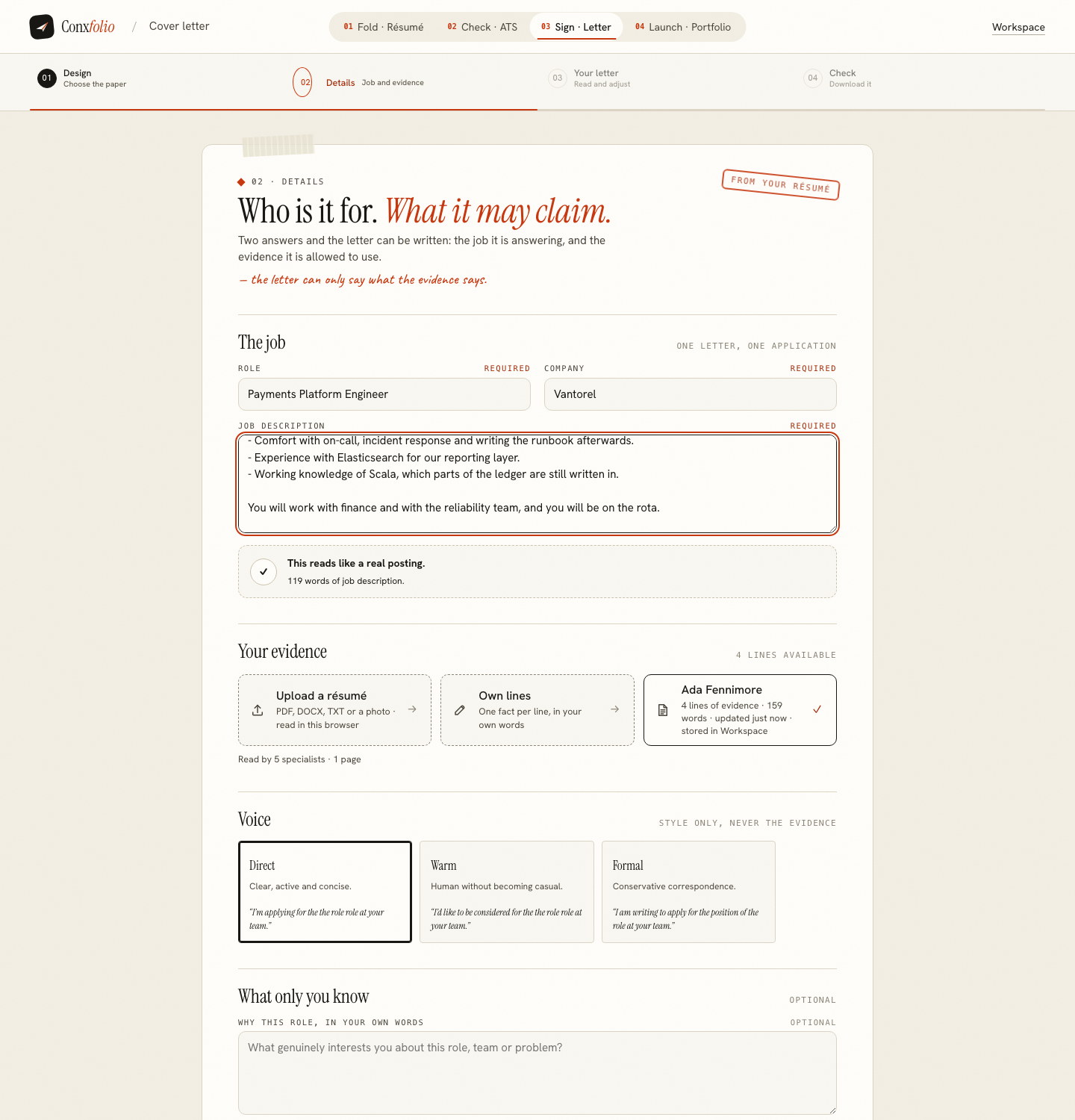
We connected the résumé of Ada Fennimore, an invented backend engineer, and pasted an invented posting for a payments platform role at a company that does not exist. The details step reported four lines of evidence available and confirmed the posting looked like a posting: 119 words of job description. The draft came back at 79 words with three proof paragraphs, each labelled with the résumé line it was taken from.
The voices are style, and the product says so
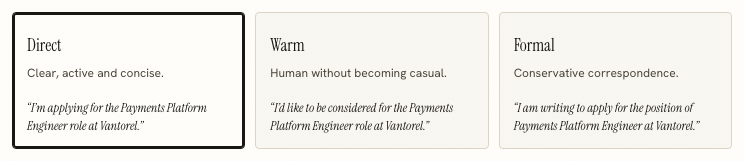
Above the three choices sits the label: style only, never the evidence. Underneath each one is the real opening sentence for your own role and company, not a description of a tone. Switching voice rewrites the connective sentences and leaves the proof paragraphs exactly where they were, and the previous draft is kept as a version first.
What it refuses to say
Requirements in the posting that your evidence cannot support come back as gaps and are never asserted. Our draft produced three, and the review printed them under a heading saying none of them were claimed. That behaviour has its own piece: the gaps list is the interview.
The review measures the draft, not your chances
Before export, every line of the letter is checked against the letter itself. Ours reported three evidence paragraphs included, a named opportunity, a reading length of 79 words with the note that 140 to 420 words is a useful guide rather than a rule, and a row reading: carries a number, listing 31 per cent, 14, 2.3 and 99.97 per cent as figures the evidence also states. Nothing on that panel is a prediction about the employer.
What the details step asks for, and what it will not ask for
Three required answers and one optional one. The role, the company and the posting, which the step checks for plausibility and reports on: ours came back as 119 words of job description, and it said so. Then the evidence, which is a connected résumé, an uploaded file, or lines you type yourself, one fact per line, with a note saying the letter cannot claim anything outside that box.
The optional field is the one worth using. It asks why this role, in your own words, and the help text under it states the contract: used exactly as you wrote it, and the product never invents a reason for wanting the job. Two sentences there are the only part of a cover letter a selection engine could never produce, which is a good argument for spending your effort on them rather than on the proof paragraphs.
What this costs you
A selected letter is plainer than a generated one. It will not open with a paragraph about your lifelong admiration for a company you found on a job board, because you did not write that sentence and the engine cannot. If your résumé has no achievements in it, the letter will be short, which is a useful thing to discover in private rather than in an inbox. What you get in exchange is a letter that cannot embarrass you in an interview, because every claim in it is a line you can already defend. The provenance is visible on each paragraph, as shown in what evidence tracing looks like, and a letter with no name on it says so, which is the unsigned letter rule.
Draft one from your own evidence
Paste the posting, connect a résumé or type your own lines, and read the draft it selects. Free, in any of the 12 designs.
Open the cover letter builderSee the tracingQuestions
- Does this use a language model
- No. The letter engine has no network call and no vendor, and the response it returns says so in its own metadata. It runs the same offline as online, which is part of why it is free.
- Where do the sentences come from
- From your résumé, or from the lines you type yourself. The engine extracts candidate evidence lines, ranks them against the posting and keeps up to three, each carried with the index of the line it came from.
- What if it cannot find good evidence
- It returns fewer paragraphs. On our test with three hand-typed lines it used two, because the third added nothing the first two had not already evidenced. It does not pad.
- What do the three voices change
- The connective sentences only: the opening, the fit line and the closing. Each voice shows you the exact opening sentence it will write for your role and company before you choose it. The evidence paragraphs are identical in all three.
- Can I write my own reason for wanting the job
- Yes, and it is used exactly as you wrote it. The field says plainly that the product never invents a reason for wanting the job.
Conxfolio is a free set of four career tools: a résumé builder with 37 rendered layouts, an ATS résumé checker that prints its own arithmetic, a cover letter builder that traces every proof paragraph back to the line it came from, and a portfolio builder with 20 authored designs. There is no account to create, nothing is held back for a paid plan, and no language model is used anywhere in the product, so the readers, the score and the letter are deterministic code you can check.