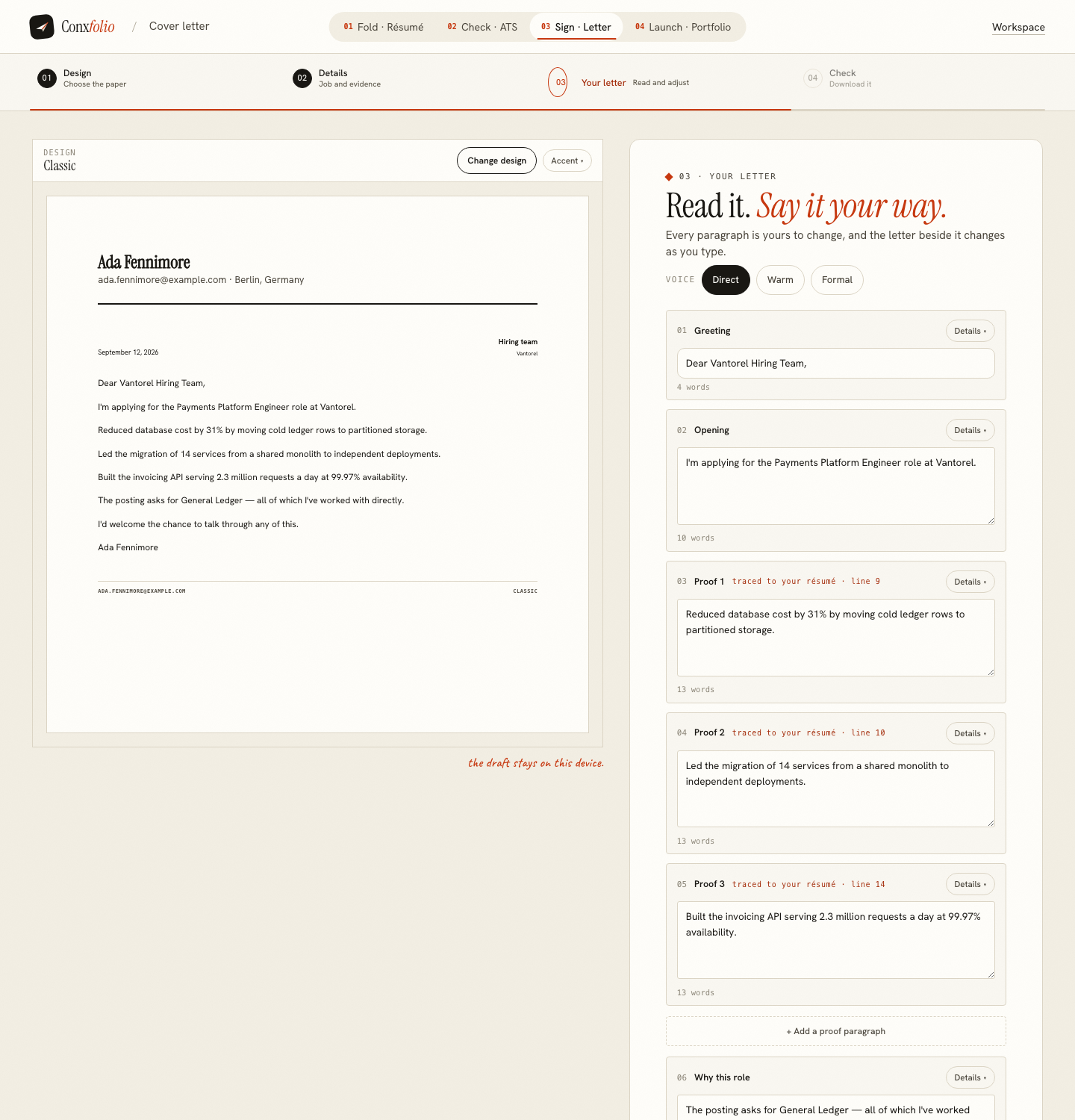
Each proof paragraph says which line of your résumé it came from
A claim you cannot trace is a claim you have to defend from memory. Every proof paragraph in this letter carries the line it was taken from.
— provenance is the only proof a sentence can carry.
The reason a generated cover letter is dangerous is not that it writes badly. It is that you cannot tell, three weeks later in a room, which of its confident sentences came from your career and which came from the generator's sense of what a good candidate sounds like.
The cover letter builder removes the question by attaching the source to every claim.
What it looks like on the page

The letter is shown twice: rendered as paper on the left, and as a list of numbered paragraphs on the right. On our draft the list ran greeting, opening, proof 1 traced to line 9, proof 2 traced to line 10, proof 3 traced to line 14, why this role, closing, and signed. Eight rows, of which three carry a line number.
Where the number comes from
When the engine extracts candidate sentences from your résumé it keeps each one with the index of the line it came from, and that index travels with the sentence into the letter. The surface is printing the engine's own source index rather than a label added afterwards, which is why it survives editing, voice changes and versioning.
The three it chose, and why
Our invented candidate's résumé offered four usable evidence lines against an invented payments posting. The engine took the cost reduction, the service migration and the invoicing API. The scoring is plain: a line scores for each skill it matches that the posting asked for, again if it carries a number, and a little for breadth. After the first pick it refuses a line that adds no skill the earlier picks did not already evidence, which is why three paragraphs do three different jobs rather than saying the same thing in three registers.
The review counts what it can see
Before export, the review reported three evidence paragraphs included, and a row reading: traced to your evidence, all seven, still the wording built from your connected résumé. It also listed the figures the letter carries, 31 per cent, 14, 2.3 and 99.97 per cent, described as figures your evidence also states. That row exists because a number is the easiest thing for a letter to inflate, and the cheapest to check.
Editing does not break the trace
A traced paragraph is a starting point. You can rewrite it, and most people should: a bullet lifted from a résumé is compressed in a way that reads oddly in prose. What editing changes is the wording. What it does not change is that the paragraph began as your line, which is the thing you will want to remember in the room.
Why three, and why not five
The engine stops at three, and it refuses a fourth even when the résumé has one. That is a judgement about reading rather than a technical limit: a letter that lists six achievements has stopped being a letter and become a second résumé, and the reader skims it the way they skim the first one.
The refusal rule underneath is stricter still. After the first pick, a line has to add a skill the earlier picks did not already evidence, so three near-identical achievements become one and the letter reaches for something different. On our draft that produced a cost reduction, a migration and an availability figure, which between them touch storage, delivery and reliability. Where the evidence cannot fill three slots the letter comes back shorter, which is the behaviour described in a letter that only claims what you proved.
What tracing cannot do
It cannot check your résumé against reality. If the line was an exaggeration when you wrote it, the letter will carry the exaggeration faithfully, with a line number attached. It also cannot tell you whether the three it chose are the three this particular employer cares about; it ranks against the words in the posting, and postings are written badly. What it does is remove one entire category of unpleasant surprise, and leave the rest of the letter, including everything it refused to claim, visible before you send. The designs the finished letter can arrive on are shown whole, which is why the gallery shows whole letters.
Read your own traced draft
Connect a résumé, paste a posting, and every proof paragraph arrives with the line it came from printed beside it.
Open the cover letter builderSee what it refuses to claimQuestions
- What does traced to line 9 mean
- That the paragraph is the ninth line of the evidence the engine read, carried through with its index so the surface can point back at it. The number is the engine's own source index, not a label written afterwards.
- Can I edit a traced paragraph
- Yes. Every paragraph is editable, and the letter beside it updates as you type. Editing is how a selected sentence becomes your sentence.
- How many proofs will a letter have
- Up to three, and fewer when the evidence does not support three. Our connected-résumé draft used three; the same posting with three typed lines used two.
- What does the review mean by all seven traced
- That every paragraph in the finished letter, connectives included, was built from the evidence supplied rather than composed. The row prints the count for the draft in front of you.
- Does tracing make the letter true
- It makes the letter consistent with your own document. Whether the document is true is your responsibility, and no software can take that over.
Conxfolio is a free set of four career tools: a résumé builder with 37 rendered layouts, an ATS résumé checker that prints its own arithmetic, a cover letter builder that traces every proof paragraph back to the line it came from, and a portfolio builder with 20 authored designs. There is no account to create, nothing is held back for a paid plan, and no language model is used anywhere in the product, so the readers, the score and the letter are deterministic code you can check.