What the posting asked for and your evidence cannot support, listed and never claimed
The requirements a letter quietly skips are the questions you will be asked out loud. So the product prints them instead of skipping them.
— the thing you cannot evidence is the thing they will ask about.
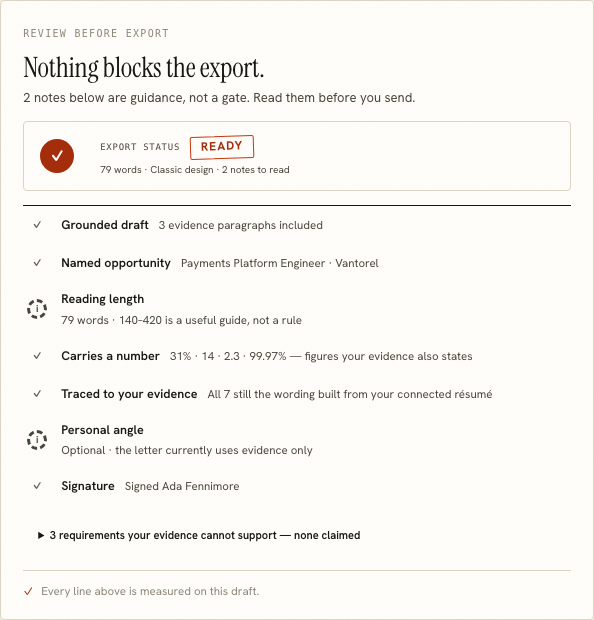
Every cover letter has a silent list attached to it: the things the posting asked for that you did not mention. In a generated letter that list is invisible to you and obvious to the reader, because the generator either skipped the requirement or asserted it on your behalf.
The cover letter builder prints the list.
How the list is made
The engine reads the posting for the skills it asks about, then compares them against the skills it can find in your whole résumé. What the posting wants and the document cannot evidence comes back as a gap. The comparison deliberately runs against the entire résumé rather than against the three lines the letter selected, because an earlier version compared against the selection only and reported things the candidate had plainly done as missing. Telling somebody they lack what they have is the same class of dishonesty as claiming something they do not.
What ours said

We wrote an invented posting for a payments platform role and planted two requirements the candidate's résumé does not contain: Elasticsearch and Scala. The review found both, plus reporting, and asserted none of them. The rest of the posting, Go, PostgreSQL, Kafka, Terraform, Kubernetes, on-call and incident response, was evidenced by the document and available for the letter to use.
The same posting with less to work with
We ran it again with three hand-typed achievement lines instead of the connected résumé. The gaps list went to eight, and the letter went to 64 words and two proof paragraphs. Fewer evidenced skills means a shorter letter and a longer list of things to be ready for, which is the correct shape of that trade rather than a failure of the tool.
Why this is the useful half of the page
A letter tells an employer what you can show. The gaps list tells you what the conversation will be about if they call. Three named items are three answers to prepare: where you have done the nearest thing, what you would need to learn, and how fast you have learned something comparable before. That preparation is available to you an hour before the interview because the software refused to paper over the list.
Three answers worth preparing
For each named gap there is a version of the same conversation. The nearest thing you have actually done, said without overreaching. You have not used that tool; you have solved the same problem with a different one. The size of the distance, honestly estimated, because a reader can tell the difference between a week and a quarter. And a piece of evidence that you close distances like that quickly, which usually already exists somewhere in your own history.
Our three were reporting, Elasticsearch and Scala. An engineer with production PostgreSQL and Kafka on the page has a real answer to the first two and a weaker one to the third, and knowing which is which before the call is most of the preparation. None of that belongs in the letter, which is exactly why the list is printed beside it rather than folded into it.
What it is not
It is not a scorecard and there is no percentage attached to it. The product does not tell you whether to apply, does not rank you against other candidates, and has no access to the employer's system or to the people who will read the letter. It reads two documents and reports the difference between them.
What to do with it
Read the list before you send. Where an item is something you have genuinely done and the résumé does not say so, the fix is in the résumé rather than the letter, and the résumé builder is where that sentence belongs. Where it is something you have not done, leave it out of the letter, which the engine will do anyway, and prepare the honest answer. The rest of the review, including the signature check that decides whether the letter can go out at all, is in the unsigned letter rule.
See your own gaps before they do
Paste the posting and the review names every requirement your evidence cannot support, without putting any of them in the letter.
Open the cover letter builderRead how the letter is builtQuestions
- What counts as a gap
- A skill the posting asks for that the whole résumé cannot evidence. It is compared against the entire document, not only against the three lines the letter chose, so something you mention once still counts as evidenced.
- Will the letter claim a gap anyway
- No. Gaps are surfaced for you and never asserted in the text. The summary line says it: requirements your evidence cannot support, none claimed.
- How many gaps did your test produce
- Three from the connected résumé, named as reporting, Elasticsearch and Scala. The same posting with three hand-typed lines as evidence produced eight, because there was much less to evidence with.
- Should I add the gaps to my résumé
- Only where they are true. A gap is a prompt to check whether your document undersells something you have actually done, and a prompt to prepare an answer where it does not.
- Does a long gaps list mean I should not apply
- No. It means the letter cannot carry those claims for you. Postings routinely list more than any one person has, and the product has no opinion about your chances.
Conxfolio is a free set of four career tools: a résumé builder with 37 rendered layouts, an ATS résumé checker that prints its own arithmetic, a cover letter builder that traces every proof paragraph back to the line it came from, and a portfolio builder with 20 authored designs. There is no account to create, nothing is held back for a paid plan, and no language model is used anywhere in the product, so the readers, the score and the letter are deterministic code you can check.