A letter with no name on it says so, before you send it
The most common way a cover letter fails is not tone. It is a file that goes out without the sender's name anywhere on it.
— unsigned is a fact, so the product prints it as one.
Applications fail for boring reasons. Among the most boring is a cover letter that arrives as a beautifully set page of prose with no name at the bottom, because the sender built it in a tool that had never been told who they were.
The cover letter builder treats that as a fact worth printing rather than an edge case worth ignoring.
The signed draft
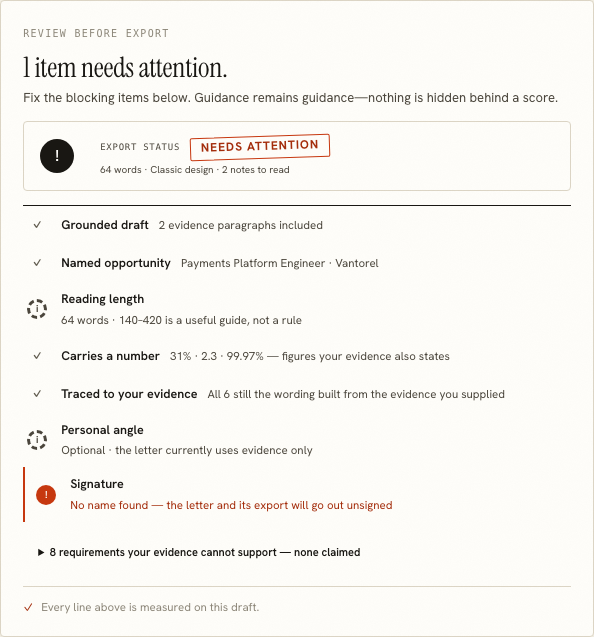
We drafted a letter for Ada Fennimore, an invented candidate, from a connected résumé. The paragraph list ended with a row reading signed, from your résumé, with the name beside it. The review reported export status ready, 79 words, three evidence paragraphs, and a signature row naming the signer. Two rows were marked as guidance rather than problems: the reading length, and the absence of a personal angle.
The same letter without a name
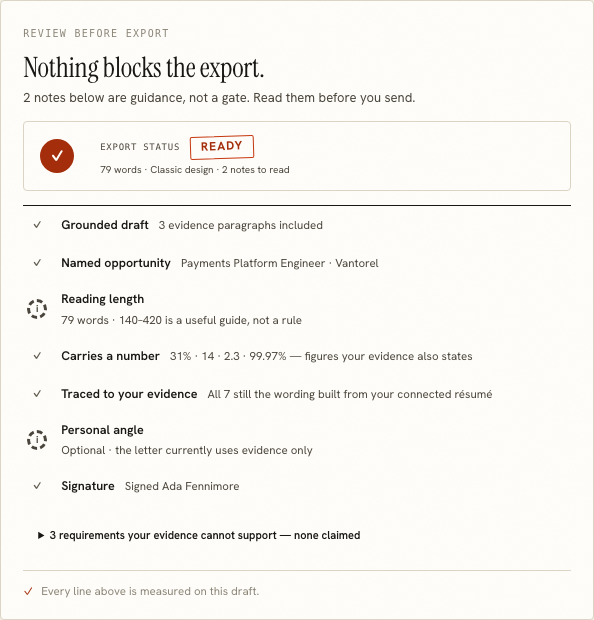
Then we built the same letter from three typed achievement lines with no name anywhere in them. The draft came back at 64 words with two proof paragraphs. The review changed: one item needs attention, export status needs attention, and a signature row reading no name found, the letter and its export will go out unsigned. The paragraph list marked its last row unsigned in the same words.
A check, not a gate
The export still works. The product's position is that it is not entitled to stop you sending your own letter; it is only entitled to make sure you knew. The header on the review says the same thing about the whole panel: the notes are guidance, not a gate, and nothing is hidden behind a score.
Why the signature is treated as evidence
Everything else on that panel is measured on the draft in front of it: the word count, the figures the letter carries, the number of traced paragraphs, the named company and role. The signature is measured the same way. It is either in the document or it is not, and the answer is a fact rather than a recommendation, which is why it is the only row on our unsigned run that changed the export status.
Where the name comes from
From the evidence. A letter drafted from a saved résumé inherits the name on that résumé, which is why the signed run needed no extra step. A letter drafted from typed lines has whatever those lines contain, and three achievements contain no name. Connecting a résumé fixes it in one action, and the résumé itself is read without a model, as described in how the résumé reader works.
The same panel also counts what it cannot see the point of guessing at. Reading length is reported and then explicitly demoted, with the note that 140 to 420 words is a useful guide rather than a rule, because a short letter answering a short posting is not a defect. A personal angle is marked optional. Neither of them changes the export status, and that restraint is what makes the one row that does change it worth reading.
The export carries whatever the page carries
Both formats are free, in any of the 12 designs, with no watermark. Both carry exactly what the draft carries, which is the reason the signature row sits in front of them rather than behind them: an unsigned letter exports as an unsigned letter, in PDF and in DOCX, and neither format adds a name the document does not have.
The fix takes one step. Connect the résumé you already have, and the name on it becomes the name on the letter, along with the contact line the design places in the sender block. If you are working from typed lines on purpose, because the résumé is out of date or you are answering a posting with three facts, put your name in the profile before you export rather than after somebody has read it.
What the check does not claim
That a signed letter is a good letter. The review has no opinion about your writing, no view on your chances, and no access to the employer. It reports six or seven measurable facts about the page you are about to export, including the requirements it refused to claim on your behalf, which is the gaps list. Whether the letter is any good remains a judgement, and it is yours.
Check a letter before it goes
The review reads the draft in front of you and reports what it found: length, figures, tracing, gaps and whether it carries your name.
Open the cover letter builderSee the tracingQuestions
- What does the product do when the letter has no name
- It says so twice. The paragraph list marks the last row unsigned, and the review prints: no name found, the letter and its export will go out unsigned.
- Does it stop the export
- No. It is a check rather than a gate. The export status reads needs attention, the reason is named, and the decision stays yours.
- Where does the name come from
- From the evidence you connected. A letter drafted from a saved résumé is signed with the name on that résumé. A letter drafted from typed lines with no name in them has nothing to sign with.
- What else does the review check
- Whether the draft is grounded in evidence, whether the opportunity is named, the reading length, whether it carries figures your evidence also states, whether every paragraph is traced, and whether you have added a personal angle.
- Is the letter worse without a name
- It is harder to act on. The reader has a document, an address and no sender, and in a stack of applications that is enough friction to lose the letter.
Conxfolio is a free set of four career tools: a résumé builder with 37 rendered layouts, an ATS résumé checker that prints its own arithmetic, a cover letter builder that traces every proof paragraph back to the line it came from, and a portfolio builder with 20 authored designs. There is no account to create, nothing is held back for a paid plan, and no language model is used anywhere in the product, so the readers, the score and the letter are deterministic code you can check.