Skills first or experience first, and the measurement that says the checker does not care
Section order is a decision about human reading, and it is usually argued as though a machine were watching. We tested whether one was.
— order is for the reader. the parser is looking for headings.
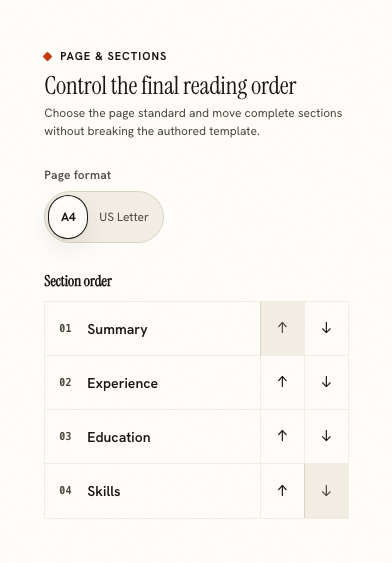
Put skills at the top so the machine sees them is one of the oldest pieces of résumé advice on the internet. It is testable, and this product prints enough of its own working to test it. The résumé builder moves whole sections in one panel, and the checker shows its arithmetic, so the experiment takes two minutes.
The test
We took an invented student page and checked it: 169 words, 19 lines, five recognised headings, published score 55 on 12 September and 85 when it was re-measured on 13 September. Then we moved the entire experience block above the projects block, changing nothing else, and checked the same text again.
The result

Identical, on both days. On 12 September it was 100 × 30% + 70 × 30% + 12 × 40% = 56, published as 55, in both orders. Re-measured on 13 September it is 100 × 30% + 100 × 30% + 62 × 40% = 85, in both orders, on the same 169 words, the same 19 lines and the same five recognised headings. The order of the sections made no difference to any check on either occasion. What did move the score on that page in September was rewriting one line so that it began with a role, which took it from 55 to 75 before the rule behind it was corrected; that experiment, and the correction, are in unpaid work on a résumé.
Why that is the expected result
The checker's rules look for recognised headings and for the evidence underneath them. Parseability asks whether the text comes out in one readable flow with sections that have content. Completeness asks whether the seven essentials are present. Content grades the achievement lines under experience. None of those is a question about sequence, and the whole method is in how the ATS score is calculated.
What the order is actually for
The reader, who has a finite attention span and starts at the top. Put first whatever is your strongest argument for this specific job. For most people with a job, that is experience. For a recent graduate it is education for about six months, which is covered in the graduate's first six months. For a career changer it may be a projects section that shows the new direction.
The version that does have a cost
Skills first is harmless. Skills instead of experience is not. A page whose real work is written up under projects or skills, with no experience section carrying roles and dates, can lose the completeness rule's experience check outright, which is worth thirty of that dimension's hundred points and can trigger a ceiling on the published score. We measured exactly that, and it is in evidence ceilings explained. Chronological, functional or hybrid has the whole comparison.
Where the control is
In the design step, under page and sections. It moves complete sections without disturbing the authored design, and the document beside it is the real render rather than a preview, so both orders can be looked at rather than imagined. A design is not a rewrite covers why that separation exists.
What a checker cannot see, and a reader can
The measurement above is narrow on purpose. It says that this scoring engine, on this text, produced the same number in both orders. It says nothing about what any employer's system does, because we have no access to one and make no claim about it, and it says nothing about the human reader, who is the actual audience and who stops reading when the page stops being interesting.
So the honest summary of section order is that it is a reading decision with no measurable machine cost here. Put your strongest argument first, keep a real experience section with roles and dates wherever else things go, and spend the time you would have spent rearranging on the achievement lines instead. Those are the things the content rules actually grade, and they are also the things a person remembers.
The decision
Order for the human. Keep an experience section with roles, dates and achievement lines under it whatever else you do. Then check the result and read the counts rather than the ring. Nothing here predicts an outcome and no page on this site claims a section order gets anybody hired; what is claimed is one measurement, repeated, on the same text.
It is worth being precise about what was held constant in the test, because a measurement is only as good as its controls. Same text, same 169 words, same 19 lines, same five recognised headings, same browser, two runs minutes apart, one variable. The report printed its arithmetic both times, which is what made the comparison possible at all: a checker that returns only a number cannot be tested this way, because you cannot tell a rule that did not fire from a rule that fired identically. That is the argument for printing the sum, made in why the checker prints its own arithmetic.
Try both orders on the real page
Move a section, look at the rendered document, and move it back. Nothing is lost and nothing is charged.
Open the résumé builderRead the formats guideQuestions
- Did the order change the score
- No. We moved a whole experience block above a projects block on the same text and re-ran the check. The arithmetic came back identical, and it still does: re-measured on 13 September, both orders return 100 × 30% + 100 × 30% + 62 × 40% = 85.
- So order does not matter
- It matters to the reader, who stops reading at some point. It did not matter to this checker on this test, because its rules look for headings and the evidence under them rather than for a sequence.
- What did change the score on that page
- On 12 September, rewriting one line so it began with a role rather than with a status took the same document from 55 to 75. That gap was a defect in our own heading rule, it was repaired the next day, and both phrasings now score 85.
- Where do I change the order
- In the design step, in the page and sections panel. It moves complete sections and leaves the authored design alone.
- Is a skills-first document risky
- It has a cost when it goes as far as replacing experience rather than preceding it. A page whose work sits outside an experience section can lose the completeness rule's experience check outright.
Conxfolio is a free set of four career tools: a résumé builder with 37 rendered layouts, an ATS résumé checker that prints its own arithmetic, a cover letter builder that traces every proof paragraph back to the line it came from, and a portfolio builder with 20 authored designs. There is no account to create, nothing is held back for a paid plan, and no language model is used anywhere in the product, so the readers, the score and the letter are deterministic code you can check.