Why a well-formatted résumé with nothing in it is held at 40
A blank page with a beautiful header can score well on format and completeness. The ceilings exist so that it cannot score well overall.
— the cap is not a punishment; it is the measurement refusing to flatter you.
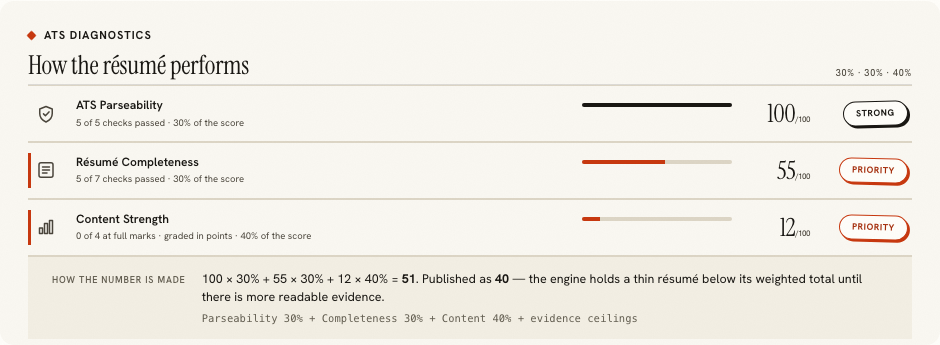
Any scoring system that adds up formatting can be gamed by a document with formatting and nothing else. Clean headings, a readable contact line, one sentence under each heading, and the sum looks respectable. The reader of that report then goes to an interview believing the hard part is done.
The ATS résumé checker closes that gap with four caps applied after the weighted sum, and we built a document to trip one.
The document we built
A real-shaped career for Ada Fennimore, an invented engineer: a summary, four substantial project write-ups with figures in them, ten skills, a contact line. No Experience heading, because the work had been contract and internal. No Education section. Nothing about it is unusual; plenty of career-changers and freelancers send exactly this.
What the report said

Parseability 100, completeness 55, content 12. The multiplication came to 51 and the published score was 40, because the rule for a document with no experience section and no education section is a cap at 40. The verdict beside the ring read: it parses, the evidence underneath is what is thin. That sentence is the whole diagnosis, and it points at the right half of the document.
The four caps
Under 25 readable words, the score is held at 15. With no experience, no education and no skills found anywhere in the text, 25. With no experience and no education, 40. With no experience and a content dimension under 30, 55. They are applied in that order, after the sum, and only the first one that matches takes effect.
The floor case

We also checked a four-line draft: a name, an email, a heading and one sentence. Nine readable words. Parseability was held at 25 rather than the 100 its clean formatting would otherwise have earned, completeness reached 25 on the identity and the email, and content scored zero. The sum came to 15, which is also the floor rule's cap, and the verdict said the text itself is hard to parse.
The same work, uncapped
The interesting part is what happened when the same career was written under an Experience heading with dated roles and bulleted achievements: parseability 100, completeness 100, content 92, published 97, with no ceiling in sight. The work did not change. The document did. That before and after is visible in the report history, which is the subject of previous reports and what a fix was worth.
Reading a capped report in the right order
Three lines, in this order. First the arithmetic: where it shows two numbers, a ceiling is in force and the weighted total is not what you are being judged on. Second the verdict sentence beside the ring, which names the half of the document that is thin. Third the top of the fix list, which is the largest single thing the checker can see.
On our capped report those three said: 51 weighted and 40 published, the evidence underneath is what is thin, and action-led achievements worth up to 12 points. That is one instruction rather than six, and it turned out to be the instruction that cleared the ceiling as well. The counts are worth a glance too, because a capped score on a nine-word extraction is a file problem rather than a writing problem, which is the distinction drawn in what the checker read.
What a ceiling is not
It is not a judgement of your career, and it is not a prediction that an employer will reject you. It is a refusal by a measurement to report a number its evidence cannot support. The report keeps recording the point cost of every fix while the cap is in place, and says on each row that the published score stays capped until there is more readable evidence, so you can see both the work to do and the reason the number is not moving yet. The counts it made that decision from are printed as well, in what the checker read, and you can watch the whole sum assemble in why the checker prints its own arithmetic.
Find out which ceiling you are under
The report names the ceiling in words and shows both numbers, so a capped score and a low score are never confused.
Open the ATS checkerSee the whole arithmeticQuestions
- What are the four ceilings
- Under 25 readable words the score is held at 15. With no experience, education or skills found anywhere, 25. With no experience and no education, 40. With no experience and a content dimension under 30, 55. They are applied after the weighted sum.
- How do I know a ceiling applied to my report
- The arithmetic line prints both figures and explains the hold in words. When no ceiling applies it says instead that the weighted total is the published score.
- My work is real. Why did the ceiling still apply
- Because the ceiling is about what the document evidences, not about what you have done. Our capped example is a real career written up as projects with no Experience heading. The same work under an Experience heading scored 97.
- Does a ceiling mean the fixes are pointless
- No, and the report says so on each fix row: the cost is still recorded, and the published score stays capped until the résumé carries more readable evidence. Clearing the ceiling is the first job, and the fix list is ordered so the biggest one is first.
- Can a ceiling be wrong about me
- It can be blunt. A genuine portfolio career with no conventional employment history will meet the no-experience ceiling, and the honest answer is to write the roles as roles where they were roles. The measurement reads a document; it cannot read a life.
Conxfolio is a free set of four career tools: a résumé builder with 37 rendered layouts, an ATS résumé checker that prints its own arithmetic, a cover letter builder that traces every proof paragraph back to the line it came from, and a portfolio builder with 20 authored designs. There is no account to create, nothing is held back for a paid plan, and no language model is used anywhere in the product, so the readers, the score and the letter are deterministic code you can check.