The line that tells you whether the score is even about your résumé
If your two dense pages come back as 90 words, the score is a distraction. The extraction is the problem, and the report shows it to you.
— read the counts before you read the number.

Every résumé score you have ever been given was computed on an extraction: the text a parser managed to pull out of your file. If that extraction is wrong, every number built on it is meaningless, and almost no tool shows it to you.
The ATS résumé checker prints it under every report. We ran three documents through and photographed the line each time.
A healthy extraction
A pasted 162-word résumé for Ada Fennimore, an invented candidate, came back as 162 words, 18 lines and 4 recognised headings. The sentence under it says what the counts are for: these are the text the score was computed from, and anything a parser could not read is not in them. That is the sentence you check first, because it decides whether the rest of the page is about your document at all.
An extraction that is telling you something else

A four-line draft returned 9 words, 4 lines and 1 recognised heading. With that extraction the score was held at 15 by the floor rule, and the report said the text itself was hard to parse. Nothing about that report is a criticism of the candidate's career, because the document does not contain one yet.
The same file, exported and read back
We also took the PDF this product renders and fed it back into the checker. It came back as 159 words, 20 lines, 4 recognised headings, 2 roles and 9 skills, and scored 94 against the pasted text's 97. The clauses about roles and skills appear only when the reader found them, which is why the line is longer on that report than on the pasted one. The three-point difference has a single cause, and it is worth its own piece: pulling text back out of a PDF.
The verified chapter is the same idea, in sentences
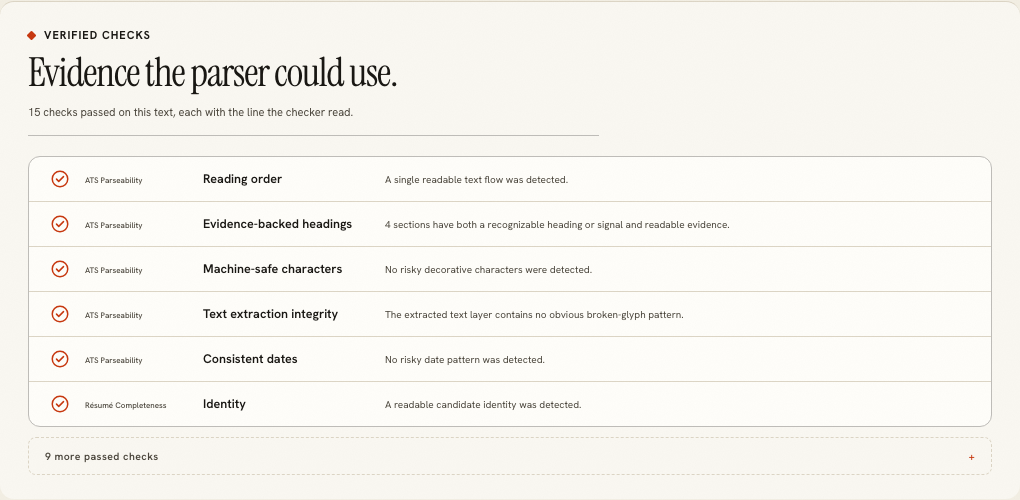
Every passed check carries its own evidence sentence: a single readable text flow was detected; four sections have both a recognisable heading and readable evidence; nine distinct skill entries were detected. There is no boilerplate row and no row that was not computed on this text. Reading the passed checks is a faster way to find a misread document than reading the failed ones.
What the counts change about your next move
A low score with a healthy extraction is a writing problem, and the fix list is ordered by what each fix is worth. A low score with a starved extraction is a file problem, and no amount of rewriting will move it until the file gives up its text. Those are different afternoons, and the counts are what tell them apart. Where the score is held below its own sum, the reason is in evidence ceilings explained.
What the volume rule actually pays
The word count is not a target. Inside the content dimension, readable volume is worth up to 20 points of the 100: 250 words or more earns all 20, 120 earns 12, 60 earns 5, and below that it earns nothing. Our 162-word document took 12 of the 20 and still published 97 overall, because the other three content rules, action-led lines, measurable evidence and evidence depth, were carrying the dimension.
So there is a floor, and then there is nothing. Past 250 words the rule pays no more, and anyone adding paragraphs for the number is working for a score that has stopped moving while making the page slower for a person to read. Where that leaves the length question, and the two controls that change a page's length without changing a word, is in white space and the second page.
What the line does not do
It does not tell you how an employer's parser will read the same file. It reports one reading, ours, made by deterministic code with no language model anywhere in it. It is a check on our own measurement rather than a claim about somebody else's, which is the only kind of claim available to anyone who does not own the employer's system. Everything downstream of the counts is printed too, in why the checker prints its own arithmetic.
See what came out of your file
Upload a résumé and the report states the extraction in counts before it states the score. A bad extraction is visible immediately.
Open the ATS checkerRead the PDF round tripQuestions
- Where is this line on the report
- Directly under the diagnostics, headed by what the checker read, with a sentence saying that anything a parser could not read is not in the counts.
- What counts as a recognised heading
- A line the engine matched against its section patterns for summary, experience, education, skills, projects and a group of others such as certifications and languages. A heading it does not recognise is still text; it simply is not counted as a section.
- My résumé is two pages and the line says 90 words
- Then the text layer of the file is the problem, not the writing. Export a text-based PDF, or paste the text, and check again. A scanned page or a heavily styled export can lose most of its text before any scoring happens.
- Why does it sometimes list roles and skills too
- Because those clauses are printed only when there is something to print. No clause appears for a zero, so a line with roles and skills on it is a line where the reader found them.
- Does a higher word count mean a better score
- Only up to a point, and the point is stated: readable volume earns its full 20 points at 250 words, 12 at 120 and 5 at 60. Beyond that, length earns nothing at all.
Conxfolio is a free set of four career tools: a résumé builder with 37 rendered layouts, an ATS résumé checker that prints its own arithmetic, a cover letter builder that traces every proof paragraph back to the line it came from, and a portfolio builder with 20 authored designs. There is no account to create, nothing is held back for a paid plan, and no language model is used anywhere in the product, so the readers, the score and the letter are deterministic code you can check.