A score you cannot check is a rating, so this one shows its working
Two résumés, two reports, two sums. Both printed the multiplication that produced the number, and one of them printed two numbers because a ceiling applied.
— show the working or hand back a horoscope.
A résumé checker that returns 68 out of 100 has told you a number and kept the reasoning. You cannot tell whether the missing 32 points are one broken thing or thirty small ones, whether they are formatting or evidence, or whether doing the work would move the number at all. The number is doing the work of a verdict and carrying none of a verdict's obligations, which is the definition of a rating.
The ATS résumé checker prints the sum instead. We ran it twice, on two different documents, and photographed both.
The first report

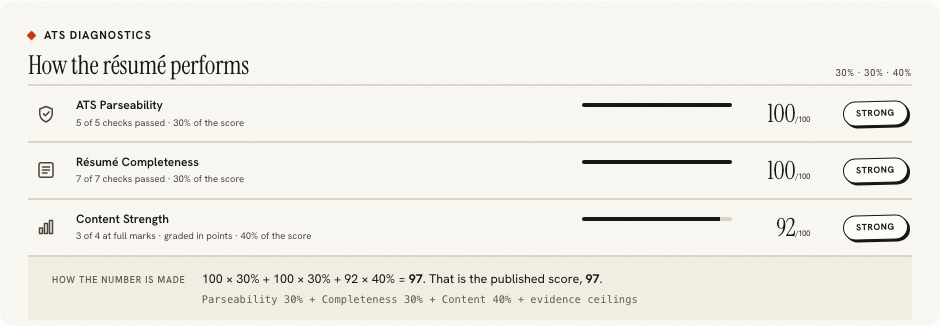
Parseability 100, completeness 100, content 92, weighted at 30, 30 and 40 per cent, published as 97. Above the line the ledger shows how each dimension earned its own score: five of five parseability checks passed, seven of seven completeness checks passed, and three of four content rules at full marks, with the fourth graded in points rather than failed.
The sentence under the sum is the engine's
Beneath the multiplication sits a line naming the method: parseability 30 per cent, completeness 30 per cent, content 40 per cent, plus evidence ceilings. That sentence is not our description of the method. It is a string the scoring engine returns with every response it produces, printed as it arrives. A page that describes an algorithm in its own words can be out of date for a year without anybody noticing. A page that prints the algorithm's own declaration cannot.
The second report printed two numbers

Parseability 100, completeness 55, content 12, weighted to 51, published as 40. The line says so in words: the engine holds a thin résumé below its weighted total until there is more readable evidence. A checker that quietly printed 40 would have left the reader chasing points in the wrong dimension. The ceilings themselves are explained in evidence ceilings explained.
Fixes carry prices, and the list is ordered by them
Under the sum, each recommendation states what it is worth: on the first report, one improvement worth up to 3.2 points of the 100. On the capped report, six improvements, the largest worth 12 points, each with a note that the published score stays capped until the evidence grows. A list of eleven suggestions in one typeface makes every suggestion equally urgent and loses your afternoon to the cheapest one. Ordering by cost is the difference between a list and advice.
What the report says about itself
The provenance line at the top of every report reads: no job description, no keyword match, no hiring prediction. Beside the score is a sentence stating that the number estimates compatibility from the structure and evidence the product could extract, and is not an employer's private score. Those sentences cost the product something, and they are the reason the rest of the page can be believed.
Each row says how it earned its own score
The ledger above the sum is not three bars. Each row states what kind of measurement it is and how much of the final score it carries: five of five checks passed and 30 per cent of the score for parseability, seven of seven and 30 per cent for completeness, and for content, three of four at full marks, graded in points, carrying 40 per cent.
That distinction does real work. Completeness is seven checks with unequal weights inside it, so passing six of seven tells you nothing about the damage until you know which one failed. Content is graded rather than passed, so a row at 92 has partial credit in it rather than a missing rule. Printing which kind each row is stops a reader doing arithmetic the engine did not do, and the counts those rows were computed from sit on the same report, as described in what the checker read.
What printing the arithmetic does not buy you
A transparent measurement is still a measurement of one document against one set of rules. It cannot tell you how a particular employer's software parses a file, because nobody outside that employer can. It does not read the job description. It says nothing about whether the work behind the résumé is any good, and a high score on a document written in four minutes is the proof of that rather than a counterexample. What it does buy you is the ability to disagree with it for a stated reason, which is more than a number on its own allows. The counts the sum was computed from are printed too, in what the checker read.
Get a number you can check
Paste or upload a résumé and the report prints its own sum, its weights and the cost of every fix it recommends.
Open the ATS checkerRead the full arithmeticQuestions
- Where does the algorithm sentence under the sum come from
- From the scoring engine itself. It returns the string with every response, and the report prints that string rather than a description of the method written by hand, so the page and the code cannot drift apart.
- What happens when a ceiling applies
- The report shows both figures and says so in words. On our capped example it printed the weighted total of 51 and then the published score of 40, with a sentence explaining that a thin résumé is held below its weighted total.
- Do the fixes have prices
- Yes. Each recommendation carries the point cost the checker recorded for that finding, weighted by its dimension's share of the score, and the list is ordered by that cost.
- Is a job description used anywhere in this
- No. The provenance line at the top of every report says no job description, no keyword match and no hiring prediction. The check reads your document and nothing else.
- Does the score predict whether I will get an interview
- No, and the report says so beside the number. It is a readability and evidence measurement of one document. It is not an employer's system and it knows nothing about the role, the market or the people reading.
Conxfolio is a free set of four career tools: a résumé builder with 37 rendered layouts, an ATS résumé checker that prints its own arithmetic, a cover letter builder that traces every proof paragraph back to the line it came from, and a portfolio builder with 20 authored designs. There is no account to create, nothing is held back for a paid plan, and no language model is used anywhere in the product, so the readers, the score and the letter are deterministic code you can check.