We rewrote one résumé's structure and the score moved from 40 to 97
The report priced the fix before we did it. Then the history kept both reports so the price could be checked against the result.
— an estimate you can audit afterwards is worth more than a confident one.
A checker that gives advice and forgets it is asking you to take its word twice: once when it tells you what to change, and again when it tells you the change worked. The ATS résumé checker keeps both reports so you can check it against itself.
The experiment
One invented candidate, Ada Fennimore, and one career: a settlement pipeline rebuilt from forty minutes to six, a database bill cut by 31 per cent, an invoicing service at 2.3 million requests a day, incidents down from nine to two a quarter. We wrote it twice. The first version presented the work as project write-ups with no Experience heading and no Education section. The second presented the same four achievements as bulleted lines under two dated roles.
What the first report priced
The first version scored 40, published under a ceiling from a weighted total of 51. The fix list named six improvements in order of cost: action-led achievements worth up to 12 points, measurable evidence 10, evidence depth 10, an Experience section 9, education 4.5, readable volume 3.2. Each row added that the published score stays capped until the résumé carries more readable evidence, so the ordering was not pretending the cap did not exist.
What the second report returned
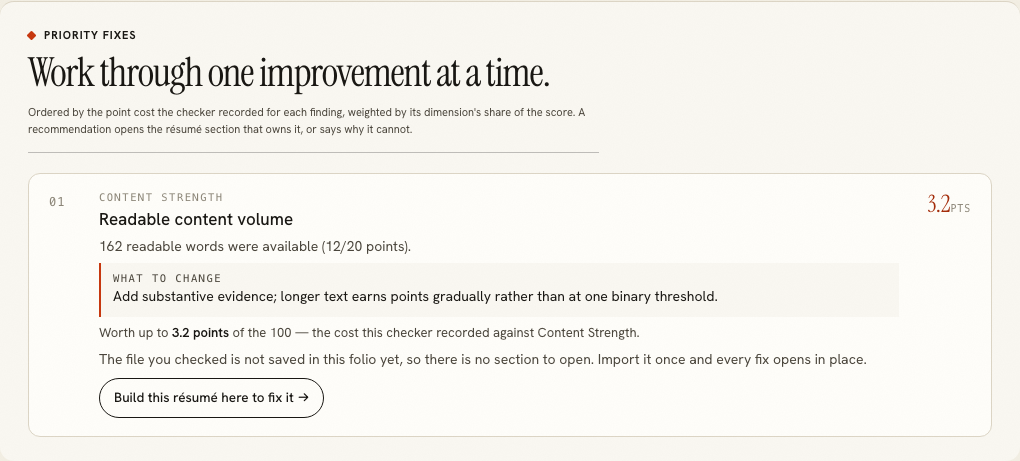
Parseability 100, completeness 100, content 92, published 97, with one improvement left worth 3.2 points. Four of the six priced fixes had been paid for by one structural change, and the ceiling had gone with them. The largest estimate in the list, 12 points for action-led achievements, turned out to be an understatement of what the rewrite was worth, because the ceiling it was sitting under was doing most of the damage.
The history is the audit trail
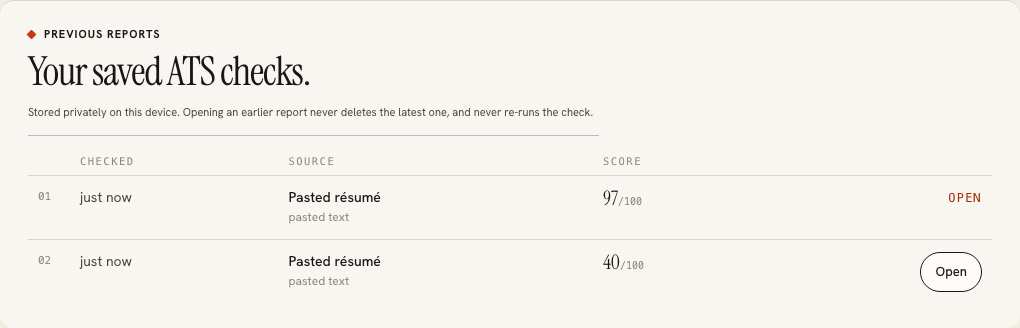
The report's fourth chapter lists the saved checks: numbered, with when they ran, what was checked, and the score. Ours read 97 and 40. The header says what the section will and will not do: stored privately on this device, opening an earlier report never deletes the latest one, and never re-runs the check. So the comparison sends nothing, touches none of the rate limits on the shared endpoints, and stays where you made it.
What actually changed in the document
Nothing about the work. The bullets became bullets, the roles got headings and dates, and the education line came back. That is the whole intervention. It is worth saying clearly because a scoring system that rewards restructuring can look like a system that rewards padding, and the difference here is visible in the counts: 197 words before, 162 after. The shorter document scored 57 points higher, which is the opposite of padding and is explained by the ceilings.
Running the same experiment on your own file
It takes about ten minutes. Check the résumé you already send and leave the report where it is. Read the top two rows of the fix list and note what they are worth. Make only those two changes, in the résumé builder or in your own file, and run the check again.
Then open the earlier report from the history and compare. Two outcomes are useful. If the score moved roughly what the list predicted, the rest of the list is worth working through in order. If it moved far more, you were under a ceiling and the arithmetic line had been saying so all along in two numbers instead of one. If it did not move at all, read the counts: the extraction rather than the writing is where the afternoon should go.
What this cannot tell you
It cannot tell you that the second document performs better in front of a particular employer, because neither we nor anyone else can see that system. It measures readability and evidence in one document against one published set of rules, and it shows its sum, which is the only honest version of this offer. What it did give us was a priced prediction, a change, and a second measurement we could put beside the first. The counts behind both are in what the checker read, and the sum itself in why the checker prints its own arithmetic.
Run it again after the fix
Reports are kept on this device. Open an earlier one to see what a change was worth, without re-running the check.
Open the ATS checkerRead about the ceilingsQuestions
- Where are previous reports stored
- On the device you ran them on. The section says so plainly: stored privately on this device, and opening an earlier report never deletes the latest one and never re-runs the check.
- Does opening an old report cost me a check
- No. It is a stored result, not a new request, so nothing is sent and no rate limit is touched.
- How does the checker price a fix
- By the points that finding cost against its dimension, weighted by that dimension's share of the final score. A completeness finding worth 30 points inside its dimension shows as 9 points of the 100.
- Did the rewrite invent anything
- No. The same four achievements, the same figures, the same two employers. What changed was the heading they sat under and the bullet marks in front of them.
- Will restructuring always be worth this much
- No. Our example started under a ceiling, which is the largest single thing a résumé can be under. A document already scoring in the eighties will move by a few points at most, and the fix rows will say so before you start.
Conxfolio is a free set of four career tools: a résumé builder with 37 rendered layouts, an ATS résumé checker that prints its own arithmetic, a cover letter builder that traces every proof paragraph back to the line it came from, and a portfolio builder with 20 authored designs. There is no account to create, nothing is held back for a paid plan, and no language model is used anywhere in the product, so the readers, the score and the letter are deterministic code you can check.