Photo or no photo, answered with the four public sources that actually disagree
This question has no single answer, and the reason is not that nobody knows. It is that four public bodies have published four different positions, and all four are current.
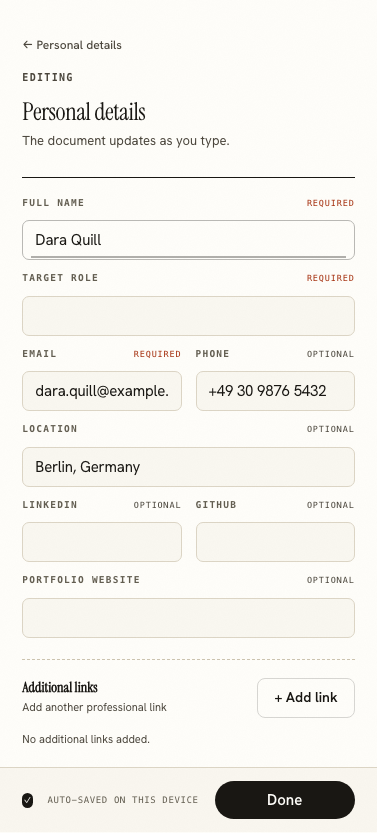
— this builder has no photograph field at all.
Four public bodies, four positions, all of them current. That is the honest state of this question, and it is why advice that opens with a single rule is advice from somebody who has read one country's guidance. The résumé builder settles it for its own documents by not having the field at all.
Germany: no longer required, still customary
The Bundesagentur für Arbeit addresses the photograph twice. On its Lebenslauf page it says "Dies ist kein Muss mehr", it is no longer a must (arbeitsagentur.de). On its application documents page it is more precise about the custom: "keine Pflicht mehr, jedoch in vielen Branchen weiterhin üblich", no longer an obligation but still customary in many sectors (arbeitsagentur.de).
The legal background is the Allgemeines Gleichbehandlungsgesetz, whose §1 names race or ethnic origin, sex, religion or belief, disability, age and sexual identity among the grounds on which disadvantage is to be prevented (gesetze-im-internet.de). A photograph makes several of those visible before a line has been read, which is why the requirement went.
United Kingdom: not among the sections
The National Careers Service sets out what a CV should contain: "Your CV should include a section for your contact details, an introduction, your education history, your work history and references" (nationalcareers.service.gov.uk). A photograph is not on that list. The same page says to leave out age, date of birth, marital status and nationality. Neither of the British sources addresses photographs directly, so this page does not claim they forbid one.
United States: the clearest of the four
Federal equal-employment guidance is direct: "employers should not ask for a photograph of an applicant. If needed for identification purposes, a photograph may be obtained after an offer of employment is made and accepted" (eeoc.gov). That is written to employers rather than to applicants, and it is the strongest signal of the four.
Europass: the outlier
The European Union's own CV format goes the other way. Its quality tips include the advice to "add a professional photograph of yourself" (europass.europa.eu). Where you are filling in a Europass CV, that is the format's own recommendation, and the Europass page covers where the format is expected.
What the product does
There is no photograph field. The gallery has a design family whose name mentions photography, and that refers to its visual character rather than to a portrait slot; the renderer places no image in a résumé. Where a photograph is expected, it is assembled into the application outside this product.
The machine-reading argument, which is weaker than it sounds
An image in a header is sometimes said to break extraction. What the checker here actually penalises is a detected table or multi-column pattern, decorative characters, and a broken-glyph pattern in the extracted text. A photograph on its own is not one of those rules. The real cost of a photograph is the space it takes and the information it gives away, not a parsing failure. The arithmetic is in how the ATS score is calculated.
What a photograph costs the page
Room, mostly. A portrait large enough to be worth including occupies the part of the first page where the summary and the first two achievement lines would otherwise sit, and those are the lines a reader uses to decide whether to continue. On a one-page document that is an expensive trade for a piece of information that answers no question about the work.
The second cost is harder to see and it is the reason the German requirement was dropped: a photograph makes several protected characteristics visible before a line of evidence has been read. That is a matter for the employer rather than for you, and the sources above set out how three jurisdictions have handled it. What is within your control is the page, and on a page where room is scarce the argument for the portrait has to be made on its merits rather than on convention.
The decision
Follow the convention of the country the job is in, and where the sources conflict, follow the posting. Nothing on this page is legal advice, and nothing here predicts what any employer will do with an image. Photo on a résumé by country sets the four positions side by side, and applying in Germany covers the one convention where a photograph is still common.
Build the version without one
Name, role, contact details and links. Free, no account, and nothing is held back behind a plan.
Open the résumé builderRead the photo by country guideQuestions
- Germany
- Not required. The Bundesagentur für Arbeit says of the photo "Dies ist kein Muss mehr", and its application documents page adds that it is "keine Pflicht mehr, jedoch in vielen Branchen weiterhin üblich" (arbeitsagentur.de).
- United Kingdom
- The published guidance does not ask for one. The National Careers Service lists the sections a CV should have and a photograph is not among them, and it says to leave out age, date of birth, marital status and nationality (nationalcareers.service.gov.uk).
- United States
- Advised against. Federal equal-employment guidance says "employers should not ask for a photograph of an applicant. If needed for identification purposes, a photograph may be obtained after an offer of employment is made and accepted" (eeoc.gov).
- Europass
- Its CV quality tips include the advice to "add a professional photograph of yourself" (europass.europa.eu).
- Can I add one in this builder
- No. There is no photograph field in the résumé builder. Where a photograph is expected, it is added to the application outside this product.
Conxfolio is a free set of four career tools: a résumé builder with 37 rendered layouts, an ATS résumé checker that prints its own arithmetic, a cover letter builder that traces every proof paragraph back to the line it came from, and a portfolio builder with 20 authored designs. There is no account to create, nothing is held back for a paid plan, and no language model is used anywhere in the product, so the readers, the score and the letter are deterministic code you can check.