The graduate résumé, and what changes in it during the first six months of work
A graduate résumé is a document with a short half-life. It is written one way to get the first job and has to be rewritten the week after it starts.
— keep the student version. you will want to compare.
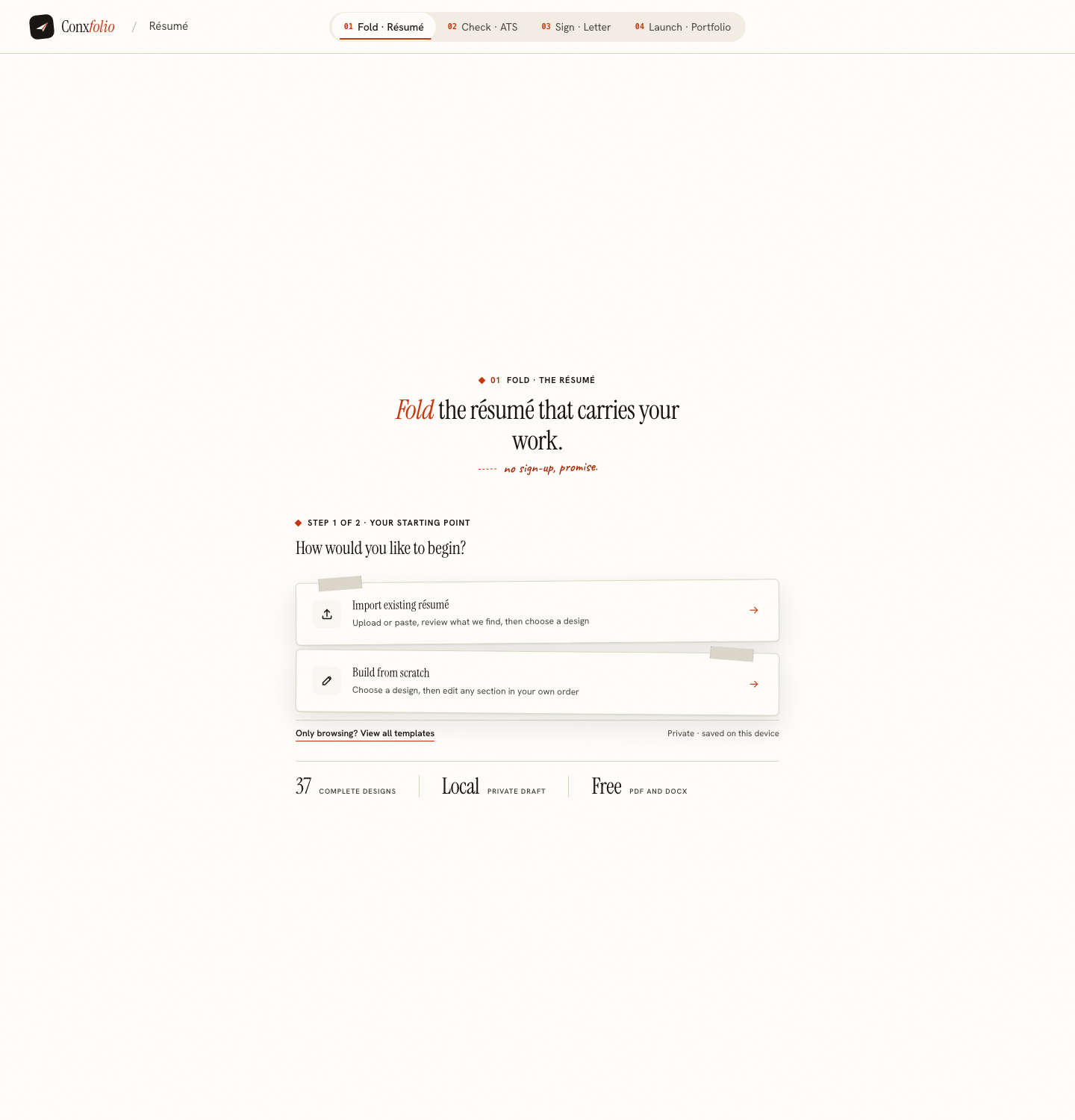
The graduate résumé is the only one that gets rewritten twice in a year. The version that gets the first job leads with a degree. Six months later, the degree is the least interesting line on the page, and the document has to be turned upside down. The résumé builder is built for that second rewrite as much as the first.
Start by importing the old one
The version you applied with is the fastest starting point, because it already contains the dates and the wording you settled on. Paste it or upload it at the first step. The reading sorts it into fields, prints what it found, and reports the fields it could not fill rather than guessing at them. The mechanism is in how the résumé reader works without a model.
Education moves, and the page changes shape
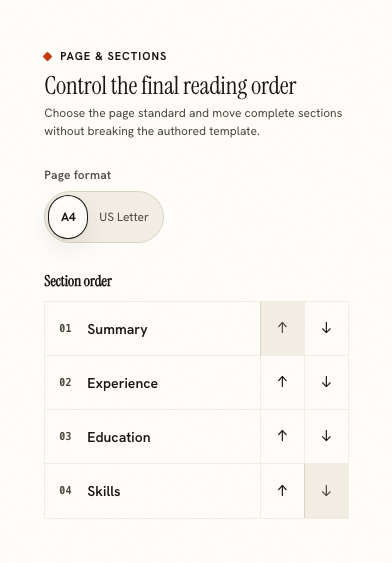
A graduate page usually opens Summary, Education, Experience, Skills. The working version opens Summary, Experience, Education, Skills. That single swap is the six-month rewrite, and the panel above does it without disturbing the layout you chose. The same panel carries the page format, A4 or US Letter, which matters if you are applying across borders.
The section that has to grow
The first job supplies the thing a student page cannot have: several achievement lines under one role. The checker grades that as evidence depth, and it is graded rather than passed or failed. Five or more lines earns the full 25 points of the rule, three or four earns 18, one or two earns 10. A graduate résumé with one line under a real job is closer to the full marks than it feels, and the report prints the count it saw.
What a first-year line should carry
Something you did, said as a thing you did, with a number in it where the number is true. The checker's measurable-evidence rule recognises percentages, money, multipliers and a number followed by a unit noun, and the unit list was widened on 13 September to cover people served or led and things run or delivered, so a line saying you cut a report from two days to four hours registers where one saying you helped with reporting does not. Quantify achievements on a résumé works through the honest versions of this, and action verbs for a résumé covers the opening word.
What to drop, and when
Modules, societies and the part-time job go when the page needs the room and not before. The student version we wrote for the empty student résumé scored 55 and then 75 on the same words on 12 September, and scores 85 on both wordings since the rule behind that gap was corrected, which is a reminder that removing material is rarely the fix. What not to put on a résumé and how long a résumé should be cover the rest of the pruning.
Check it, then check it again in six months
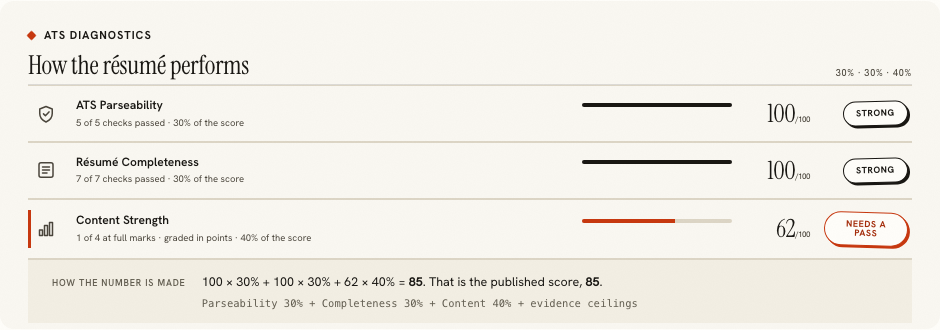
Run the ATS résumé checker on both versions and keep the reports. They are kept in this browser, so the second check sits beside the first and the difference is visible rather than remembered. Previous reports and what a fix was worth shows that view.
What none of this tells you
Whether you will get the job. The checker has no job description, no access to any employer's system and no opinion about your career. It measures a document. Everything else on the page is a claim we do not make, and the arithmetic behind the score is printed so you can see exactly how small a claim it is.
The rest of the application
A first letter is the harder half, because the résumé has one role on it. The cover letter builder selects its proof paragraphs from your own lines and lists what the posting asks for and your evidence cannot support, rather than asserting it. The no-experience letter guide covers the shape, and every design in the résumé gallery and the letter gallery is free, with no watermark on the export.
One practical note about the second rewrite. Keep the student version rather than overwriting it. Applications for graduate schemes and applications for a role you are now doing are different arguments, and a scheme deadline in the autumn will want the earlier page. Versions are kept in the builder when you ask for one, and an export is a second copy that survives a cleared browser.
The other thing that changes in the first six months is the vocabulary. A student page describes what a course covered; a working page describes what a system does and what you changed in it. The words you now use every day at work are the right ones for the page, and they are also the words a posting for your next role will use. That is the whole of tailoring at this stage, and it is covered properly in one résumé or one per job.
Rebuild it around the job you have
Import the version you applied with, then move education down and let the role take the top of the page.
Open the résumé builderRead the first-job guideQuestions
- When should education stop being at the top
- When the work below it is the better argument. The page and sections panel in the design step moves whole sections without touching the design, so you can try both orders and look at the rendered document before deciding.
- Do I remove my degree classification
- Not while it is doing work for you. There is no rule in the product about it, and the checker's education rule looks for a qualification and an institution rather than a grade.
- What does the checker count as evidence depth
- Achievement lines under experience. Five or more earns the full 25 points of that rule, three or four earns 18, one or two earns 10. That is the rule most graduate résumés lose points on in the first year.
- Can I keep two versions
- Yes. The builder keeps versions of a draft, taken when you ask for one, and the export is the other way to keep a copy. There is no account, so a version lives in this browser.
- Does any of this predict whether I will get the job
- No. The checker measures whether the document is readable and evidenced. It is not an employer's system and it makes no prediction.
Conxfolio is a free set of four career tools: a résumé builder with 37 rendered layouts, an ATS résumé checker that prints its own arithmetic, a cover letter builder that traces every proof paragraph back to the line it came from, and a portfolio builder with 20 authored designs. There is no account to create, nothing is held back for a paid plan, and no language model is used anywhere in the product, so the readers, the score and the letter are deterministic code you can check.