A nursing résumé full of numbers, and the rule that could not count them
Clinical work produces numbers that belong to a ward rather than to a person. We wrote a nurse's résumé, checked it here, found the one rule that could not see any of them, and had the rule changed.
— beds, staff and students were not units the rule knew. now they are.
Nils Farrow is invented. His résumé is not unusual: six years on acute medical wards, shift leadership, a handover template he rewrote, eleven students mentored, a falls audit. We put it through the ATS résumé checker to see what a machine would make of clinical evidence, and one result was worth a page of its own.
Zero measurable achievements, on a page of numbers
On 12 September the check read 157 words, 17 lines and four recognised headings, passed fourteen of its checks, gave completeness a full 100 with all seven of its checks passing, and published 100 × 30% + 100 × 30% + 67 × 40% = 87. The priority fixes chapter opened with the reason: no achievements use measurable evidence, nought of a possible 25 points, worth 10 points of the whole score. That is a surprising line to read under a résumé that says eight staff, twenty-eight beds, eleven students, nine passes, fourteen omissions falling to three, twenty colleagues trained.
The rule was the explanation. It recognises a percentage, a currency amount, a multiplier such as 3x, the form 12+ followed by a word, and a number followed by one of a list of unit nouns. That list held thirteen entries: users, customers, clients, hours, days, weeks, months, years, engineers, reports, countries, markets, ms. A ward's nouns were not among them. Neither were a classroom's, which is why the same thing happened in a teacher's outcome lines.
The list was measuring the wrong thing

Two résumés carrying the same amount of countable evidence were getting different numbers, and the thing separating them was the industry the counts came from rather than whether they were counts. The list was rewritten on 13 September around countable outcomes: people served or led, things run, delivered, handled or fixed, the time and reach it already covered, and the scale words a number is written in. A hyphen now counts as the separator too, because 28-bed ward is the ordinary way a clinical page writes it.
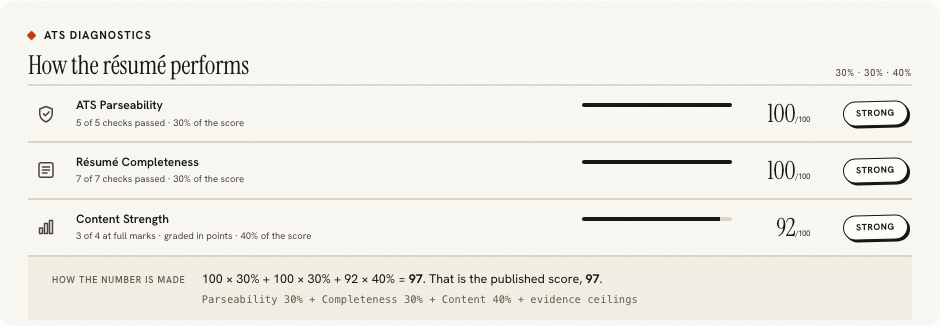
Nothing in that change rewards a bigger number. It lets the rule see a number that was already on the page. The same 157 words now return four measurable achievements and the full 25 of 25, content rises from 67 to 92, fifteen checks pass, and the published score is 100 × 30% + 100 × 30% + 92 × 40% = 97. The one improvement left is readable content volume at 157 words, worth 3.2 points.
What this is, said plainly
The 87 above is kept because it is what this page measured on the day it was written, and because the finding is the useful part. It was a limit of the measurement rather than a judgement of clinical work, and it was never what an employer's system does, because this checker is not one. The report says as much beside the ring: the score estimates compatibility from the structure and evidence it extracted, and it is not a hiring prediction. The arithmetic is printed for the same reason, and it is taken apart in how the ATS score is calculated.
The honest fix, and the dishonest one
The dishonest one is to write a percentage you do not have. Do not, whatever a rule pays for it. The honest one is narrower: write the count you actually have, in the noun you actually use. Eight staff, a 28-bed ward, eleven student nurses and twenty colleagues trained are all real figures and all of them now read as evidence. Where a true proportion or a true duration exists as well, it is worth writing. Where nothing was measured, leave the line alone and lose the points. Quantify achievements on a résumé works through which numbers are safe to claim.
What did score full marks
Action-led achievements, 30 of 30, from six lines that begin with what he did. Evidence depth, 25 of 25, from six achievement lines across two roles. Both scored full marks on 12 September as well, before anything was changed. Those two rules reward the ordinary discipline of writing a ward job down as a sequence of things you changed, and clinical résumés tend to do that well once the shifts are described as work rather than as a rota.
Building it here
The résumé builder takes an import of whatever you have now, prints what the reading found, and leaves a field empty rather than filling it with a guess. Registration details, revalidation dates and mandatory training have no dedicated field; the additional section takes a heading you choose and a list of lines under it. Every design in the gallery is free, 21 of the 37 are marked ATS-safe in the catalogue, and there is no watermark on a PDF or a DOCX.
Bank, agency and rotations
Clinical careers carry shapes the reverse-chronological format handles badly: bank shifts alongside a substantive post, agency placements across several trusts, rotations within one employer. The builder's entries take whatever shape you give them, and the clearest one is usually the employer as the entry with the rotations named in the lines beneath it. That keeps the dates continuous and gives the evidence-depth rule more lines to count, which is the same argument made for contract work in a contractor's CV.
Where bank or agency work runs in parallel with a permanent post, write it as its own entry with the span of years and the trusts named in a line. The parseability rule only asks that the date format is consistent across the page, so the overlap itself costs nothing. What costs something is nine one-line entries where three would have carried the same record with room for evidence underneath.
The letter half
The cover letter builder takes its proof paragraphs from the résumé's own sentences and traces each back to the line it came from, so nothing on the letter is a clinical claim you did not already make. Requirements in the posting your evidence cannot support come back as a list of gaps rather than as assertions, which is the subject of the gaps list is the interview. Nothing in any of it uses a language model, and nothing in it predicts an outcome.
Write the ward evidence down
Import the version you have, or start from a blank sheet. Everything stays in this browser and every design is free.
Open the résumé builderRead the quantifying guideQuestions
- Why did the checker find no measurable evidence on 12 September
- Its rule recognises percentages, currency amounts, multipliers such as 3x, the form 12+ followed by a word, and a number followed by a unit noun. The unit list held thirteen entries, all of them drawn from software work, so a line saying eight staff on a 28-bed ward registered as unmeasured.
- What does the same résumé score now
- 97. The unit list was widened on 13 September to cover people served or led and things run, delivered or fixed, and a hyphen now counts as the separator so 28-bed reads as a count. The same 157 words return four measurable achievements and the full 25 points, with fifteen checks passed.
- Should I invent a percentage to satisfy it
- No. Never write a figure you cannot stand behind. Where a true proportion or a true time exists, write that; where it does not, leave the line as it is and accept the points. The measurement is a readability check, not an employer.
- Does the checker know anything about clinical work
- No. It reads a text. It does not know what a ward is, it uses no job description, and it makes no prediction about any application.
- What about my registration number
- The product has no field for it and makes no claim about it. Put it wherever your regulator or the employer asks; the builder has an additional section you can name yourself.
- Is there anything here for the letter
- Yes. The cover letter builder selects its proof paragraphs from lines already in your résumé and carries each one back to the line it came from, so a clinical claim on the letter is one you already wrote down.
Conxfolio is a free set of four career tools: a résumé builder with 37 rendered layouts, an ATS résumé checker that prints its own arithmetic, a cover letter builder that traces every proof paragraph back to the line it came from, and a portfolio builder with 20 authored designs. There is no account to create, nothing is held back for a paid plan, and no language model is used anywhere in the product, so the readers, the score and the letter are deterministic code you can check.