An engineering résumé is a scope problem, and the page has four places to solve it
Engineering work is easy to describe and hard to size. The difference between a junior page and a senior one is rarely the technology list.
— the stack is the cheapest line on the page.
An engineering résumé fails in a predictable way. It lists what was used and leaves out what was carried. Two people can write the same six technologies and mean a weekend project or a payments platform, and the document that does not say which is the one that gets read twice. The résumé builder has four places where scope can go, and the checker grades two of them.
Scope is four facts
The system, its size, what you owned, and what changed. A line that carries all four sizes itself: rebuilt the settlement pipeline, cutting end-of-day reconciliation from forty minutes to six. A line that carries none reads as a job description. How to write experience bullets has the pattern, and quantifying achievements covers which figures are safe to claim.
What the checker's two content rules count
Evidence depth counts achievement lines under experience: five or more earns the full 25 points, three or four earns 18. Measurable evidence counts the lines carrying a figure the rule recognises, and its list is finite. Percentages, money, multipliers, the form 12+ followed by a word, and a set of unit nouns that includes users, customers, engineers, teams, projects, releases, deployments, incidents, tickets, sites, hours, days, months and years. The list was widened on 13 September, after a nursing résumé showed it was measuring which industry a count came from rather than whether it was a count. Requests per second is still outside it. So is services. The full behaviour, with the sums, is in how the ATS score is calculated.
The links, and where they render
The identity section carries optional fields for LinkedIn, GitHub and a portfolio website, each rendered only when it has a value. Which of them to give is a real decision rather than a formality, and it is worked through in linking a portfolio from a résumé. A repository is evidence for somebody who will open it; a written page is evidence for somebody who will not.
The skills list stops paying
The completeness rule wants at least three distinct skill entries, and our measured examples registered seven and nine. Past that the list earns nothing further and costs the page room that an achievement line would use better. The skills section guide and hard skills and soft skills cover what belongs there.
Columns, tables and what a parser sees
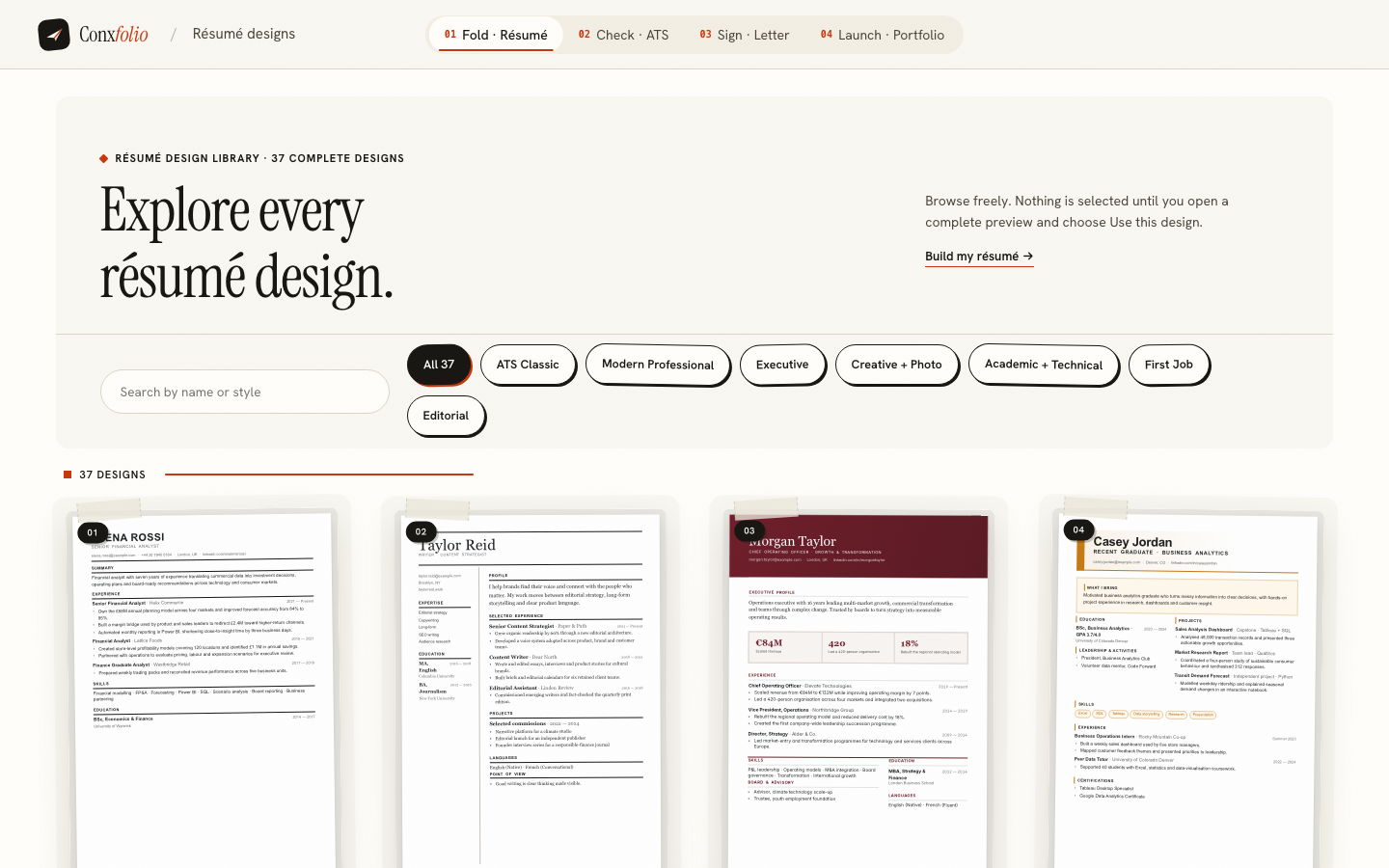
Engineering pages attract two-column layouts, because a skills rail looks efficient. The parseability rule deducts when it detects a table or a multi-column pattern in the extracted text, and the catalogue marks 21 of the 37 designs as ATS-safe for that reason. What ATS-safe means on a design explains what the mark does and does not promise, and single column against two column is the longer version.
Projects when the job title undersells the work
Contract work, internal tooling and open-source maintenance often sit badly under a title. The builder has a projects section and an additional section you can name yourself, and the import will keep both when it finds them. Filing real work under Projects has a cost in the checker's completeness rule, though, which is measured in evidence ceilings explained.
No model, anywhere in it
Engineers ask this first, so it is worth saying plainly. Nothing in Conxfolio calls a language model. The reader that sorts an imported document into fields is deterministic code whose specialists may only quote spans of your own text; the scorer is a set of rules; the letter engine selects sentences rather than writing them. How the résumé reader works without a model goes through the mechanism, and it is part of why the whole product is free with nothing held back.
Then check it, and read the counts
Run the checker and look under the ring at what it read: words, lines, recognised headings. If your two dense sides came back as ninety words, the score is the wrong thing to be reading. The format guide is the fix, and pulling text back out of a PDF shows what extraction does to a rendered document.
A last note on seniority, because it is the thing the page is really arguing about. Junior evidence describes a task completed. Mid-level evidence describes a system owned. Senior evidence describes a decision made under constraint, and the constraint is the part that gets left out. Chose Postgres over a queue because the team was three people and the recovery story mattered more than the throughput is a sentence only one kind of engineer can write, and it is worth more than any list of technologies.
None of that is visible to the checker, which grades readability and evidence rather than judgement. It is visible to the person on the other side of the table, who is the reader the page is actually for. Write for them, then run the check to make sure the document survives extraction, and treat the two as separate jobs.
Put the scope on the page
Import what you have and correct it section by section. Free, no account, PDF and DOCX with no watermark.
Open the résumé builderRead the developer portfolio guideQuestions
- Where do GitHub and a portfolio go
- The identity section has optional fields for LinkedIn, GitHub and a portfolio website, and it renders a link only when you provide one. You can add further named links beside them.
- How many skills should the list carry
- Enough to be true. The checker counts distinct skill entries and wants at least three for the completeness check; beyond that the list stops earning points and starts costing space.
- Does a two-column layout hurt extraction
- It can. The parseability rule deducts when it detects a table or a multi-column pattern in the extracted text, which is why the catalogue marks the designs it considers ATS-safe.
- What counts as measurable evidence
- Percentages, currency amounts, multipliers such as 3x, the form 12+ followed by a word, and a number followed by a unit noun. The list includes users, customers, engineers, teams, projects, releases, deployments, incidents, tickets, sites, hours, days, months and years. Requests per second and services are not on it.
- Does any of this involve a model
- No. The reader, the scorer and the letter engine are deterministic code, with no provider, no key and no network call to a model anywhere in the product.
Conxfolio is a free set of four career tools: a résumé builder with 37 rendered layouts, an ATS résumé checker that prints its own arithmetic, a cover letter builder that traces every proof paragraph back to the line it came from, and a portfolio builder with 20 authored designs. There is no account to create, nothing is held back for a paid plan, and no language model is used anywhere in the product, so the readers, the score and the letter are deterministic code you can check.