A student résumé with no paid jobs on it, run through our own checker
The first résumé is written by somebody who has never been paid for the work it describes. Here is what this product did with one, including the twenty points that used to move when a single word changed place.
— the page is not empty. our own reader was misreading one line of it.
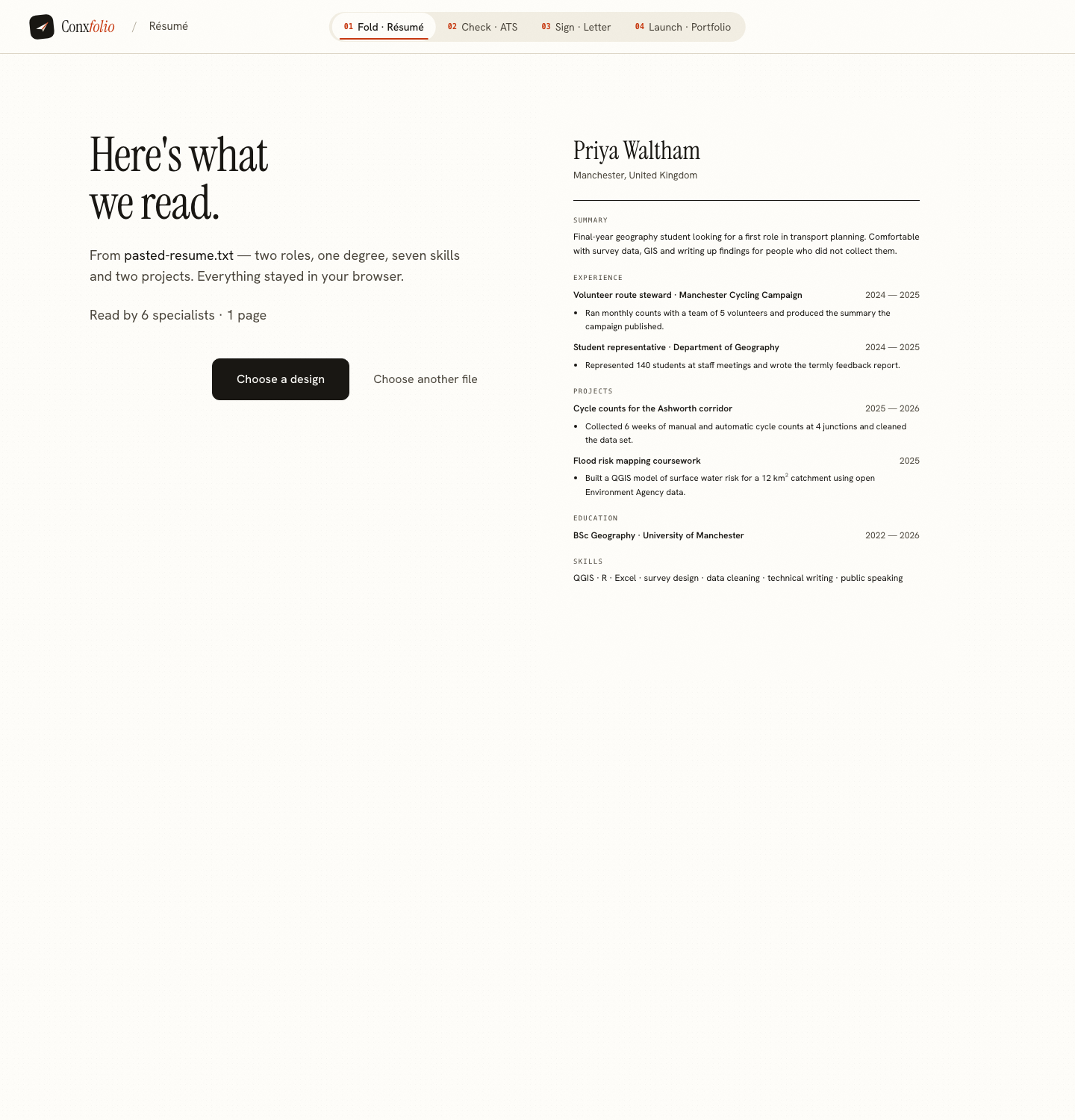
Priya Waltham does not exist. We invented her so that we could write the résumé a final-year student actually has to write: a dissertation, a piece of coursework, two unpaid roles, one degree and seven skills. No employment. Then we put it through the résumé builder and the checker and photographed what came back.
What the reading found

Six specialists ran over one page. The review then showed each section it had built, and said plainly where it had found nothing rather than filling a field in. That behaviour is the whole point of the import, and it is set out in what the import review catches.
The check, and the sum it printed on 12 September
We ran the same text through the ATS résumé checker. It read 169 words, 19 lines and five recognised headings, and it printed its arithmetic: 100 on parseability, 70 on completeness, 12 on content, giving 56, published as 55 because a ceiling applied. Eleven checks passed. Five improvements were listed with a point cost on each.
The section that was not there
The failed completeness check said it in the report's own words: no experience section with role, dates or achievement evidence was detected. That is a strange thing to read on a page with an EXPERIENCE heading and two roles under it. Both roles had dates. Both had an achievement line.
The cause was one word. The first line under the heading began with Volunteer, and the checker's section rule was treating a line opening with that word as the start of a new section. Everything below it was filed elsewhere, so the Experience section the scorer looked at was empty, and the three content rules that read experience lines had nothing to read. Content scored 12 out of 100, all of it from readable volume.
One word moved, twenty points
We rewrote that line as a role with the status in brackets afterwards and ran the check again. Completeness went from 70 to 100, content from 12 to 37, and the ceiling lifted. The published score went from 55 to 75 on the same 169 words, the same 19 lines and the same five headings. Two documents that said the same thing about the same work were being given different numbers, and the difference belonged to our rule rather than to the writing.
So the rule was changed, and the page was measured again

A heading is a label, and the rule now asks structurally whether a line is one. A line carrying dates, or entry separators between its own words, or a verb clause after the label, is an entry rather than a heading, whichever word it begins with. Volunteer route steward, Manchester Cycling Campaign, 2024 to 2025 fails that test on two counts, so it stays inside Experience where it was written.
Re-measured on 13 September, the original text scores 100 × 30% + 100 × 30% + 62 × 40% = 85. So does the version with the role written first. So does the version with the Experience block moved above Projects. Thirteen checks pass, three improvements remain, and the 169 words, 19 lines and five headings are unchanged throughout.
What that does and does not mean
The finding was real and the repair is the honest end of it. The score that stands today is 85, and the 55 above is kept because it is what this page measured when it was written. None of it is a claim about any employer. The checker here is a readability and evidence measurement of a text, it uses no job description, and it says on its own face that it is not a hiring prediction. What the experiment left behind is narrower and more useful: a student page is full of roles that do not look like jobs, so it is the page most likely to expose a reader's assumptions, which is why it is worth running.
The three fixes that remain, with prices
The report orders them by what each is worth. Action-led achievements, 2 detected of a possible 30 points, worth 6 points of the whole. Evidence depth, 2 experience achievement lines, worth another 6. Readable volume at 169 words, worth 3.2. Measurable evidence already scores its full 25, on two lines carrying figures. That ordering is the difference between a list and advice, and it is explained in how the ATS score is calculated. Two of the three are the same instruction in different clothes: write more of the entries as lines that start with something you did.
What the builder will not do for you
It will not invent a job. A field the reading could not fill stays empty, and a specialist may only quote a span of your own document. It will not claim a skill on your behalf in a letter either, which is covered in why a cover letter only claims what the résumé shows. Nothing here predicts an outcome, and no page on this site will tell you a document gets anybody hired.
Writing yours
Start in the builder with what exists: coursework with a scope, a society role with a number of people in it, a placement, a shift job. Give each one a title first. Put the dates on. Write one line per entry that begins with what you did. Then run the checker and read the counts it printed rather than the ring. The no-experience guide and relevant coursework on a résumé go through the sections one at a time, and the first-job guide covers what to leave off. Every design in the gallery is free, including the 21 the catalogue marks ATS-safe out of 37.
One more thing the experiment settles. We also moved the whole experience block above the projects block, changing nothing else, and the score did not move at all, on either day. It was 55 alongside the unrewritten run on 12 September and it is 85 alongside both runs today. Section order was never the variable. That is a useful correction to the common advice that a student page should be rearranged to please a parser, and the measurement behind it is in skills first or experience first.
What we would say to a student writing this page for the first time is narrower than most advice on the subject. Give every entry a title, a date range and one line that starts with a verb. Put a number in the line where a number is true and leave it out where it is not. Run the check, read the counts it prints rather than the ring, and fix the finding with the largest price on it. That is a twenty-minute loop, it is free, and it does not require you to believe anything about how employers read documents.
Start the one you have to write
Import what you have written already, or begin from a blank sheet. No account, and the document stays in this browser.
Open the résumé builderRead the no-experience guideQuestions
- Does coursework count as experience
- It counts as evidence. Our student page carried a dissertation and a mapping project under Projects, and the reading kept both with their dates and their lines. What the checker's completeness rule wanted separately was an Experience section with a role, dates and achievement lines under it.
- Does it matter whether a line begins with the word Volunteer
- It did, and it no longer does. On 12 September a line opening with that word was read as the start of a new section, which left the Experience section empty and held the score at 55. The heading rule was changed on 13 September and the same document now scores 85 whether the line begins with the word or with the role.
- What does the page score today
- 85. Parseability 100, completeness 100, content 62, with thirteen checks passed and three improvements left. All three of the phrasings we tested return the same 85 on the same 169 words.
- Is a low score a judgement of my work
- No. The score measures whether a document is readable and evidenced. It is not an employer's applicant tracking system, it uses no job description, and it predicts nothing about an application.
- Should I invent something to fill the page
- No. The builder will not invent work for you either: a field it could not read stays empty. A short honest page is worth more than a padded one, and the checker's volume rule awards points gradually rather than at one threshold.
- Do I need an account to try this
- No. There is nothing to sign up for, and the work is kept in this browser. The only part of Conxfolio that asks for an email address is claiming an address for a published portfolio.
Conxfolio is a free set of four career tools: a résumé builder with 37 rendered layouts, an ATS résumé checker that prints its own arithmetic, a cover letter builder that traces every proof paragraph back to the line it came from, and a portfolio builder with 20 authored designs. There is no account to create, nothing is held back for a paid plan, and no language model is used anywhere in the product, so the readers, the score and the letter are deterministic code you can check.