A teacher's résumé, and the three points a fourteen-word summary cost it
Teaching produces outcomes that belong to a class, a cohort and a department at once. We wrote one teacher's résumé and checked it, and the report found two things worth knowing. One of them was our own fault.
— a heading called summary is not a summary until it has words in it.
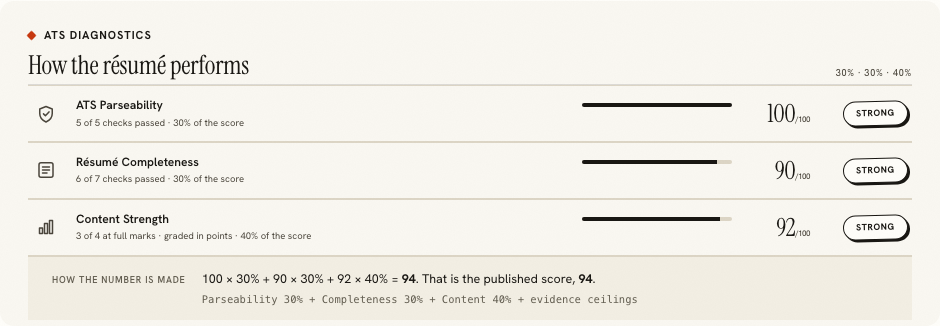
Maren Ostberg is invented. Her résumé is a second in department's: a rebuilt scheme of work, four teachers line-managed, a retrieval routine across nine classes, a maths club that grew. We ran it through the ATS résumé checker and photographed the report.
Ninety-four, and where the six go

Parseability 100. Completeness 90. Content 92. Fourteen checks pass, including 94 words of experience evidence, four action-led achievements at full marks and five achievement lines at full marks for depth. Two findings remain, each with a price on it: readable content volume at 147 words, worth 3.2 points, and the summary, worth 3.
When this page was first published on 12 September the same document scored 89, with content at 79. The difference is one rule, and the section below keeps both numbers because the reason it moved is the useful part.
The summary that was not a summary
The completeness rule lost exactly ten of its hundred, and the report named the check: no substantive professional summary was detected, worth three points of the whole score. The document had a SUMMARY heading with a sentence under it. The sentence was fourteen words. The rule wants an introduction of substance, and its own advice on the fix says roughly twenty to sixty words.
This is worth knowing because the trap is invisible. A heading looks like a section. The summary guide has the shapes that work, and objective or summary covers whether to carry one at all.
One measurable line out of five, and then four
On 12 September the first fix on the list was measurable evidence: one achievement uses measurable evidence, twelve of a possible 25 points, worth 5.2 points of the whole. The line that counted was the one carrying a percentage, where the proportion reaching the expected standard rose from 54% to 71%. The line about a club growing from seven pupils to thirty-four did not count, because pupils was not one of the unit nouns the rule recognised. Neither was classes, so two more outcome lines went unread.
That was a fault in the rule rather than in the writing, and it was the same fault a ward résumé exposed on the same day, which is set out in a nursing résumé full of numbers. The unit list was rewritten on 13 September around countable outcomes, pupils and classes among them. The same document now shows four measurable achievements and the full 25 of 25: the percentage, the nine classes, the six classes and the thirty-four pupils. Do not manufacture a percentage to satisfy any rule. Write the count you have, in the noun you use.
What a teaching outcome line looks like
Start with what you did, then say what moved, then say over what period. Rebuilt the Year 10 scheme of work; the proportion reaching the expected standard rose from 54% to 71% over two years. That single sentence carries an action, an outcome, a figure and a timescale, and it is the reason the action-led rule scored full marks on this page. How to write experience bullets takes the pattern apart.
What the product does with all this
The résumé builder imports what you have, prints what the reading found and leaves a field empty rather than inventing one. Pastoral roles, examiner work and subject leadership go in as additional sections with a heading you choose. The design step moves whole sections without touching the layout, so a second in department can put experience above education without rebuilding the page.
Two documents, one set of evidence
The cover letter builder reads the same résumé and selects its proof paragraphs from its sentences, carrying each back to the line it came from. A school's person specification usually asks for things a résumé cannot evidence, and those come back as a list of gaps rather than as claims. That behaviour is described in why a cover letter only claims what the résumé shows.
The sections a teaching page needs that the default does not have
The builder opens with summary, experience, education and skills. A teaching page usually wants two more: the subjects and key stages taught, and the responsibilities held beyond the classroom. Both go in additional sections whose headings you name yourself, and both can be moved in the page and sections panel so they sit where a head of department would look for them.
Safeguarding training, examiner work, subject leadership and pastoral roles are the material most often left off a teaching résumé and most often asked about in an interview. They are evidence, and they belong on the page with a date beside them. What the product will not do is decide which of them matters for the post you are applying for; that judgement is yours, and tailoring a résumé to a job goes through how to make it quickly.
The limits, plainly
This checker is not a school's applicant system, it uses no job description, and it predicts nothing. No page here will tell you a document gets anyone a post. What it will do is print the counts it read and the arithmetic it used, and the Parseability 30% + Completeness 30% + Content 40% + evidence ceilings string it returns with every response is the same one the report prints. Every design in the gallery is free and the exports carry no watermark.
Write the department down
Import what you have, correct the sections, and export a PDF or a DOCX. Free, no account, no watermark.
Open the résumé builderRead the summary guideQuestions
- Why was a summary section not detected
- The rule wants a substantive introduction rather than a heading. Our teacher's summary was fourteen words, and the check reported that no substantive professional summary was detected. The report priced the finding at three points of the hundred.
- How long should the summary be
- The report's own advice is roughly twenty to sixty words. That is a checker's guidance rather than a convention, and there is no rule in the product forcing you to have one at all.
- Why did only one line count as measurable on 12 September
- The measurable-evidence rule recognises percentages, currency, multipliers and a number followed by a unit noun. Pupils and classes were absent from that list, so only the line carrying a percentage registered. Both were added on 13 September and the same page now shows four measurable achievements and the full 25 points.
- Does the checker understand school data
- No. It reads the text of a document. It has no job description, no knowledge of any school, and it makes no prediction about an application.
- Can I keep a separate version for independent and state applications
- Yes, by keeping versions in the builder or by exporting each one. Everything is kept in this browser and there is no account.
Conxfolio is a free set of four career tools: a résumé builder with 37 rendered layouts, an ATS résumé checker that prints its own arithmetic, a cover letter builder that traces every proof paragraph back to the line it came from, and a portfolio builder with 20 authored designs. There is no account to create, nothing is held back for a paid plan, and no language model is used anywhere in the product, so the readers, the score and the letter are deterministic code you can check.