Changing career, and a letter that argues from lines you have already written
A career change letter is asked to do something a résumé cannot: explain why work in one field is evidence for another. Most of them do it by asserting. This one selects.
— the gaps are the honest half of the letter.
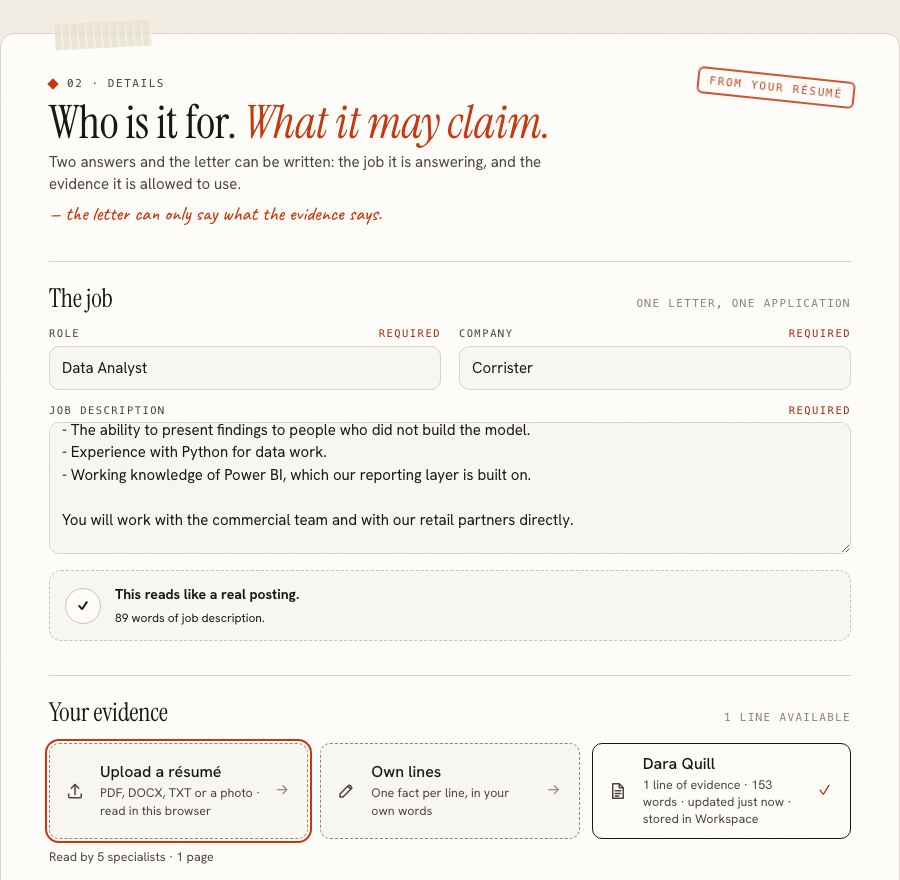
Dara Quill is invented: eight years running retail shops, moving into data analysis. We wrote her a posting at an invented company that asked for two things her résumé cannot evidence, then used the cover letter builder on it and photographed the result. The interesting part of a career change letter is what it refuses to say.
Two answers, then the letter
The role, the company, the posting, and where the evidence comes from. That is the whole input. The step says on its face that the letter can only say what the evidence says, which is the rule the rest of it follows.
What it selected
Three evidence paragraphs, each a sentence from Dara's own résumé, carried with the line it came from. Her rebuilt stock forecast, her reporting to three directors, her training of eighteen supervisors. Those are retail lines being used as analysis evidence, which is exactly the move a career change letter has to make, and the letter makes it by quoting rather than by claiming.
What it refused to say

The posting asked for Python and for Power BI. Neither is on the résumé. The review returned both as requirements the evidence cannot support, none claimed, and the letter did not mention them. A generated letter would have written a sentence about being keen to develop those skills, which is the sentence every reader has learned to discount. The gaps list is the interview covers what to do with the list instead.
The review, and the numbers on it
Nothing blocked the export. Two notes were guidance rather than gates. 71 words, Classic design, three evidence paragraphs, the opportunity named as Data Analyst at Corrister, and a note that the letter carries the figures 3, 18 and 24, all of which appear in the evidence it drew from. On reading length it said 140 to 420 words is a useful guide rather than a rule, which is a more honest thing for a checker to say than a red cross.
Seventy-one words is a starting point
A first draft of 71 words is short because the evidence it was allowed to use was short. The letter is not finished at that point. Every block is an editable field with its own word count, proof paragraphs can be added, removed and reordered, and changing the voice rewrites the whole letter while keeping the previous draft as a version. The engine's job is to stop you claiming things; the writing is still yours.
Where the reason for the change goes
In the optional field for what only you know, in your own words. The engine will not invent a motivation, and this is the field that exists because of that refusal. One honest paragraph about why the move, sitting among three paragraphs of proof, is the whole argument of a career change letter. The career change letter guide has the structure.
The résumé underneath it
The letter is only as good as the lines it can select from, so the résumé is the real work. A changer's page has to make old evidence legible to a new reader, which is the subject of the career change résumé guide and tailoring a résumé to a job. Build it in the résumé builder, then come back.
What is not claimed
Nothing here predicts what a letter does to an application, and no page on this site says a document gets anyone hired. No language model is involved at any point, in either the reading or the writing, which is why every sentence in the letter can be traced to a line you wrote. What evidence tracing looks like shows the trace itself.
Two more things the review reported that are worth knowing. It said the posting read like a real posting, at 89 words of job description, which is a check on the input rather than on the letter: a three-line posting produces a thin match because there is little to match against. And it named the evidence source with its own reading, five specialists over one page, so the letter's raw material is visible before a word is written.
The pattern for a career changer is therefore mechanical rather than mysterious. Get the résumé's achievement lines into the shape where an analyst's posting can match them, paste the posting, read what was selected and what came back as a gap, and then write the one paragraph the engine refuses to write. If the selection is poor, the résumé is the thing to fix, and the measurement on a student page shows how much a single badly shaped line can cost.
Write the letter from your own lines
Paste the posting, point it at your résumé, and read what it selected. Free, no account, PDF and DOCX export.
Open the cover letter builderRead the career change letter guideQuestions
- Does it write the letter for me
- It selects. Every evidence paragraph is a sentence from your own résumé, carried with the line it came from so the surface can show where it is from. There is no model involved at any point.
- What happens to requirements I cannot evidence
- They come back as gaps and are never asserted. Our invented changer's posting asked for Python and Power BI, and the review listed both as requirements the evidence cannot support, none claimed.
- Can I say why I am changing career
- Yes, in the optional field for what only you know, in your own words. The engine will not invent a motivation for you.
- Can I edit the letter afterwards
- Yes. Every block of the letter is an editable field with its own word count, and proof paragraphs can be added, removed and reordered.
- How long was the letter it produced
- 71 words, before any editing. The review said so and called the 140 to 420 range a useful guide rather than a rule, which is the honest description of it.
Conxfolio is a free set of four career tools: a résumé builder with 37 rendered layouts, an ATS résumé checker that prints its own arithmetic, a cover letter builder that traces every proof paragraph back to the line it came from, and a portfolio builder with 20 authored designs. There is no account to create, nothing is held back for a paid plan, and no language model is used anywhere in the product, so the readers, the score and the letter are deterministic code you can check.