How to turn a résumé into a portfolio website
The material for a portfolio is already written. It is in the roles, projects and outcomes on your résumé, filed in a shape built for paper rather than for a page.
— nothing here is invented. You switch things on.
A résumé and a portfolio page contain the same facts in different shapes, and each is better at a different job. The résumé is a record, ordered by time, compressed for a reader with ten seconds. The page is an argument, ordered by importance, with room for a sentence about what changed. Turning one into the other is mostly a question of re-filing.
Which is why the builder here starts from the document you already have rather than an empty form.
Step 01: choose the world
The portfolio builder opens on a gallery of 20 designs, grouped into 6 directions: Minimal, Editorial, Technical, Cinematic, Expressive and Modern. Each is a complete authored page rather than a theme with your colours dropped in, so the card you are looking at is the page you will get.
Opening a card fills the screen with the design at full size, with a desktop and a phone switch and arrows to walk through the set. Choosing one takes a click, and the product says what is true: pick one, you can change it later. Switching design later rewrites nothing you wrote.
Step 02: your details
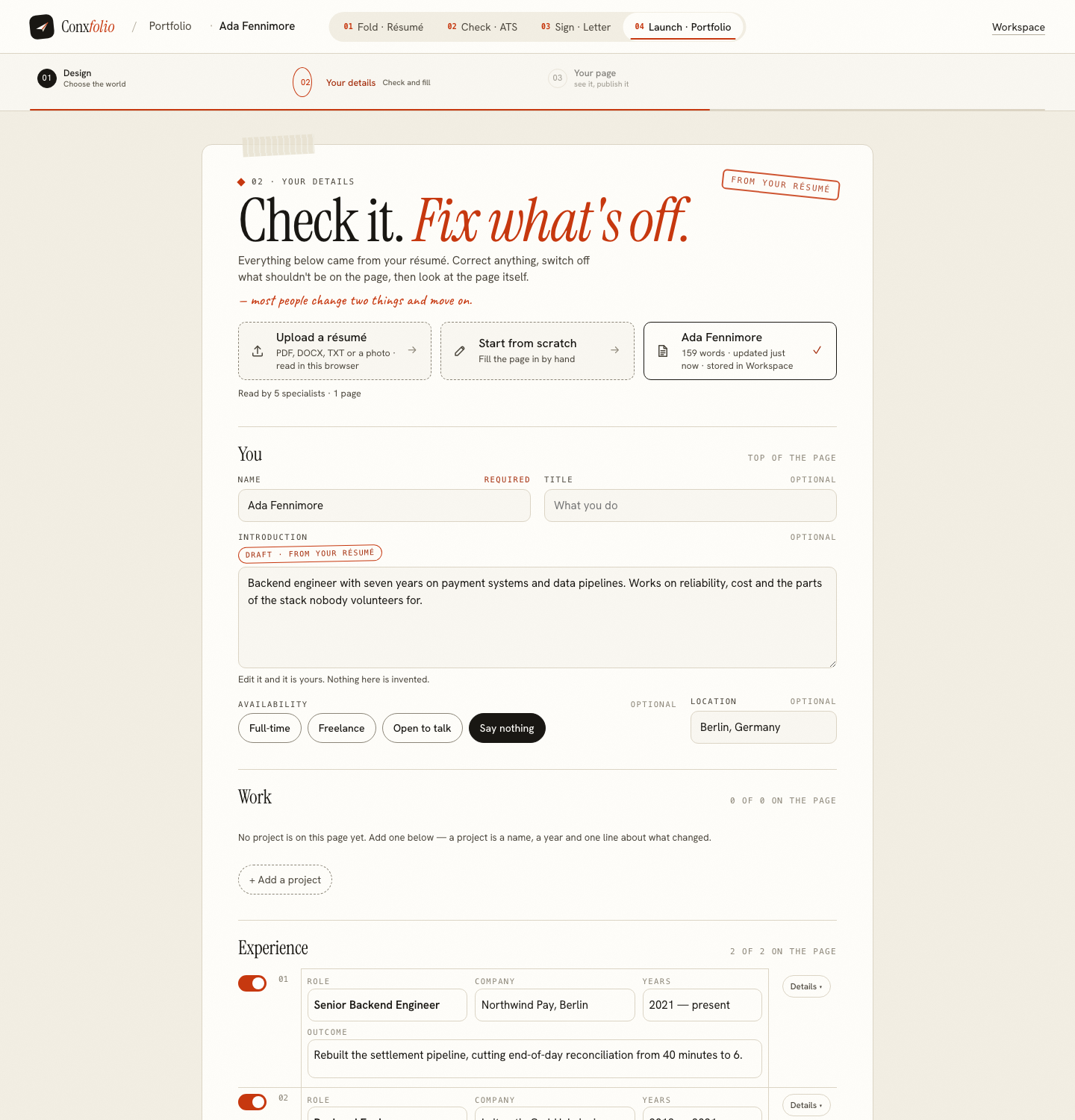
The second step is a sheet, and it arrives filled. The instruction at the top is "check it, fix what's off", and underneath it says everything below came from your résumé, that you should correct anything, switch off what should not be on the page, and then look at the page itself.
- You: name, an optional title, an introduction, an availability setting and a location.
- Work: your projects. The sheet defines one as a name, a year and one line about what changed.
- Experience: role, company, years and the outcome, with a details panel per entry.
- Skills, as chips you remove or add.
- More: education, certifications and languages, each with what it says on the page.
- Contact: email, phone and links, with a note that empty ones do not print.
Each section carries a counter of how many of its entries are actually on the page, so the sheet is also an inventory. The draft is marked as coming from your résumé and the sheet states that nothing in it is invented.
Step 03: your page
The third step opens the real page over the builder, at desktop or phone width, with the design's own name on it. This is the page itself rather than a preview image, which is the point: what you approve is what publishes. The phone half of that switch matters more than it sounds, because it is the width most first visits arrive at.
Publishing
Publishing opens over the page and asks for two things before it will go live. The first is an address: you type the handle you want, and the rules are stated on the sheet as lower-case letters, digits and dashes, between 3 and 63 characters. The second is an email address, which receives a one-time code to prove the claim is yours. The sheet notes that the page is private and noindexed until you press publish.
That email is the only thing in this product that asks for one. Everything before it, including every design and both widths, works with no account at all. Choosing the address goes through what makes a good handle.
What to change while you are in the sheet
Two things are usually worth the time. The first is the outcome line on each role, because a portfolio page gives it more room than a résumé bullet did, and one sentence about what changed is worth more than three about responsibilities. The second is switching things off. A page that shows everything is a résumé with pictures; a page that shows four things is a portfolio.
If the underlying material is thin, the fix is upstream. Writing the résumé properly improves both documents at once, because the page is reading from it.
What this does not do
It does not write your entries and it does not add projects you have not done. It has no view on whether a page gets you work. What it does is take material you already wrote, put it into a page somebody designed by hand, and let you look at the result at both widths before anybody else can.
What to do before you start
Spend five minutes deciding what the page is for. A page aimed at one kind of role is a page that can leave things out, and leaving things out is the only editorial power a portfolio has. A page aimed at everybody keeps everything and argues nothing.
The practical form of that decision is a sentence you write for yourself and never publish: this page exists to convince a particular kind of reader of a particular thing. Every later choice about which entries to switch off answers to it, and the choices get faster because the criterion already exists. Without it the details sheet becomes a list of everything true about you, which is a document you already have.
Start from the design
Open a design full screen at desktop and phone width, use it, and the details sheet arrives filled from the résumé you already have.
Open the portfolio builderSee the 20 designsQuestions
- Do I need to write anything new
- Not to get a page. The details sheet arrives filled from the résumé, and the work is correcting entries and switching off what does not belong. Most people change two things and move on, which is what the sheet says at the top.
- Does it invent projects or descriptions
- No. The sheet states it plainly under the introduction: the draft comes from your résumé and nothing here is invented. A field it could not read stays empty for you to fill.
- Do I need to code
- No. The 20 designs are complete hand-built pages, and choosing one is the whole of the design work.
- Does it cost anything
- No. Every design, both widths and publishing are free. The only thing publishing asks for is an address and a one-time code sent to an email address.
- Can I take the page down again
- Yes. A published page can be unpublished from the same session that claimed it.
Conxfolio is a free set of four career tools: a résumé builder with 37 rendered layouts, an ATS résumé checker that prints its own arithmetic, a cover letter builder that traces every proof paragraph back to the line it came from, and a portfolio builder with 20 authored designs. There is no account to create, nothing is held back for a paid plan, and no language model is used anywhere in the product, so the readers, the score and the letter are deterministic code you can check.