Each of the 20 portfolio designs is a page, not a preset
The word template usually means a grid with your content poured into it. These are complete pages that were drawn before anybody's content arrived.
— a preset is configuration; a page is a decision.
Template is doing a lot of work in this industry. It is used for a stylesheet, for a layout with slots, for a colour scheme, and occasionally for an actual designed page. When every option in a gallery is generated from one page, the gallery is a settings screen with pictures.
The 20 designs behind the portfolio builder are each a page somebody drew.
How you can tell from the outside
Open two of them. A preset system reveals itself immediately: the hero is in the same place, the project cards are the same cards, the scroll behaves the same way, and the differences are colour and type. An authored set does not survive that test, because the pages disagree about where a career should start, how a role should be shown, and whether the page should move at all.
What the full-size view gives you
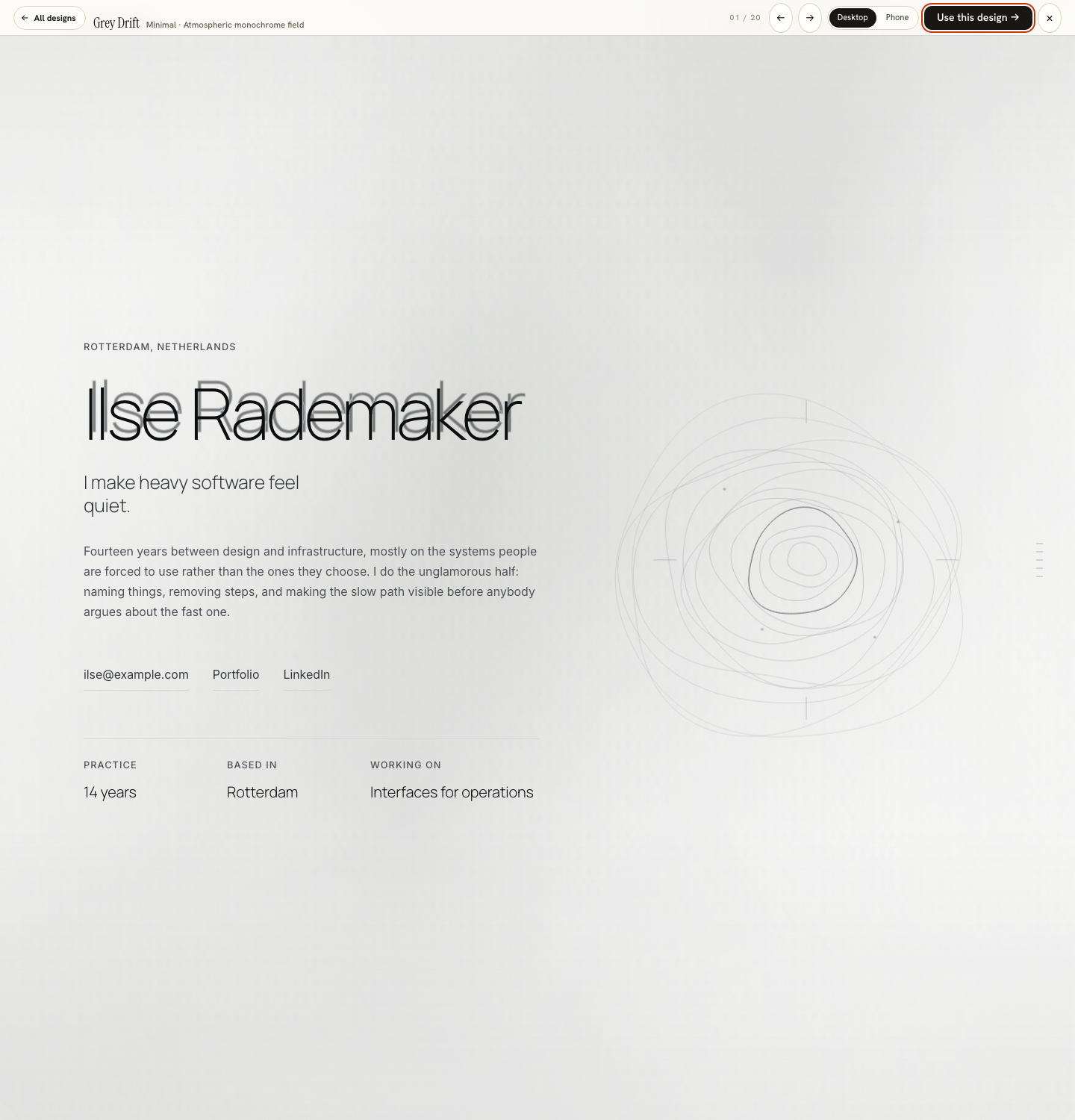
Opening a design fills the screen with the whole page. Across the top: the design's name, its direction, its one-line description, a position out of 20, arrows to the next and previous design, a Desktop and Phone switch, and a button to use it. You can read the entire set without returning to the grid, which is the only way anybody actually compares twenty pages.
The people in them are invented, and said to be
Each sample page carries a different fictional person with a location, a line about their practice and a short biography. They exist so the typography has something true-shaped to hold. None of them is a customer, none is a testimonial, and none of them was hired by anybody, because there is nobody there.
It also constrains what can be promised. A preset system can advertise any number of options, because options are cheap to generate. A set of pages can only advertise the pages that exist, which is why the count on the gallery comes from the registry that renders them rather than from a line of marketing copy, and why it changes when a design is parked.
What authoring costs
Everything is slower. A new design is a new page rather than a new row in a configuration file, a change to the shared renderer has to be checked against every page, and the set cannot grow to two hundred options. That last part is the trade worth making: twenty pages that disagree with each other are more useful than two hundred that do not.
What it gives you
A page that has a point of view before your content arrives, which means your content arrives somewhere rather than into a container. It also means the preview is honest, because there is no gap between the design system and the rendered result, as described in the poster and the page agree.
How the set is ordered
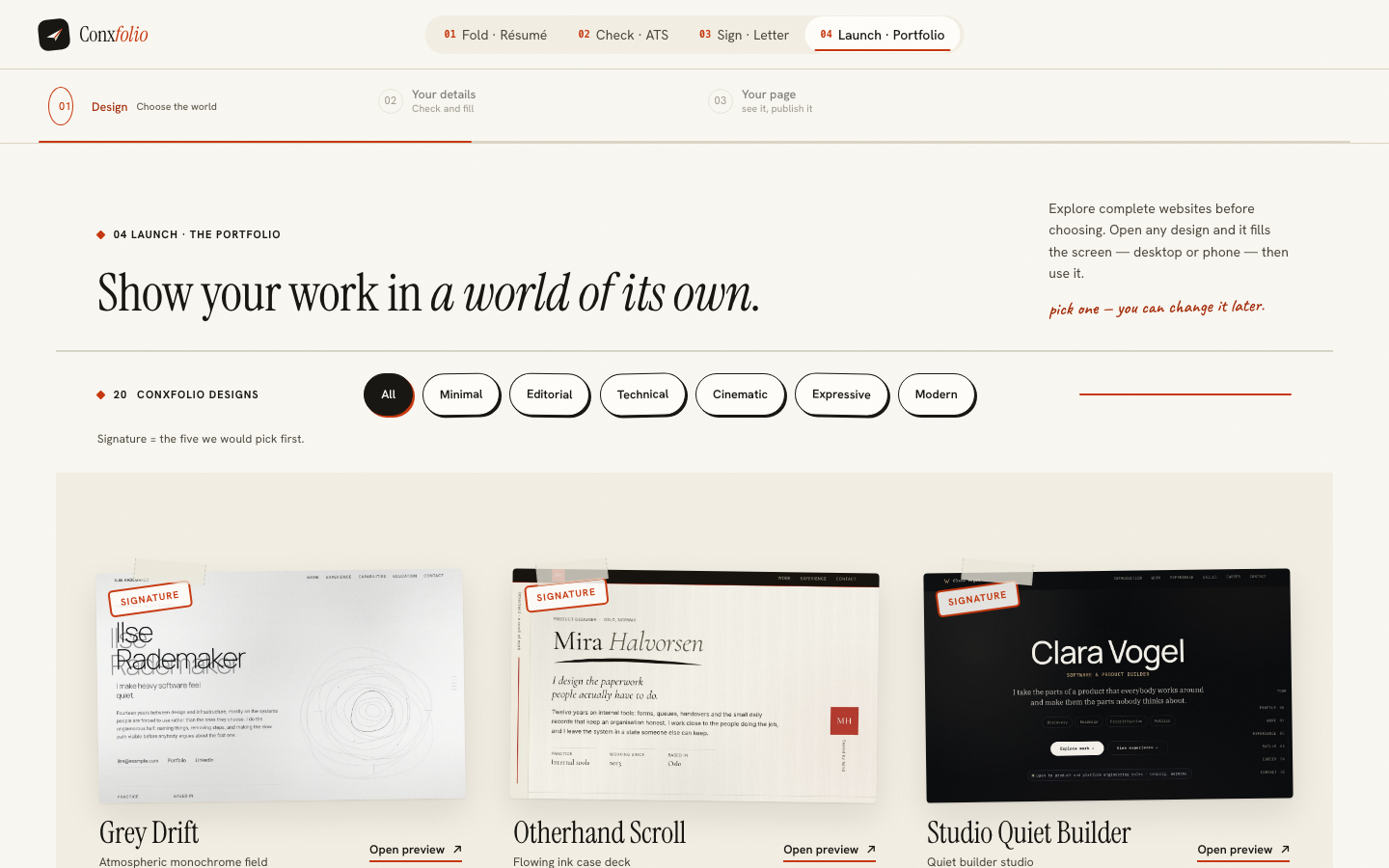
The gallery is not alphabetical and it is not sorted by popularity, which in most products means whatever the product wants to sell. It is ordered by a judgement, and the gallery says so: a note under the filters explains that the signature mark is the five we would pick first. The numbering on the cards follows the same order.
Stating a preference out loud is more useful than hiding it behind a neutral-sounding sort, because it can be disagreed with. The first five are a starting point for somebody who has no opinion yet and wants a good page in ten minutes. Everybody else should use the directions, and the ordering becomes irrelevant the moment you have filtered to the four designs that could carry your work.
The limit to be clear about
An authored page has a shape, and your material has to fit it. A design built around four case panels will look sparse with one project, and a design that leads with a portrait expects a portrait. That is not a fault in the design, it is what having a design means, and it is why the gallery shows the whole page rather than a promise. The directions the twenty are grouped into, and how to find your half of the room, are in designing twenty portfolio worlds.
Open one full size before you decide
Every design opens as a whole page, with a Desktop and Phone switch and a counter telling you where you are in the 20.
Open the portfolio builderBrowse the portfolio designsQuestions
- What makes a design authored rather than a template
- It has its own structure, typography and motion, written for that page, instead of being one shared layout with different variables. Two designs in the same direction share a direction and very little else.
- Who are the people in the sample pages
- Invented. Every name, location and biography in the gallery was written for the gallery. None of them is a customer and none of them is a real person.
- Will my page look like the sample
- It will use the same structure with your material in it. A design built around four case panels will look different with one project, which is the honest consequence of a page having a shape.
- Can I edit the design itself
- You choose the design and control what appears on the page: which roles and projects are on, their wording, their images, their tags. The page's structure belongs to the design.
- Is there a counter so I know where I am
- Yes. The full-size view carries a position out of 20, arrows to move between designs, and a device switch, so the whole set can be read without going back to the grid each time.
Conxfolio is a free set of four career tools: a résumé builder with 37 rendered layouts, an ATS résumé checker that prints its own arithmetic, a cover letter builder that traces every proof paragraph back to the line it came from, and a portfolio builder with 20 authored designs. There is no account to create, nothing is held back for a paid plan, and no language model is used anywhere in the product, so the readers, the score and the letter are deterministic code you can check.