Applying for a job at your own employer, where the letter has the harder task
An internal application is the one case where the reader has independent information about the candidate. The letter that ignores that fact is the one that reads as a form.
— they know what you do. tell them what you have done.
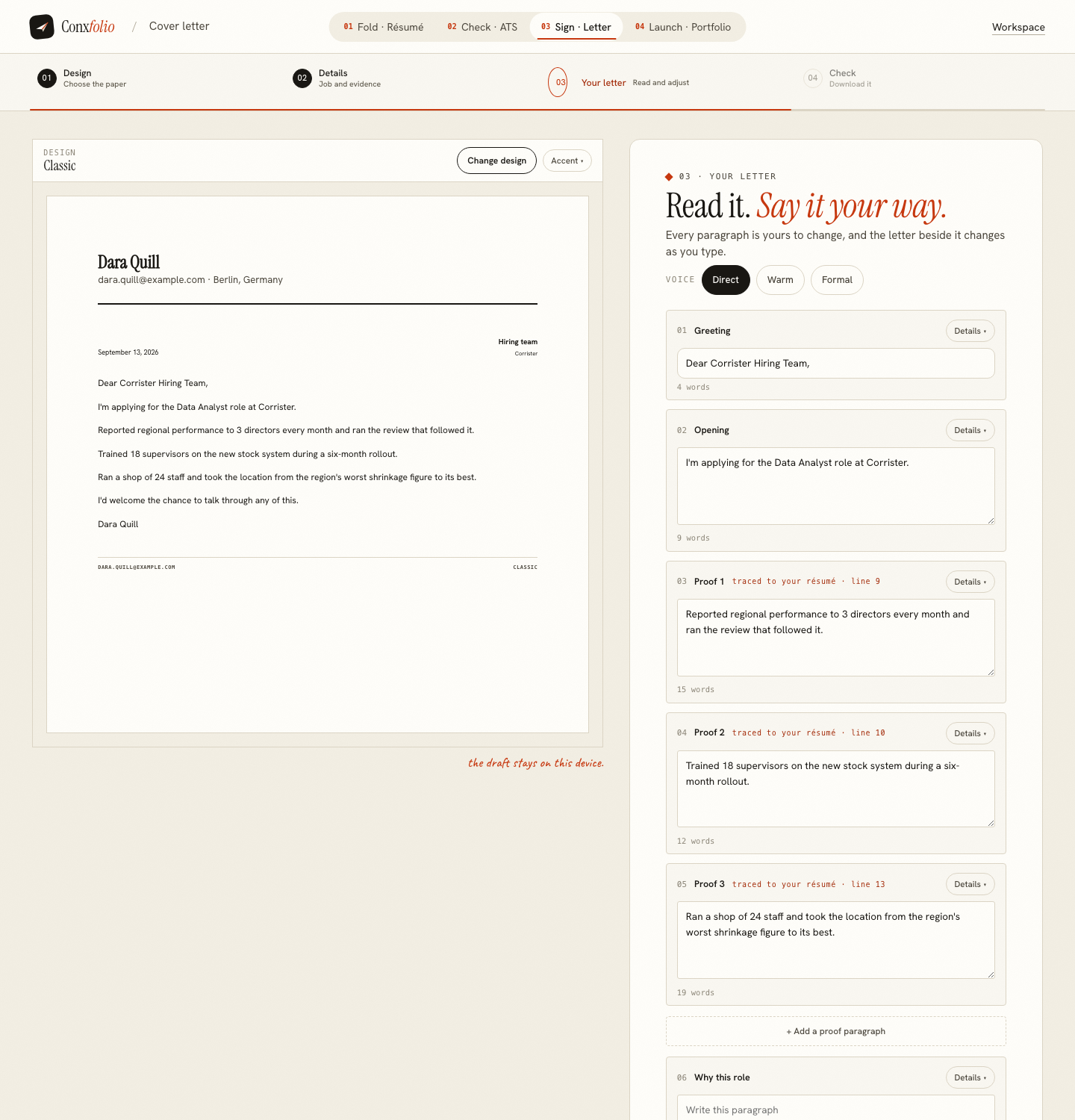
Internal applications get written badly for a structural reason: the two usual jobs of a letter are already done. The reader knows who you are, and they know what you have been working on. What is left is the part most letters skip, which is the evidence that you have already done the job you are asking for. The cover letter builder is built around that part.
The résumé nobody has updated
Most internal candidates have not touched their résumé since they were hired. That matters here twice: the panel may ask for it, and the letter engine selects its proof paragraphs from it. A résumé that stops at the job you already have will produce a letter that argues for the job you already have. Start in the résumé builder, import the old file, and write down the last three years.
What the letter selects
It selects rather than generates. Every evidence paragraph is a verbatim or lightly trimmed sentence from your own résumé, carried with its source so the surface can show where it came from. Where it cannot find real evidence it returns fewer paragraphs instead of padding. On an internal application that behaviour is a gift, because a padded claim can be checked by the person reading it.
The gaps, and what to do with them

Requirements the posting asks for and your résumé cannot evidence come back as a list. Externally that list is preparation. Internally it is better than that: it is a short agenda for a conversation with the person who will make the decision, held before the interview rather than during it. The gaps list is the interview covers the idea.
What the tool does not know
Your employer. There is no directory, no integration, no knowledge of any organisation anywhere in the product, and nothing is ever sent to anybody. It knows the posting you paste and the résumé you point it at. It also will not invent a reason for wanting the role, which on an internal move is the sentence that matters most and the one you have to write yourself, in the optional field for what only you know.
Tone, and the three voices
The engine offers direct, warm and formal, and changing the voice rewrites the whole letter while keeping the previous draft as a version. Internally, the formal register usually reads as distance and the direct one as confidence, though that depends entirely on the place you work and this page cannot know it. The letters gallery shows whole letters rather than swatches, which is the subject of why a letter gallery shows whole letters.
Editing is expected
The first draft is a starting point. Every block of the letter is an editable field with its own word count, proof paragraphs can be added, removed and reordered, and nothing stops you replacing a selected sentence with a better one. The check step reviews the result and tells you what is guidance rather than a gate.
The résumé is also the record you will need later
Internal applications are the moment most people discover that four years of work exists only in their own memory and in a performance review system they cannot export. Writing it down now produces the document for this application and the document for the next external one, and the two are the same document with a different top third.
The builder keeps it in this browser, so there is nothing to create and nothing your employer holds. Export a PDF or a DOCX when it is finished, because a browser can be cleared and there is no account to restore it from. That trade, and everything it means, is in why there is no account, and the master-and-exports model is in one résumé or one per job.
The honest limits
No language model is used anywhere in this, which is why every sentence can be traced to a line you wrote. Nothing here predicts a promotion or a transfer, and no page on this site claims a document gets anybody a job. The internal role guide has the structure, what to include in a cover letter has the contents, and both exports are free with no watermark.
Write the internal letter
Paste the internal posting, point it at your résumé, and read what it selected and what it refused to claim.
Open the cover letter builderRead the internal role guideQuestions
- Do I still need a résumé for an internal move
- Usually yes, and it is the document that has been neglected longest. The letter engine also draws its proof paragraphs from it, so a thin résumé produces a thin letter.
- Does the product know who my employer is
- No. It knows what you paste into the posting field and what is in your résumé. It has no directory, no integration and no knowledge of any organisation.
- What does it do with requirements I cannot evidence
- Lists them as gaps and never asserts them. On an internal application that list is a useful thing to walk into a conversation with.
- Can I edit the draft
- Yes. Every block is an editable field with its own word count, and proof paragraphs can be added, removed and reordered.
- Is anything sent to my employer
- Nothing is sent anywhere except the text you ask us to read for a check, a draft or a PDF export. There is no account and no directory.
Conxfolio is a free set of four career tools: a résumé builder with 37 rendered layouts, an ATS résumé checker that prints its own arithmetic, a cover letter builder that traces every proof paragraph back to the line it came from, and a portfolio builder with 20 authored designs. There is no account to create, nothing is held back for a paid plan, and no language model is used anywhere in the product, so the readers, the score and the letter are deterministic code you can check.