Age on a résumé, what two governments actually publish, and what this builder asks for
The date question has two correct answers depending on which country's guidance you are reading, and one thing that is true in both: nothing on a résumé has to be a birth certificate.
— thirty years of work is the asset. the date is not.
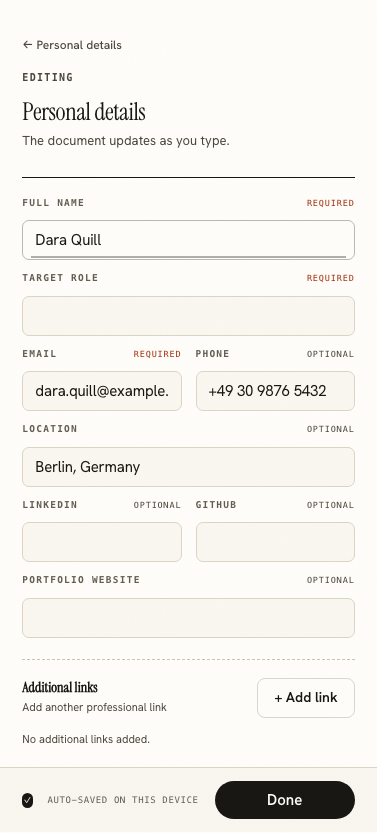
Somewhere after twenty-five years of work, the résumé stops being a record and starts being an editing problem. The date question arrives with it, and it has two published answers rather than one. The résumé builder takes a position by omission: it does not ask.
What the two sets of guidance say
The United Kingdom's National Careers Service, which is government careers guidance rather than a recruiter's blog, lists what a CV should contain and then says plainly: "You should not include your age, your date of birth, whether you're married or your nationality" (nationalcareers.service.gov.uk). German guidance goes the other way. The Bundesagentur für Arbeit lists "Geburtsdatum und -ort" among the personal details a Lebenslauf carries (arbeitsagentur.de). Both are public, both are current, and they contradict each other because they are describing different conventions.
What the builder asks for
No date of birth, no photograph, no marital status, no nationality. Where the German convention applies and you want those details on the page, the additional section takes a heading you name and a list of lines under it, which is where they go. Applying in Germany goes through the whole set with its sources.
The dates that are actually on the page
Employment dates are the arithmetic everyone does anyway. Education dates are the ones that give the number away for free, which is why so much advice says to remove the years from a degree taken in 1991. That is a decision rather than a rule, and there is no rule about it in this product either. What there is instead is a parseability rule that penalises mixed date formats and shortened years, so whatever you decide, do it consistently. Date formats on a résumé has the detail.
Where to stop
The ATS résumé checker has no rule about how old a role is. Nothing scores lower for having happened in 2003. What does happen is that the page fills, and the lines from 2003 are competing with the lines from 2021 for the same space. How far back a résumé should go and how long a résumé should be work through the cut.
Thirty years is a depth problem, not a length problem
The content rules reward achievement lines with figures in them, and a long career usually has better figures than a short one. Evidence depth counts the achievement lines under experience and pays full marks at five. Measurable evidence recognises percentages, currency, multipliers and a number followed by one of a list of unit nouns covering people, things run or delivered, and time. A senior page that reads as a list of job titles is losing points a junior page could not earn. How the ATS score is calculated has the whole grading.
Designs, and what they signal
There are 37 of them and 21 are marked ATS-safe in the catalogue. Nothing in the gallery is aimed at an age, and a design that is simply legible is doing more for a thirty-year record than one that is trying to look current. What ATS-safe means on a design covers what the mark is and is not.
What actually changes on a senior page
The top third. A reader deciding in ninety seconds needs the current scope in the summary and the strongest two achievement lines immediately under the most recent role. Everything from before 2010 can be compressed into a single line naming the employers with no evidence under it, which keeps the dates continuous and returns most of a page to the work that is still being bought.
That compression is also the answer to the education-dates question, in a way that does not involve hiding anything. A degree with its years, sitting at the bottom of a page whose top is full of recent evidence, is read as a fact rather than as a date of birth. Where the page is thin above it, the degree is the first thing the eye finds. Whether to list every job covers the compression, and what not to put on a résumé covers what goes entirely.
What we are not saying
We are not telling you what any employer will do with a date, because we do not know and nobody honest does. The checker is not an employer's applicant tracking system, it uses no job description and it predicts nothing, and no page on this site claims a document gets anybody hired. The sources above are conventions with publishers' names on them, and the rest of the decision is yours. Photo on a résumé by country and UK CV conventions carry the neighbouring questions, and everything in the product is free with no account.
Put thirty years on two pages
Import what you have and cut it back to what is still working for you. Free, no account, no watermark on the export.
Open the résumé builderRead how far back to goQuestions
- Does a UK CV carry a date of birth
- The National Careers Service is explicit that it should not: "You should not include your age, your date of birth, whether you're married or your nationality" (nationalcareers.service.gov.uk).
- Does a German Lebenslauf carry one
- German guidance asks for it. The Bundesagentur für Arbeit lists "Geburtsdatum und -ort" among the personal details a Lebenslauf carries (arbeitsagentur.de).
- Is age a protected ground
- In Germany the Allgemeines Gleichbehandlungsgesetz names age in §1 among the grounds on which disadvantage is to be prevented (gesetze-im-internet.de). We are not lawyers and this page gives no legal advice.
- Does this builder ask for my date of birth
- No. The identity fields are name, target role, email, phone, location, LinkedIn, GitHub and a portfolio website, plus any further links you name. There is no date-of-birth field and no photograph field.
- How far back should the page go
- Far enough to carry the evidence you want read. The checker has no rule about how old a role is, and there is a whole guide on where to stop.
Conxfolio is a free set of four career tools: a résumé builder with 37 rendered layouts, an ATS résumé checker that prints its own arithmetic, a cover letter builder that traces every proof paragraph back to the line it came from, and a portfolio builder with 20 authored designs. There is no account to create, nothing is held back for a paid plan, and no language model is used anywhere in the product, so the readers, the score and the letter are deterministic code you can check.