What to include in a cover letter, and what to leave out
A cover letter is a page of A4 with room for about six things. Deciding which six is the whole job, and the test is the same one every time.
— if it cannot be checked, it is taking up space.
Every question about what to include in a cover letter has the same answer underneath it, and tailoring it to a posting is the same question asked once per application. Can a reader check it. A claim that can be checked is worth a paragraph; a claim that cannot is worth nothing, however true it feels while you are writing it.
That test sorts the contents of almost any letter in about a minute.
The six that earn their place
- The role, named exactly. As the posting names it, once.
- The employer, named correctly. Once, spelled right.
- Two to four things you did, each with the result attached. This is the letter.
- One figure, if your evidence honestly contains one. A number is the most portable kind of proof there is.
- The reason, if you have a real one. Something you know about this employer's work that made you apply.
- A way to reply and a signature. An unsigned letter is an unfinished letter.
That fits on a page with room left over, which is the correct shape. The length page has the arithmetic, and an internal application needs fewer words again.
The five that do not
Adjectives about yourself. Hard-working, detail-oriented, a strong communicator. Every letter in the pile has them and none of them can be verified, so a reader discounts them on sight.
A restatement of the résumé. The reader has both documents in front of them. A paragraph saying you worked somewhere for four years has spent forty words on a line they already read.
A restatement of the posting. Reading their own advertisement back to an employer proves that you opened it and nothing else.
Explanations that are longer than the thing they explain. A gap, a short tenure, a change of field: one sentence each. The rest belongs in the interview, where somebody has asked.
Anything you cannot support. Which brings us to the part the builder is strict about.
The rule the engine applies
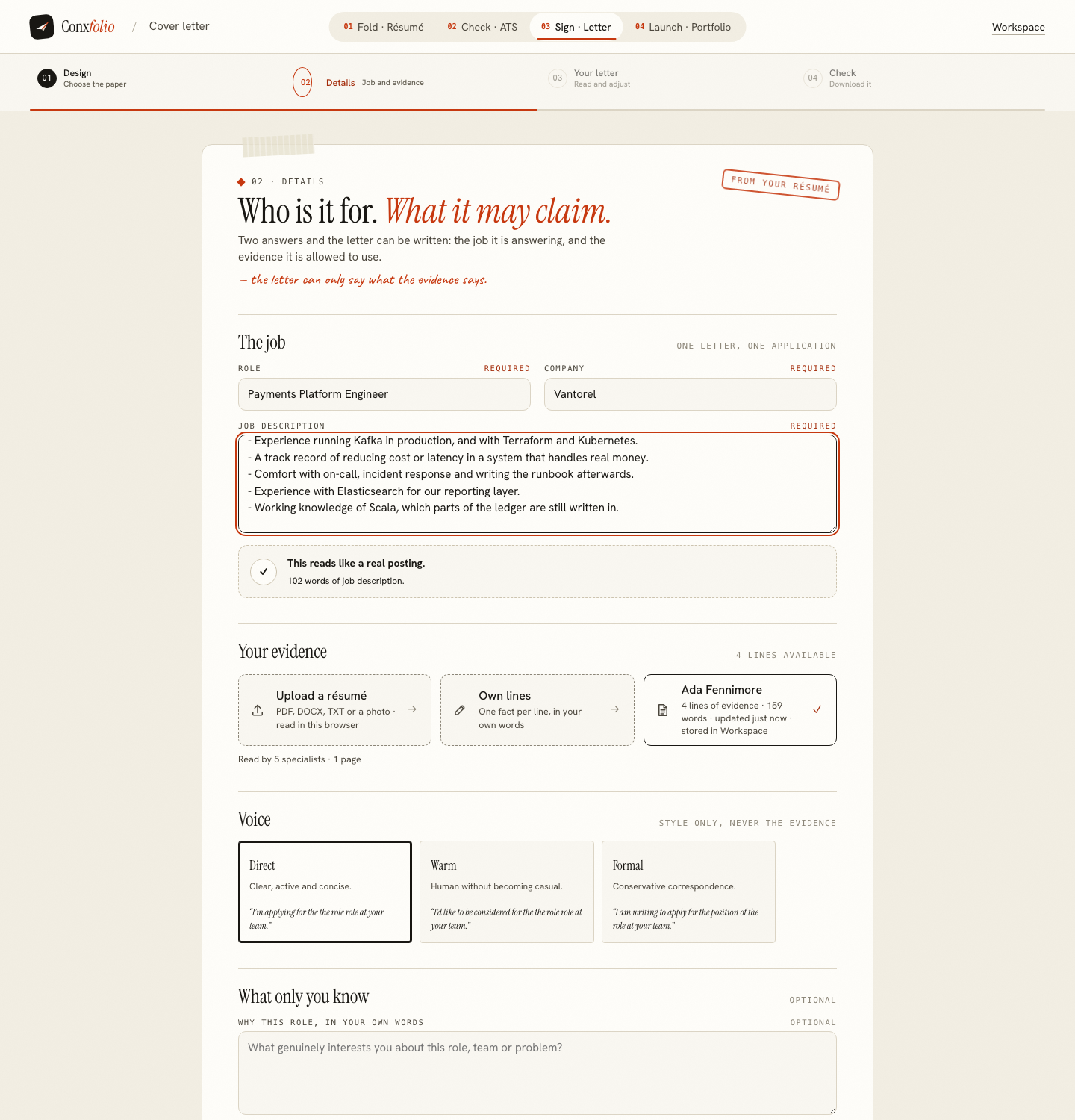
The cover letter builder selects the proof paragraphs from your own evidence rather than composing them, and each one arrives carrying the line of the source it came from, shown in the product as "traced to your résumé" with the line number. Where it cannot find evidence for a requirement, it returns fewer paragraphs rather than filling the space.
Requirements in the posting that your evidence does not support come back as a list, and none of them appear in the letter. On a real draft for an invented candidate, three requirements came back unsupported and the check step reported them plainly: three requirements your evidence cannot support, none claimed.
The consequence for the question of what to include is useful. You cannot accidentally include a claim you cannot back, because the mechanism that writes the paragraph is the mechanism that found the line.
The one thing no reading can supply
Motivation. A document can be read for what you did; it cannot be read for why you want the next thing. The details step has a field for it, described in the product as what only you know, and the note under it says the content is used exactly as you wrote it and that no reason for wanting the job is ever invented.
Leaving it empty is a legitimate choice. The review step then notes that the letter is running on evidence alone, which is a colder letter and an honest one. What is not a legitimate choice is manufacturing a reason, because it is the one paragraph an interviewer will ask you to expand on.
Where skills actually go
Inside a sentence about something you did. "Go and PostgreSQL" is a line on a résumé and a claim in a letter. "Rebuilt the settlement pipeline in Go, cutting end-of-day reconciliation from forty minutes to six" is the same information with the proof attached, and it is half a paragraph rather than a bullet list. The skills section is where the list belongs, and it does that job better than a letter can.
The check before it leaves
The last step measures the draft and prints what it measured: the reading length, whether a figure the evidence also states survived into the letter, whether every line is still traced, whether it is signed, and the unsupported requirements. The product calls these notes guidance rather than a gate, which is the right relationship between a measurement and your judgement. The mistakes page covers what those notes usually catch.
The order things should appear in
Strongest proof first. A reader who stops after two paragraphs should have met your best evidence, and the only way to guarantee that is to put it at the top. Chronology is the résumé's organising principle and it is the wrong one here.
The exception is where two pieces of evidence build on each other, in which case keep them adjacent and lead with whichever makes the other legible. What never works is saving the best for the close, on the theory that a letter should build. Letters are not read that way, and the last paragraph is the one most often skipped.
Put the six things in
The role, the company, the posting and your evidence. The draft comes back with each proof paragraph traced to the line it came from.
Open the cover letter builderSee the 12 letter designsQuestions
- Should I include my salary expectations
- Only if the posting asks for them. Where it does, a range with a note that it is negotiable is the usual answer. Where it does not, raising it first spends a paragraph on a conversation nobody has started.
- Should I mention notice period or availability
- One clause in the closing, and only if it is unusual or the posting asks. A three-month notice period is worth flagging early; a standard one is not news.
- Do I list my skills
- Not as a list. A skills list is the résumé's job. In the letter, a skill appears inside a sentence about something you did with it, which is the version a reader can check.
- Should I explain a gap in the letter
- One sentence if it needs explaining at all. The résumé page on career gaps covers the longer version, and a letter that spends a paragraph on an absence has spent it badly.
- What does this site put in automatically
- The header from your evidence, the greeting from the company, and proof paragraphs selected from your own lines with the source line carried beside each one. The reason for wanting the role is asked for and used exactly as written.
Conxfolio is a free set of four career tools: a résumé builder with 37 rendered layouts, an ATS résumé checker that prints its own arithmetic, a cover letter builder that traces every proof paragraph back to the line it came from, and a portfolio builder with 20 authored designs. There is no account to create, nothing is held back for a paid plan, and no language model is used anywhere in the product, so the readers, the score and the letter are deterministic code you can check.