The cover letter mistakes that actually cost you something
Most cover letter advice lists twenty mistakes of equal weight. In practice one is fatal, four are expensive, and the rest are matters of taste.
— one of these is fatal. The rest are habits.
Lists of cover letter mistakes tend to treat a wrong company name and a slightly long third paragraph as comparable problems, and most of them appear while adapting a letter to a new posting. They are not. One of them ends the application in the first second and the other costs you a fraction of the reader's patience.
The fatal one: the wrong employer
A letter carrying another company's name is finished before the second line. It is not read as carelessness, it is read as evidence that the application was not really about them, which is usually accurate. Nothing later in the letter recovers it.
It is almost entirely a disease of adaptation. Somebody takes last week's letter, updates the opening, misses the third paragraph, and sends it. The structural defence is to generate the header and the greeting from fields rather than editing them in the body, which is how the cover letter builder works: the company and role you enter at the details step produce the recipient block and the greeting, and the check step afterwards reports the named opportunity it actually found in the draft.
Expensive habit one: restating the résumé
The reader has both documents. A paragraph that repeats your employment history in sentences has spent forty words telling them something they read ten seconds ago. The proof paragraphs exist for what the résumé could not carry: the result behind the line, the decision behind the result.
Expensive habit two: adjectives about yourself
Hard-working. Detail-oriented. A strong communicator with excellent interpersonal skills. Every letter in the pile contains them, none of them can be checked, and a reader discounts them automatically. The replacement is always the same: one thing you did, with the result attached. What belongs in a letter goes through the swap in detail.
Expensive habit three: claiming what the evidence cannot support
A letter that asserts a tool you have read about is a letter that will be found out in twenty minutes of interview, and the cost is higher than the gap would have been. The engine here will not do it for you: the proof paragraphs are selected from your own evidence and carry the line each came from, and the requirements your evidence cannot support come back as a list that is never claimed anywhere in the letter.
Reading that list is not pleasant and it is the most useful thing on the screen. Those are the questions you will be asked. Naming one and saying what you are doing about it is honest; asserting it is the mistake.
Expensive habit four: the letter that never arrives at a point
An opening that defines a quality, a second paragraph that restates the posting, a third that describes a temperament, and a close that hopes to hear soon. Nothing in it is false and nothing in it is about you. This is the commonest letter in any pile and the reason cover letters have the reputation they do.
The repair is mechanical. Delete every sentence that does not contain something you did, and see what is left. If the answer is two sentences, the letter was two sentences long and pretending otherwise was the mistake.
The mistakes that are matters of taste
Whether to use "Yours sincerely" or "Kind regards". Whether the date goes above or below the recipient. Whether a design has a masthead. Reasonable people differ and no application has turned on any of them. The closing page gives the conventions for the ones worth knowing, and then the subject is closed.
What the check step actually measures
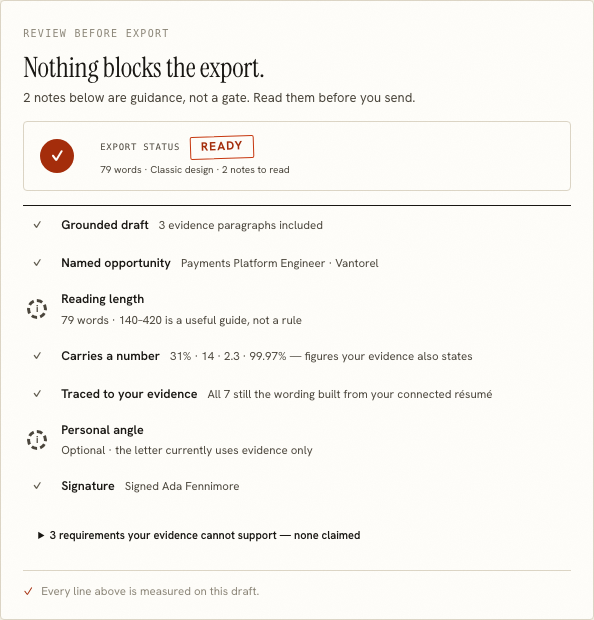
Before the export, the draft is measured and the findings printed: the export status, whether the draft is grounded in evidence and how many proof paragraphs it carries, the named opportunity, the reading length against a stated range, whether a figure your evidence also states survived into the letter, whether every line is still traced, whether a personal angle is present, and whether the letter is signed. Under that, the count of requirements the evidence cannot support.
Each of those is a measurement on your bytes rather than an opinion about your candidacy. None of them stop the export, and the panel says as much in its own words: the notes are guidance rather than a gate.
The two checks worth doing yourself
Read it aloud once. Every sentence you stumble on is a sentence a reader will stumble on, and it catches more than a spellchecker does. Then read the first line of each paragraph on its own; if that sequence does not make an argument, the paragraphs are in the wrong order. Both take under a minute, and between them they catch most of what is left after the measurements above.
The mistake of sending the same letter twice
Not to the same employer, which is rare, but to two employers in the same small industry who talk to each other. A letter whose reason paragraph is generic enough to be reused is a letter that says nothing about either company, and in a field where the hiring managers know one another, that is occasionally discovered.
The proof paragraphs can and should be reused, because they are facts about you. The reason paragraph cannot, because it is a claim about them. Keeping that line clear is what makes reuse safe, and it is the same line the builder draws between evidence, which it selects, and motivation, which it asks you for and never invents.
Let the draft be measured
The check step reports the named opportunity, the reading length, the figures carried, the tracing and the signature on your own draft.
Open the cover letter builderSee the 12 letter designsQuestions
- What is the fatal mistake
- Another employer's name in the letter. It is the only error in this document that ends an application on sight, and it happens almost entirely to people adapting a previous letter rather than writing a new one.
- Is a typo fatal
- No. A typo is a cost, not an ending. Reading the letter aloud once catches most of them, and reading it the next morning catches the rest.
- Is it a mistake to be too short
- Rarely. A short honest letter is read more often than a long careful one. The review step reports the reading length against a guide of 140 to 420 words and blocks nothing at any length.
- Does the site catch these for me
- It measures the draft and prints what it measured: the role and company it found, the length, whether a figure survived, whether every line is traced, whether it is signed, and the unsupported requirements. It does not correct your prose.
- What if the review flags something I meant to do
- Send it anyway. The notes are guidance rather than a gate, and the product says so in its own words on the panel.
Conxfolio is a free set of four career tools: a résumé builder with 37 rendered layouts, an ATS résumé checker that prints its own arithmetic, a cover letter builder that traces every proof paragraph back to the line it came from, and a portfolio builder with 20 authored designs. There is no account to create, nothing is held back for a paid plan, and no language model is used anywhere in the product, so the readers, the score and the letter are deterministic code you can check.