How to tailor a cover letter to the posting without rewriting it
Tailoring is not rewriting. Three things change per application and the rest of the letter stays where it is, which is why a tailored letter takes ten minutes rather than an evening.
— the posting picks the evidence. You pick the posting.
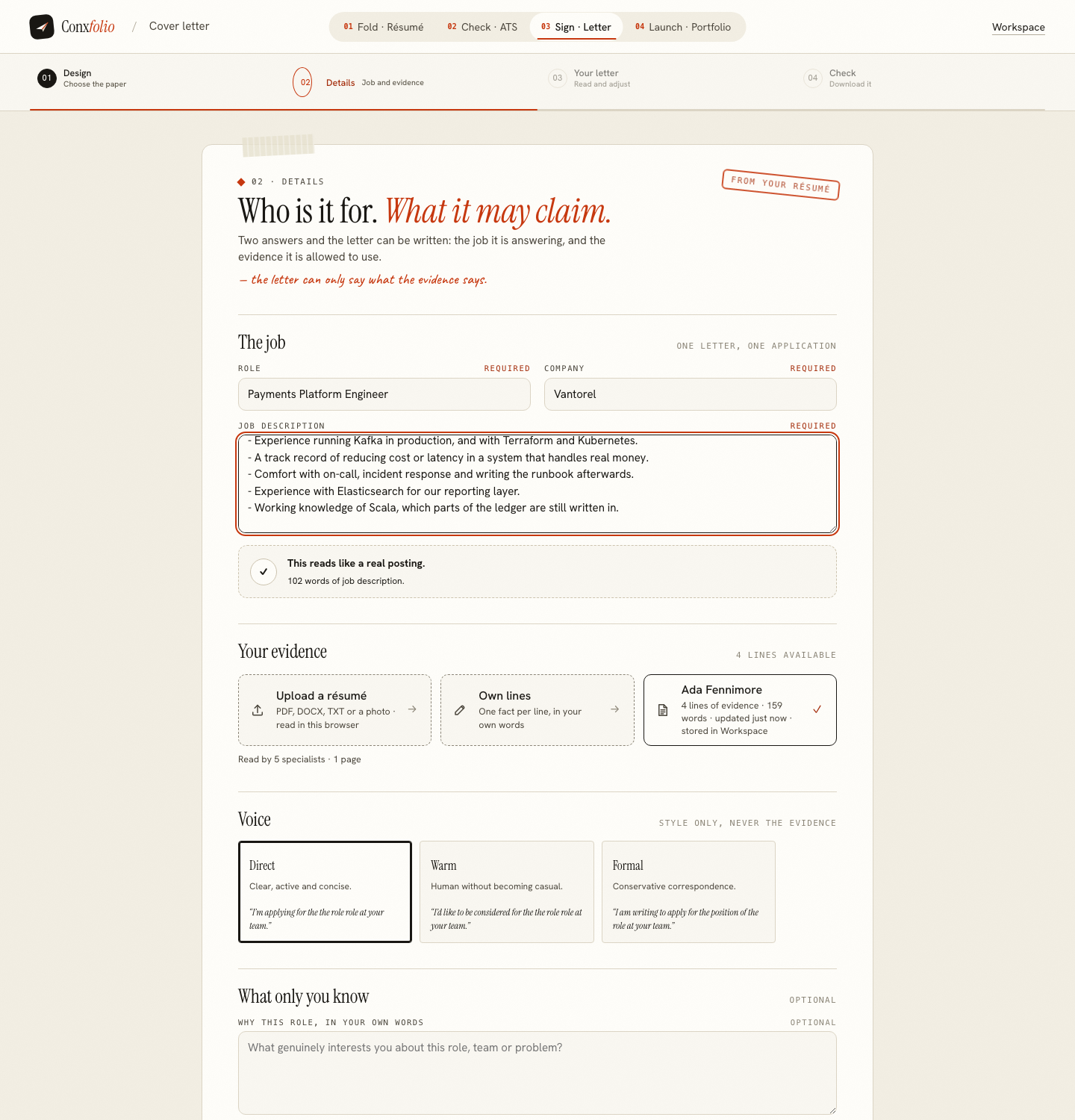
The reason people do not tailor letters is that tailoring is imagined as rewriting. It is not. A tailored letter is the same letter with three decisions made again, and once the evidence is in one place those decisions take minutes.
The three things that change
- The role and the company. Named exactly as the posting names them, in the recipient block and once in the opening.
- The opening sentence. Which of your evidence this employer should hear about first.
- Which proof paragraphs you use. Two or three out of the six or eight you have, chosen against what the posting actually asks for.
That is the whole of tailoring. The header, the block order, the closing and the signature are constant across every application you will ever send.
Read the posting for requirements, not adjectives
Most postings contain two kinds of sentence. The first kind states a requirement: production experience with a particular database, responsibility for a particular process, a volume or a scale. The second kind describes a culture. Only the first kind selects evidence.
Go through the posting and mark the requirements. Four or five is typical. Then look at your own evidence and ask which of your lines answers each one. The lines that answer something are your proof paragraphs for this application; the rest stay in the drawer until a posting asks for them.
What the builder does with the posting
The details step of the cover letter builder asks for the role, the company and the job description, all three required, and it reports back on what you pasted. On the draft above it confirmed that the text reads like a real posting and counted the words in it, which is a useful signal when you have pasted half a page by accident.
The posting then does the selection. Evidence paragraphs are chosen from your own lines against what the posting asks for, and each one arrives carrying the line it came from. Where a requirement has no evidence behind it, nothing is invented: it goes on the list of requirements your evidence cannot support, and the letter does not claim it anywhere.
The gaps list is the second half of tailoring
An unsupported requirement is information about the application, not only about the letter. If the posting asks for five things and your evidence answers two, the tailoring problem is smaller than the targeting problem, and the time is better spent on a posting that fits.
Where the gaps are one or two, they are interview questions with the date not yet set. Naming one in the letter and saying what you are doing about it is a legitimate paragraph. Asserting it is the expensive mistake.
Mirror once, never twice
Using the posting's own term for a thing is sensible: if they call it reconciliation, call it reconciliation rather than settlement matching. Doing it once per requirement reads as precision. Doing it throughout reads as a letter assembled by find-and-replace, and the effect is the opposite of the one intended.
The same restraint applies on the other document. Tailoring a résumé is mostly reordering and relabelling rather than rewriting, for the same reason.
Keep a single source of evidence
The reason tailoring feels expensive is usually that the evidence lives in five documents. One master résumé with every result in it, kept current, turns each application into a selection task. The builder here reads the résumé already in this browser rather than asking you to retype anything, which is the same idea applied mechanically.
If you would rather not connect a document, the details step takes your evidence as flat lines, one fact per line, in your own words. That box is a perfectly good master list in itself.
What tailoring does not do
It does not improve a mismatch. A letter tailored beautifully to a posting you cannot answer is a well-aimed letter that still misses, and no amount of wording repairs that. It also does not affect the readability check: the ATS résumé checker reads your résumé on its own and uses no job description, so tailoring is a letter concern and a targeting concern rather than a scoring one.
What it does do is make the ten seconds a reader spends on your first paragraph land on the thing they were looking for, which is the only part of this you control.
Read the posting twice
Once for the requirements and once for the instructions. The second reading is the one people skip and it is where the application is lost: a file format, a reference number, a question to answer in the body of an email, a closing date earlier than the advertised one. None of that is in the part of the posting describing the role.
It is also where the recipient's name often hides, in a line about who to contact with questions. Two readings cost five minutes and they catch the failures that no amount of good writing recovers from, which makes them the highest-value part of tailoring.
Paste the posting and see what it selects
The evidence paragraphs are chosen against the posting, and the requirements your evidence cannot support are listed rather than claimed.
Open the cover letter builderTailor the résumé tooQuestions
- How much of the letter changes per application
- The role and company, the opening sentence, and which two or three proof paragraphs you use. The header, the structure, the closing and the signature stay put.
- Should I copy phrases from the posting
- Mirroring a requirement's own words once is fair and useful. Copying its sentences back at the employer proves you opened it and nothing more.
- Does the posting affect the ATS check
- No. The ATS check on this site reads the résumé alone and uses no job description at all. The posting is used by the letter, which is a different tool.
- What if the posting is vague
- Then the letter carries more of the argument. Write the two proof paragraphs you would want any employer in that field to read, and keep the reason paragraph specific to this one.
- How long does a tailored letter take
- About ten minutes once you have the evidence in one place, because tailoring is a selection problem rather than a writing problem.
Conxfolio is a free set of four career tools: a résumé builder with 37 rendered layouts, an ATS résumé checker that prints its own arithmetic, a cover letter builder that traces every proof paragraph back to the line it came from, and a portfolio builder with 20 authored designs. There is no account to create, nothing is held back for a paid plan, and no language model is used anywhere in the product, so the readers, the score and the letter are deterministic code you can check.