How to write a cover letter that only claims what you can show
A cover letter is a short argument: this is the job, this is the proof, here is where the proof comes from. Everything below is how to assemble those three things without inventing a fourth.
— the letter can only say what the evidence says.
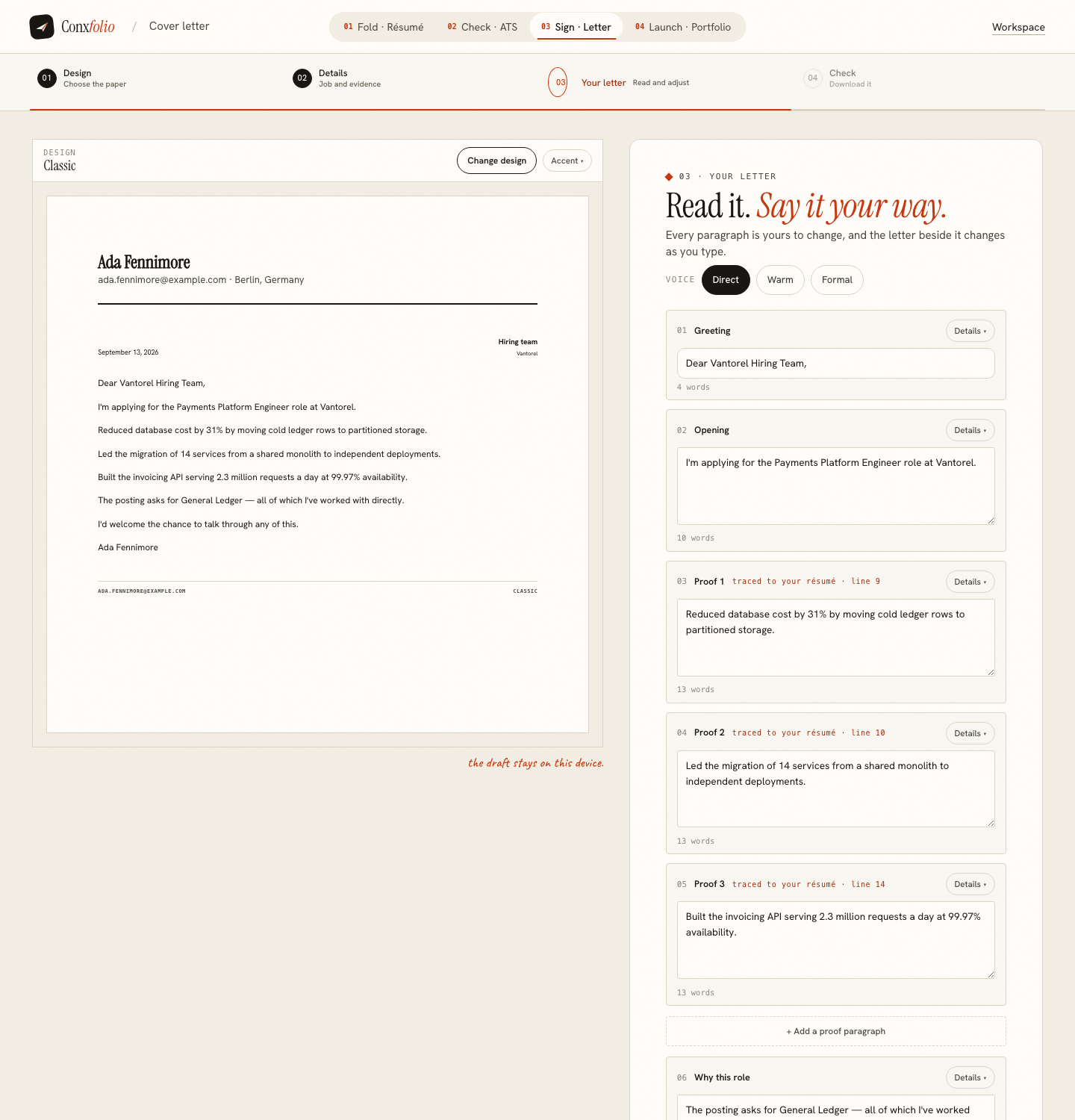
Most advice about cover letters is advice about tone. Tone is the last problem. The first problem is that a letter has to say something specific about you, and the only specific things available are the things you have already done. A letter built any other way ends up describing an enthusiasm rather than a person.
So write it backwards. Start with the posting, find the evidence you already hold that answers it, and let the sentences follow from that. The four parts below are what is left when you do. If you are still deciding whether the letter is worth writing at all, that question has its own page.
Part one: who it is for
One letter, one application. The role, the company and the posting itself are the three things a letter cannot be written without, because they decide which of your evidence is relevant. A general letter sent to twenty employers is a letter that answers none of their postings, and a reader can tell within a line.
Name the role exactly as the posting names it. If the posting calls it Payments Platform Engineer, your letter says Payments Platform Engineer, not "the engineering position". That single agreement is worth more than any adjective you could add.
Part two: the opening
The opening does one job: it states which role you are applying for and, where you have one, why this employer rather than another. It is two sentences at most. There is a whole page of advice on how to open a cover letter, and the short version is that the reader already knows you want a job, so the sentence has to carry something they did not know.
Part three: the proof
This is the letter. Two to four paragraphs, each one a thing you did, with the result attached. A proof paragraph that carries a number is stronger than one that does not, and the numbers you already have in your résumé achievements are the ones to reach for.
The rule that keeps this honest is simple: a claim in the letter must correspond to a line in the evidence. If you cannot point at the line, the claim comes out. That rule is not a style preference. It is the difference between a letter you can be interviewed on and a letter you will have to walk back.
The cover letter builder on this site applies it mechanically. It reads the posting, selects sentences from the evidence you connect, and carries each one with the line of the source it came from, so the paragraph list shows "traced to your résumé, line 9" beside the paragraph. Where it cannot find real evidence for a requirement, it returns fewer paragraphs rather than filling the gap with language.
Part four: the close and the signature
One sentence offering to talk, and your name. A letter with no name on it is an unfinished letter, and the check step says so before you export. The closing is the least interesting part of the letter and should stay that way; how to end a cover letter goes through the few variations worth having.
The voice is style, never the evidence
Three voices are offered in the product, and the details step shows each one as the opening sentence it will actually write for your role and your company: Direct, Warm and Formal. Switching between them rewrites the wording and keeps the previous draft as a version first. What it never does is change what the letter claims. The label on that control in the product reads "style only, never the evidence", which is the whole design in four words.
What only you know
There is one field in the builder whose content is used exactly as you wrote it: why this role, in your own words. Nothing is generated there and nothing is paraphrased. The reason a person wants a particular job is the one thing no reading of a résumé can produce, so it is asked for and then left alone. Leaving it empty is allowed, and the review step will tell you the letter is running on evidence only.
Check it before you send it
The last step measures the draft and prints what it measured: the reading length, whether the letter carries a figure that your evidence also states, whether every line is still traced to your evidence, whether it is signed, and how many requirements in the posting your evidence cannot support. On the draft above, the answer to that last one was three, and none of them were claimed.
None of those notes block the export. They are described in the product as guidance rather than a gate, which is the correct relationship between a measurement and a person's judgement. What they usually catch is on the mistakes page.
What this does not do
It does not invent a reason for wanting the job. It does not claim a skill your evidence does not show. It has no view on whether you will get an interview, and no honest tool has. What it can do is make sure that every sentence in front of a reader is one you can stand behind in the room afterwards, which is the part you control. If you are still assembling the evidence itself, writing the résumé comes first, and a first letter with no work history has its own page, and tailoring it to the posting makes the letter much easier to write.
Write the letter from your own evidence
Paste the posting, connect the résumé you already have, and the draft arrives with every proof paragraph traced to the line it came from.
Open the cover letter builderSee the 12 letter designsQuestions
- How long should a cover letter be
- Short enough to read standing up. The review step on this site reports the reading length of your draft and says that 140 to 420 words is a useful guide rather than a rule, which is how it is phrased in the product. A letter under that range usually means the evidence is thin; a letter over it usually means the résumé is being repeated.
- Does the letter get written for me
- The paragraphs are selected, not composed. Each proof paragraph is a sentence from your own evidence, carried with the line it came from, and every paragraph is editable. No language model is used anywhere in this product.
- What happens if the posting asks for something I have not done
- It is listed as a requirement your evidence cannot support, and the letter does not claim it. On the draft in the picture above, three requirements came back unsupported and none of them appeared in the letter.
- Do I need an account
- No. The draft is kept in this browser. The text of the résumé, the posting, the role and the company are sent to our server when you ask for the draft, and the result comes back.
- Can I export it
- Yes, to PDF and to DOCX, free, in any of the 12 designs. Nothing is held back for a paid tier and there is no watermark.
Conxfolio is a free set of four career tools: a résumé builder with 37 rendered layouts, an ATS résumé checker that prints its own arithmetic, a cover letter builder that traces every proof paragraph back to the line it came from, and a portfolio builder with 20 authored designs. There is no account to create, nothing is held back for a paid plan, and no language model is used anywhere in the product, so the readers, the score and the letter are deterministic code you can check.