How to open a cover letter without wasting the first sentence
The reader already knows you want the job. The opening has to carry something they did not know, and it has about two sentences to do it in.
— the first line is the only one everyone reads.
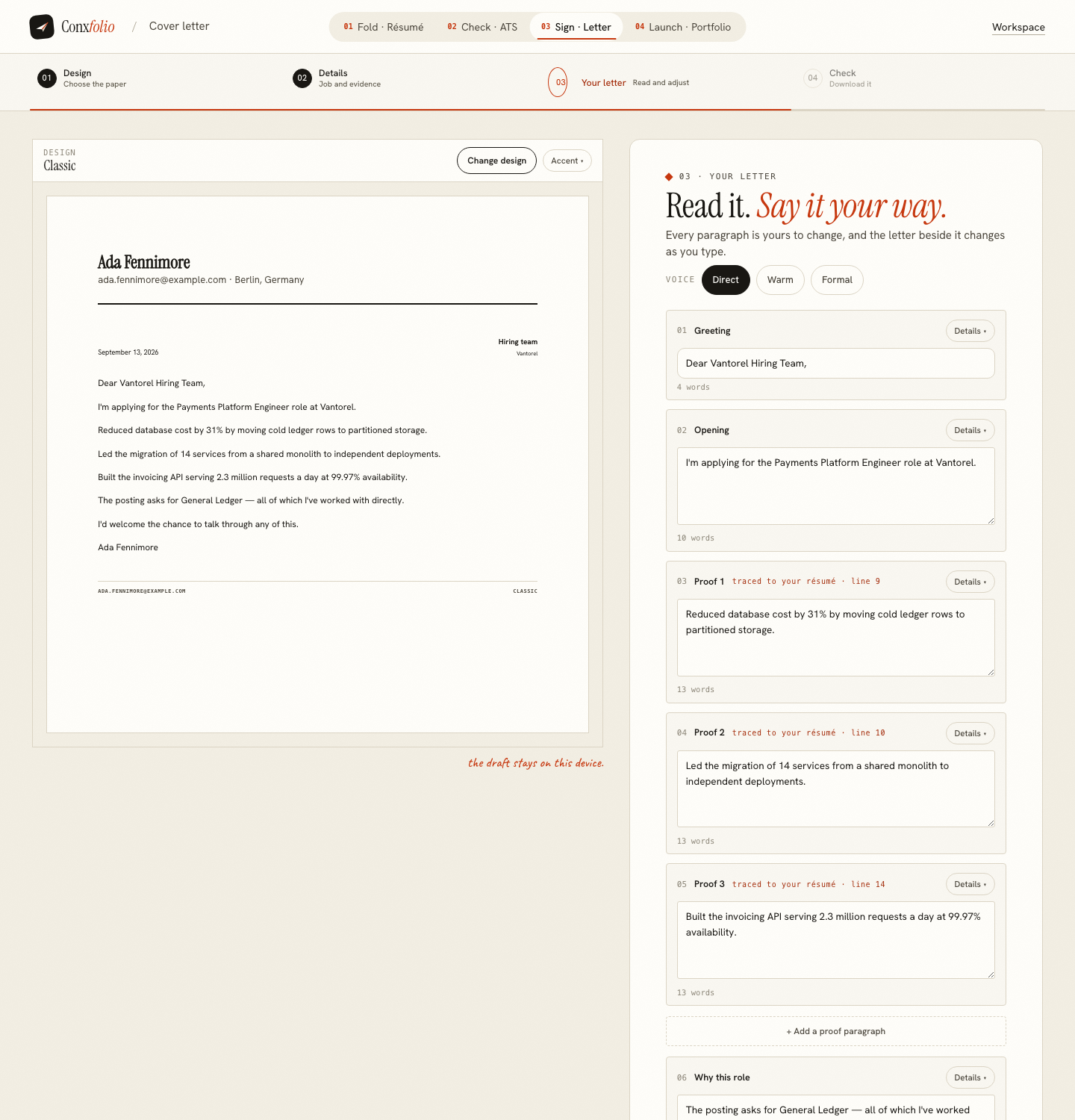
The opening of a cover letter is the sentence most likely to be read and least likely to be written carefully. It usually arrives as some version of "I am writing to apply for the position advertised on your website", which is true, and which the reader had already worked out from the letter in front of them.
The test for an opening is simple. Delete it. If the letter reads the same without it, the sentence was not carrying anything.
What the opening has to do
- Name the role exactly. Employers run several vacancies at once. A letter that does not say which one has made a filing problem out of an application.
- Name the employer. Once, correctly spelled. A letter with another company's name in it is the only mistake in this document that is fatal on sight.
- Carry one real thing. The reason this employer, or the single piece of evidence that makes the rest of the letter worth reading.
That is all. Three jobs, two sentences, and then the proof paragraphs take over.
The three voices, and the sentences they write
The cover letter builder offers three voices, and the useful part is that it shows each one as the opening sentence it will actually produce for your role and your company before you choose. Direct is described in the product as clear, active and concise. Warm is human without becoming casual. Formal is conservative correspondence, and opens with the familiar "I am writing to apply for the position of".
Seeing the three sentences side by side is a better way to choose than reading three adjectives. Changing your mind later rewrites the whole letter in the new voice and keeps the previous draft as a version first, so nothing is lost by trying one.
What the voice does not change
The control is labelled "style only, never the evidence" in the product, and it means it. A voice changes the wording of the greeting, the opening and the closing. It does not add a claim, remove a gap, or make a piece of evidence sound larger than it is. That separation is the reason the voice control is safe to play with.
Openings that work
Three shapes carry their weight. The first names the role and attaches the single strongest result you have: you are applying for the settlement role, and you rebuilt a settlement pipeline. The second names the role and one specific thing about the employer that you could not have written about anyone else. The third, for an internal move, names the role and says you already work there, which changes the whole reading of the letter and is covered on the internal application page.
What the three have in common is that they are checkable. Someone could ask you about any of them and you would have an answer. An opening for a change of career has one more job again, which is to name the change before the reader has to work it out.
Openings that cost you
The dictionary opening, where the letter begins by defining a quality. The mirror opening, which restates the posting back to the employer. The superlative opening, which claims to be the ideal candidate before any evidence has been offered. Each one spends the most valuable sentence in the letter on nothing, and a reader who has opened forty letters that morning has seen all three.
There is a fourth, quieter failure: the opening that promises something the rest of the letter does not deliver. If the first line says you transformed a department, the proof paragraphs have to show the department. Otherwise the letter has argued against itself by the third paragraph.
Where the opening comes from
If nothing obvious presents itself, the opening is usually already written somewhere in your evidence. The strongest line in your experience bullets, the one with a number in it, is a candidate. So is the summary at the top of your résumé, which is the same argument at a different length; the summary page covers how to make that line earn its place.
What is not a source is invention. If you cannot find the reason this employer, leave the reason out and let the evidence carry the letter. The review step will tell you plainly that the letter is running on evidence alone, and a letter that is honestly cold reads better than one that is warmly false.
Then stop
Once the role, the employer and the one real thing are on the page, the opening is finished. Everything else belongs in the proof paragraphs, where a reader expects it and where each claim can be traced back to a line of the evidence it came from.
Write it last
The opening is the hardest sentence in the letter and the one people write first, which is why so many of them are placeholders that survived to the send button. Write the proof paragraphs, then read them back and ask which of them a reader should meet first. The opening is usually a compressed version of that paragraph, and by then you know what it says.
Doing it in that order also removes the blank-page problem. There is nothing harder than opening a letter you have not written yet, and nothing easier than opening one you have.
See the opening before you choose the voice
The details step shows each of the three voices as the opening sentence it will write for your role and your company.
Open the cover letter builderSee the 12 letter designsQuestions
- Should I open with "I am writing to apply for"
- It is the formal voice's opening on this site and it is perfectly serviceable. It spends a sentence on something the reader already knows, which is a cost worth paying only when the register of the employer calls for it.
- Can I open with a story
- You can, and it is a risk. A story that takes three sentences to reach its point has spent the part of the letter that is certain to be read. One sentence of story followed by the result is the version that survives.
- Does the builder write the opening
- It assembles it from the role and the company you gave it, in the voice you chose, and shows you the sentence in advance. You can rewrite it afterwards and the letter updates as you type.
- What if I do not know why I want this employer
- Then say nothing about it rather than inventing something. The field for motivation in this product is optional and its content is used exactly as you wrote it. An opening that names the role plainly is better than a paragraph of manufactured enthusiasm.
- Is there a right length
- Two sentences is the working figure. The whole letter is measured at the check step, where the product reports the reading length against a guide of 140 to 420 words.
Conxfolio is a free set of four career tools: a résumé builder with 37 rendered layouts, an ATS résumé checker that prints its own arithmetic, a cover letter builder that traces every proof paragraph back to the line it came from, and a portfolio builder with 20 authored designs. There is no account to create, nothing is held back for a paid plan, and no language model is used anywhere in the product, so the readers, the score and the letter are deterministic code you can check.