Cover letter format: the eight blocks a letter is made of
A letter has a fixed skeleton and a variable middle. Here is the skeleton, block by block, in the order a reader meets it, and what belongs in each one.
— the shape is fixed so the middle can vary.
A cover letter has less freedom than people expect, and that is useful. It is also, in many applications, optional rather than required, which makes the shape worth getting right the once. The reader is looking for the same eight things in the same order in every letter they open, so a letter that puts them where they belong is read faster and argued with less.
1 · The header
Your name, and the ways to reach you. Email address first, because that is how a reply will come, then a phone number and the city you are in if it is relevant to the role. This is the same information as your résumé header, set out in full on the header and date page, and the two should agree exactly. A letter whose email address differs from the résumé's by a character is a letter nobody can answer.
2 · The date
One line, in a format that cannot be misread. Dates written as numbers alone are read differently on either side of the Atlantic, which is why date formats matter in this document too. Spelling the month out removes the question entirely.
3 · The recipient
The hiring team, the company, and the role if the design places it here. In the letters rendered on this site the recipient block sits under the date and above the greeting, which is the ordinary correspondence order.
4 · The greeting
Four words at most. The United Kingdom's National Careers Service says plainly that "it's important to try to address your cover letter to someone by name", and gives "Dear Sir or Madam" as the fallback when no name can be found (nationalcareers.service.gov.uk). There is a whole page on how to address a cover letter, including what to do when the posting hides the employer.
5 · The opening
Two sentences. Which role, and what drew you to this employer rather than another. The cover letter builder writes this block from the role and company you gave it, in the voice you chose, and shows you the exact sentence each voice will produce before you commit to one.
6 · The proof
Two to four paragraphs, one claim each, each with a result attached. This is the only part of the letter that is really about you, and it is the only part a reader will quote back at you in an interview.
In the builder these are numbered as separate paragraphs in the list beside the letter, each labelled with the line of the evidence it came from. You can add a proof paragraph, delete one, or rewrite any of them, and the letter beside the list changes as you type. Paragraphs you write yourself are yours; the tracing label belongs to the ones the engine selected.
7 · Why this role
One short paragraph, and the only one with no evidence behind it, because motivation is not a thing that can be read out of a document. The field for it in the product is labelled "what only you know" and its content is used exactly as written. Nothing is invented there. If you leave it empty, the review step notes that the letter is running on evidence alone, which is a fair letter and a slightly colder one.
8 · The closing and the signature
An offer to talk, a sign-off, your name. The letter is signed from the name on your evidence, and a draft with no name on it is reported as unsigned before you can export it. Ending a cover letter has the closings worth using and the ones that cost you nothing to drop.
Where the design comes in
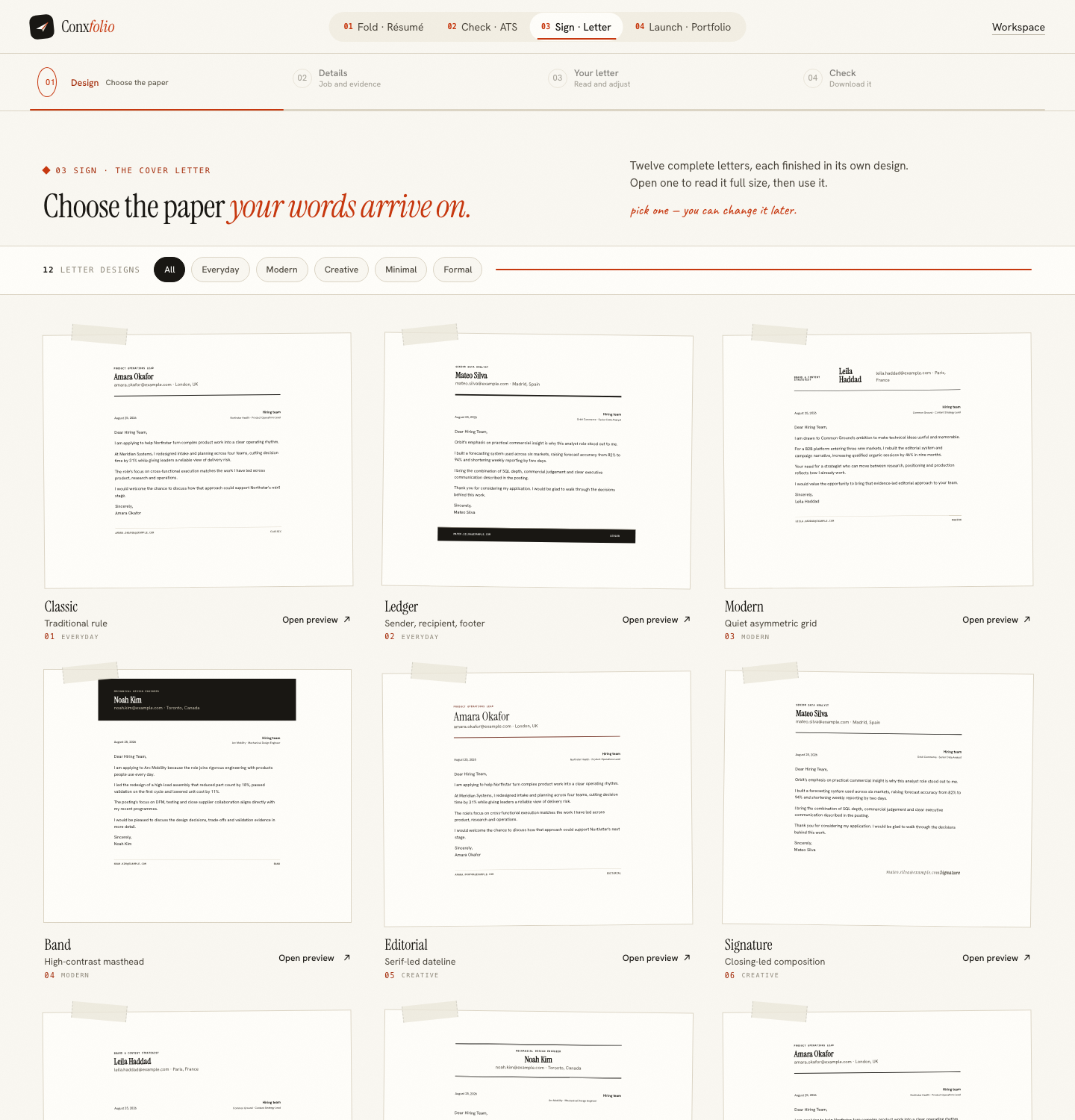
All 12 designs on this site carry the same eight blocks. What changes is the paper: a masthead instead of a plain name, a dateline in a serif, metadata in a column beside the text. The gallery renders each one as a whole letter at full size rather than as a thumbnail, so you are choosing the thing itself. Switching design rewrites nothing you wrote.
The designs are grouped into 5 families, which is a way of finding the register you want quickly: conservative correspondence at one end, an editorial dateline at the other. A conservative choice is rarely wrong. The gallery is at cover letter designs if you want to look before you start.
What the structure will not fix
A well-ordered letter with nothing in the proof block is still an empty letter. The structure is a container, and a letter written before your first job shows how little it takes to fill one honestly. If the middle is thin, the fix is in the evidence rather than in the format, and writing stronger achievement lines in the résumé fixes both documents at once.
Start from the structure
Choose the paper, add the job and the evidence, and the blocks arrive in order with each proof paragraph traced to its source line.
Open the cover letter builderSee the 12 letter designsQuestions
- Is the block order fixed
- The frame is. Header, date, recipient, greeting, opening, proof, closing and signature appear in that order in every design here. The middle varies: you can add a proof paragraph, remove one, or reorder the ones you have.
- Should the letter be one page
- In the United Kingdom, the government's nidirect guidance says of a covering letter that "one A4 page is preferable" (nidirect.gov.uk). The National Careers Service describes it as "a short letter, usually 3 to 5 paragraphs long" (nationalcareers.service.gov.uk).
- Do the designs change the structure
- No. A design changes the paper, the type and where the blocks sit. The blocks themselves, and the words in them, are the same letter in all 12 of them.
- What goes in the header
- Your name and the ways to reach you, then the date, then the recipient. The header page covers what to do when you do not know the recipient's name.
- Can I export the letter
- Yes, to PDF and DOCX, free and without a watermark, in any design.
Conxfolio is a free set of four career tools: a résumé builder with 37 rendered layouts, an ATS résumé checker that prints its own arithmetic, a cover letter builder that traces every proof paragraph back to the line it came from, and a portfolio builder with 20 authored designs. There is no account to create, nothing is held back for a paid plan, and no language model is used anywhere in the product, so the readers, the score and the letter are deterministic code you can check.