The lines that transfer, the letter that uses them, and the gaps to prepare for
A change of field is an argument about which of your existing lines still count. This chain lists every line the readers found, writes a letter for the role you are moving to, and prints what your evidence cannot support.
— the gaps list is the prep.
Changing field is not mostly a writing problem. It is a sorting problem: of everything you have done, which parts still count for the thing you are moving to, and which parts are only legible to people inside the field you are leaving. A rewrite done before that sort is a rewrite done in the dark.
This chain does the sort with the tools rather than with advice. It lists every evidence line the readers extracted, writes a letter for the target role from those lines, and prints what your evidence could not support.
Do it here
Everything the readers found, then a letter for the role you are moving to, then the gaps it could not close.
- 01Read it in
- 02Evidence
- 03The posting
- 04The letter
- 05Into the tools
Why the flat list is the useful view
On a résumé, every line sits under a job title, and the title tells the reader how to read the line. A line about coordinating a rota reads as retail management under a retail title and as operations under an operations title, and the words are identical. Stripping the titles off, which is all the second step does, is what makes that visible.
Read the list and mark the lines that carry a number, a scale, or a named responsibility. Those transfer furthest, because they describe something that happened rather than a role somebody held. Quantifying achievements covers how to find the numbers you already have, and the piece on numbers you can actually get is about the ones that are reachable when nobody kept records.
Lines that describe unpaid, voluntary or caring work belong in that list too. Care work and unpaid experience and describing a team effort both cover how to write them so they read as evidence rather than as a gap being explained away.
The letter is the test, not the deliverable
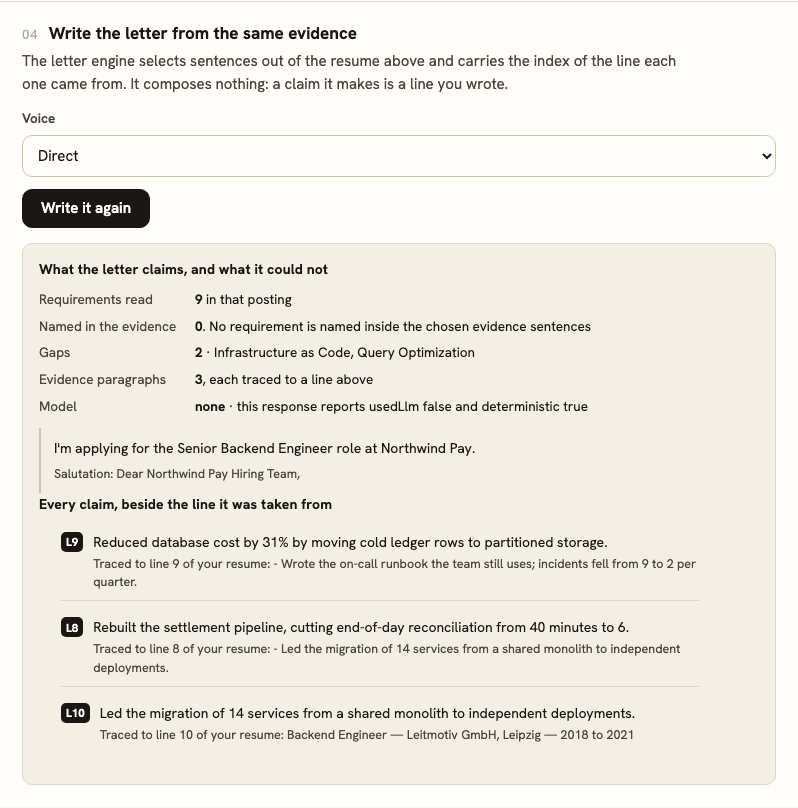
Paste the posting for the role you are moving to. What comes back is a letter, and more usefully, three numbers: how many requirements the engine read out of the posting, how many of them are named inside the evidence it chose, and how many it could not support at all.
The second of those three is the one that surprises people. A résumé can hold a skill in its skills list and never name it in a single evidence line, and a letter written from the evidence will then claim nothing about it. That is not the engine being cautious. It is a real weakness in the document, visible before an interviewer finds it. Writing experience bullets is the fix.
Every claim the letter makes carries the index of the line it came from, printed beside the line itself. Read those traces before you read the prose. The rule that a letter only claims what the document shows is the reason this is worth doing on a career change more than on any other application.
Reading the gaps as preparation
The gaps list is the requirements the posting asked for that your evidence cannot back. On a within-field application it is usually short. On a change it is the most useful paragraph you will read all week, because it is a written version of the conversation you are about to have.
Work down it and put each item in one of three piles. The first is things you have done and did not write down, which is a document problem and takes ten minutes in the builder. The second is things you have done differently, which is where you need a sentence prepared rather than a line added. The third is the real gaps, and naming them yourself is better than being caught by them. Reading your own gaps list covers the sorting, and applying when you meet half the criteria covers whether to apply at all.
Some of those gaps will be preferences dressed as requirements. Telling them apart is worth ten minutes before you talk yourself out of a posting.
Then the document itself
A career-change résumé usually needs reordering rather than rewriting. Skills and projects above the chronology, the most transferable role expanded, the least relevant one cut to a line. The career-change résumé guide sets out the shape, and the format guide covers when a hybrid earns its place.
The letter carries more weight on a change than it does elsewhere, because it is the only place the argument gets made in sentences. The career-change letter guide covers the opening, and the box marked what only you know in the letter builder is used exactly as you wrote it, which is where the reason for the change belongs.
When the letter reads honestly, check the document the way you would any other. The export chain scores the file rather than the draft, and the bundle chain runs the whole sequence for the next posting in a single sitting. Where the new field expects to see work rather than read about it, the portfolio chain builds the page from the same reading.
Write the letter properly
The letter builder keeps every paragraph editable, with the trace to the résumé line beside each claim and a box for what only you know.
Open the cover letter builderOr start from the résuméQuestions
- Will the letter say I have experience I do not have
- No. Evidence paragraphs are selected from lines you wrote, and each one carries the index of the line it came from. A requirement your evidence cannot support is listed as a gap rather than claimed.
- What does the evidence list show that the résumé does not
- The same lines with the labels stripped off. Seeing them as a flat list, without the job titles framing them, is what makes the transferable ones visible; inside a job title they read as that job's work.
- Should I rewrite my lines before running this
- Run it first. The gaps list tells you which rewrites are worth doing, and rewriting before you know that is how people spend an evening improving a line nobody asked about.
- Is the gaps list a rejection
- No. It is a list of things the posting asked for that your current document does not evidence. Some you will have and did not write down, some you will answer with a different kind of experience, and some are real. Knowing which is which before the interview is the point.
- Does a career change need a different résumé as well
- Usually the ordering changes more than the content. Skills and projects moving above a chronology is the common shape, and the builder reorders sections without rewriting anything.
- Does any of this use a language model
- No. The readers, the score and the letter engine are deterministic code, and the letter's own response reports that it used none. The chain prints that field in the receipt.
Conxfolio is a free set of four career tools: a résumé builder with 37 rendered layouts, an ATS résumé checker that prints its own arithmetic, a cover letter builder that traces every proof paragraph back to the line it came from, and a portfolio builder with 20 authored designs. There is no account to create, nothing is held back for a paid plan, and no language model is used anywhere in the product, so the readers, the score and the letter are deterministic code you can check.