Turn the résumé you already have into a portfolio page
The portfolio builder reads a résumé through the same specialists the other tools use. This page shows you what it would arrive with, lets you settle the design first, and then opens the builder with the document already read in.
— the roles are already written.
A portfolio and a résumé hold the same material in two shapes. The résumé is a file somebody screens; the portfolio is a page somebody reads. Writing the second from scratch when the first already exists is duplicated work, and duplicated work is where the two versions start disagreeing with each other.
The portfolio builder reads a résumé through the same specialists the résumé builder and the letter use. This page shows you what that reading produces before you commit to it, which is the part the builder cannot show you until you are already inside.
Do it here
Read the résumé in, see the sheet rows it fills, choose the design, then carry it into the builder.
- 01Read it in
- 02The sheet
- 03Design
- 04Into the tools
What the sheet actually holds
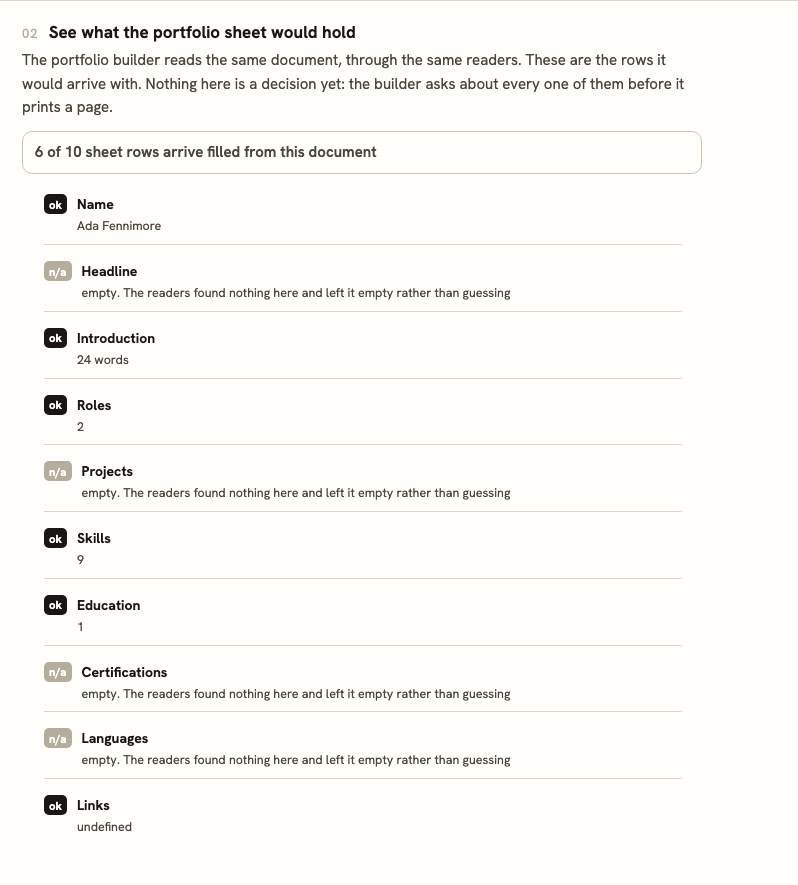
The sheet is the builder's content surface: one row per thing a portfolio page can print. Your name, your headline, the introduction, the roles, the projects, the skills, the education, the certifications, the languages, and the links. The chain above lists all of them and marks which ones your document fills.
An empty row is information. It means the readers found nothing for it and refused to compose something, which is the same rule that governs every reader on this site. A field that fails their own check that it is a span of your document is dropped and counted rather than kept, so the count in the first receipt is worth reading before you go on.
The rows that matter most for a portfolio are the projects and the lines under your roles. A résumé written tightly for a one-page limit often carries three lines per role where a portfolio page has room for six. How many projects to show covers the judgement, and the piece on evidence you forgot you had covers where the extra lines usually come from.
Choosing the design before the content
The design chooser sits before the builder here on purpose. There are 20 authored designs across 6 directions, and they are not interchangeable skins: a cinematic design wants a short introduction and strong project images, an editorial one wants prose, a technical one wants runbook lines and numbers. Settling that first changes what you write.
Each of the six on this page is drawn by the product's own gallery route as the page loads, so the poster is the design rendering rather than a picture taken of it once. The full showcase has the other fourteen, at full width, with the filters. Choosing between two designs is the piece to read when two of them both look right.
Then the builder, with the document in it
The door at the end of the chain hands the text to the builder through the same import an uploaded file goes through. The builder then asks about every row before it prints anything: which roles to show, which projects, which sections to keep. Nothing is published, and nothing already saved on this device is altered.
That asking is the whole design of the thing. A page built by a tool that guesses reads like a page built by a tool that guesses. The questions the readers ask are where the accuracy comes from, and answering six of them takes about two minutes.
Publishing, and keeping it private
A portfolio stays a draft in this browser until you publish it. Publishing gives it an address here and costs nothing, including the address. You can also keep it unpublished and export the material, which is what most people do while they are still applying. The piece on publishing or keeping it private covers the trade, and choosing an address covers the handle itself.
Whatever you publish, check it at phone width before you send the link. Most first views of a portfolio happen on a phone, and a design that only holds together at 1440 is a design most readers never see properly. The phone guide covers what changes.
Where the portfolio sits beside the rest
A portfolio does not replace the file an employer asks for. It is the thing a link in your résumé header points at, which is why linking one from a résumé is worth doing properly rather than as an afterthought. And a portfolio is worth the ten extra minutes mostly when the work is visual, built, written or measurable. When a portfolio beats a résumé is honest about the cases where it does not.
If you want the file half of the application settled first, the export chain renders the PDF and reads it back through the checker, and the bundle chain is the résumé, the check and the letter in one sitting. A portfolio also carries a change of field further than a file does, which is where the career-change chain starts.
Open the portfolio builder
One of 20 authored designs across 6 directions, built from the roles and projects your résumé already lists.
Open the portfolio builderSee every design firstQuestions
- Does a portfolio need code or hosting
- Neither. The builder renders the page, and publishing gives it an address on this site. There is nothing to deploy and nothing to pay for, including the address.
- Why does the sheet show empty rows
- Because the readers found nothing for them in your document, and left them empty rather than guessing. An empty row is a question for you to answer, which is more useful than a plausible sentence nobody wrote.
- Are those design previews real
- Yes. Each one is drawn by the product's own gallery route at the moment you load this page, so what you are looking at is the design rendering rather than a screenshot of it from some earlier build.
- Can I change the design after starting
- Yes. The design is a choice you can revisit in the builder at any time, and changing it does not touch your content. Choosing here only decides which one the door opens on.
- Does the portfolio replace a résumé
- No. Most applications ask for a file, and a portfolio is a page. They answer different questions, and the builder is designed so one document can feed both without being written twice.
- Is the page public as soon as I make it
- No. A portfolio is a draft in this browser until you publish it, and publishing is a deliberate step with its own screen.
Conxfolio is a free set of four career tools: a résumé builder with 37 rendered layouts, an ATS résumé checker that prints its own arithmetic, a cover letter builder that traces every proof paragraph back to the line it came from, and a portfolio builder with 20 authored designs. There is no account to create, nothing is held back for a paid plan, and no language model is used anywhere in the product, so the readers, the score and the letter are deterministic code you can check.