A value the reader cannot trace to your document is dropped, and the drop is counted
The rule is small enough to state in one sentence and it is the reason nothing in this product can put words in your mouth.
— a silent drop is a lie of omission; a counted one is a receipt.
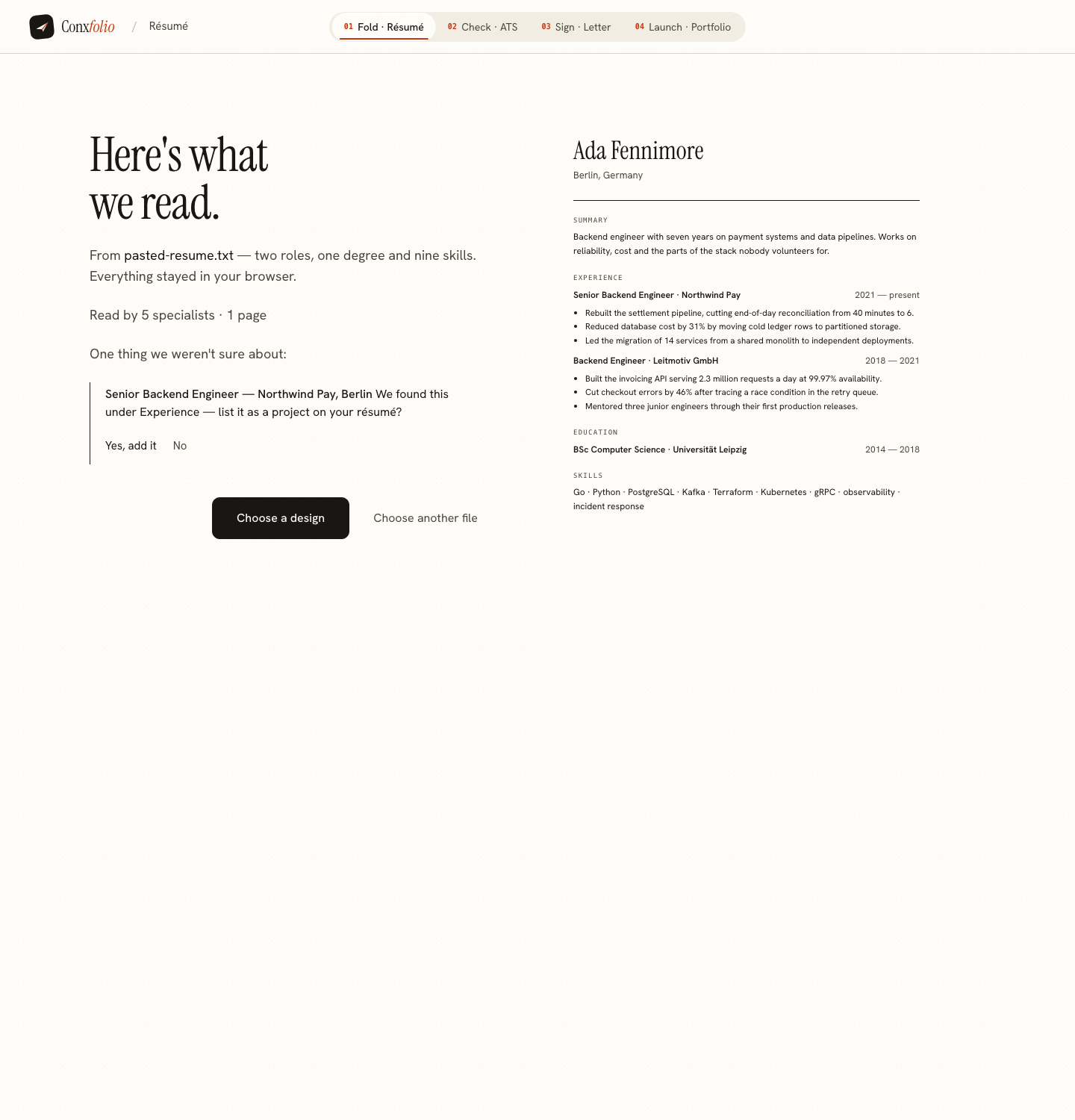
There are two ways for a résumé parser to produce a field you never wrote. It can invent one, which is what a language model does when the document is quiet. Or it can assemble one: take a fragment from the heading, a fragment from the line below, normalise the join, and present the result as a value read from your file.
The second is more common and much harder to notice. The résumé builder closes it with a single verification rule.
The rule
Every string a specialist emits is checked, in code, to be a span of the source document. Not similar to a span. A span. A value that fails the check is dropped, and the drop is recorded with the place it was going to land and the reason it was removed. The reader is allowed to decide where your sentence belongs. It is not allowed to produce a sentence that is not in your file.
What the reading line says

The line is built from counts and nothing else. How the document was read, how many pages, how many pages needed optical character recognition, how many lines were dropped, how many sections a specialist re-filed, and how many questions are still open. No clause is printed for a zero, which is why the line above has no drop clause: the pasted text produced none. And when a response carries no reading report at all, the line is not printed. A sentence about a reading that did not happen is a claim this product does not make.
Where drops actually come from
On a pasted document, rarely anywhere. On a PDF, from the page itself. Running headers, page numbers, footers and the residue of a scanned page are removed at the extraction boundary and counted there, each with the page it came from and the reason: page furniture, or noise from optical character recognition. That is the same boundary described in pulling text back out of a PDF, where we exported a file from this product and read it back in.
A drop is not an empty field
They look identical on the page and mean different things. An empty field is one the reader never found: our test import reported Target role and LinkedIn as not found, because the document did not contain them. A drop is a value that existed, failed verification, and was removed. Counting only the second is deliberate, because only the second is a decision the software made about your text.
What the count is for
It gives you somewhere to look. Three dropped lines on a two-page PDF is a signal about the file, not about your career: the text layer is fighting the reader, and pasting the text or exporting a cleaner file usually ends the argument. Zero drops and a field you expected to see filled is the opposite signal, and it sends you to the import review to put it in by hand.
How to read a drop count of three
Start with the file rather than with the content. Three dropped lines on a two-page PDF usually means running headers and a page number, which cost you nothing, or a scanned page whose noise is being cleared, which costs you plenty. The reading line says which, because pages that needed optical character recognition get their own clause. Where it does, paste the text instead and compare the two readings.
Then check the review against the document in front of you. A drop removes a value, so its absence shows up as an empty field or a missing entry, and the review is editable in place. Nothing about a drop is permanent: it is a report on one reading of one file, and typing the value in by hand is both allowed and, with a PDF that is fighting you, faster than another import.
What this does not do
Verification is not accuracy. A value can be a perfect span of your document and still be filed under the wrong heading, which is why the reader also asks when it is unsure and why the review is editable. What the rule guarantees is narrower and worth more: nothing on your résumé arrived from anywhere except your résumé.
Import a file and read the line
The reading line counts what happened to your document: how it was read, how many pages, how many lines were dropped, and how many questions are open.
Open the résumé builderSee the reader's rulesQuestions
- What is a dropped field
- A value a specialist produced that failed verification against the source text. Rather than show it, the reader removes it and records the drop with the place it was going to land and the reason it was removed.
- Why would a value fail verification
- Because every string a specialist emits has to be a span of the source document. A value stitched together from two places, or normalised into something the document does not say, is not a span, so it does not survive.
- Does the product tell me when something was dropped
- Yes, as a count in the reading line. Our test import dropped nothing, so the clause is absent from the line in the picture. No clause is printed for a zero, and no line is printed at all when a response carries no reading report.
- Are drops the same as fields it left empty
- No. An empty field is one the reader never found. A drop is one it found, could not verify, and removed. Both end as nothing on the page, and only the drop is counted.
- Does a drop mean my file is bad
- Not by itself. Page furniture in a PDF, headers, footers and noise from a scanned page are the usual causes, and the same file pasted as text often reads with no drops at all.
Conxfolio is a free set of four career tools: a résumé builder with 37 rendered layouts, an ATS résumé checker that prints its own arithmetic, a cover letter builder that traces every proof paragraph back to the line it came from, and a portfolio builder with 20 authored designs. There is no account to create, nothing is held back for a paid plan, and no language model is used anywhere in the product, so the readers, the score and the letter are deterministic code you can check.