An uncertain parser should ask you, and nothing should move until you answer
A parser that is unsure has three options. Two of them are guessing and failing. The third one is the only one that keeps you in charge of your own document.
— the question is the feature; the guess is the bug.
Parsing a résumé is a classification problem with no ground truth. A block headed "Northwind Pay, 2021 to present" with four achievement lines under it could be a job, a contract, a consulting engagement or a side project, and the document rarely says which. A parser will meet that ambiguity on most real files.
What it does next is the whole design. The résumé builder asks.
What the question looked like
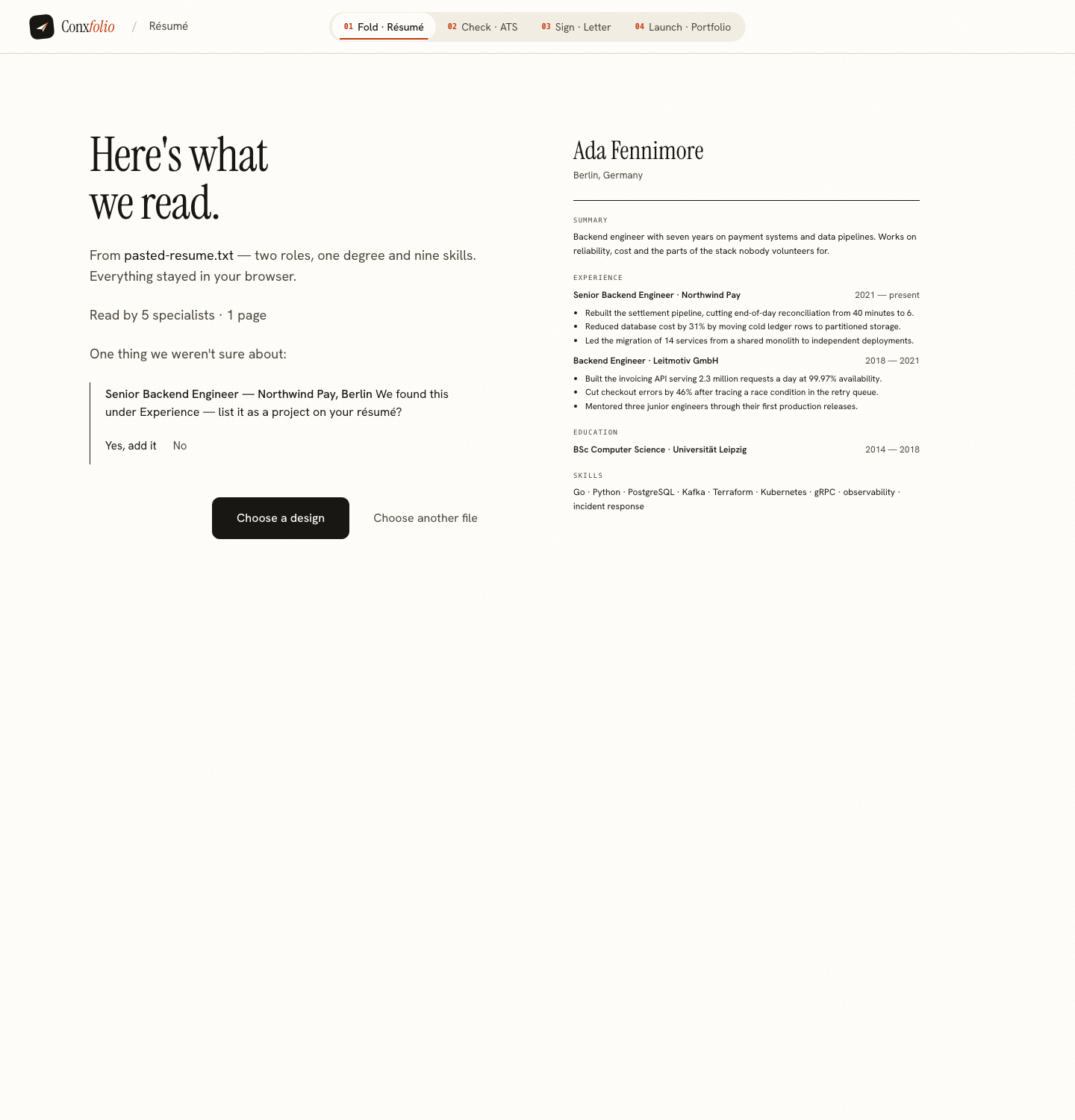
We imported a 162-word résumé for Ada Fennimore, an invented engineer. The reading was confident about nearly all of it and unsure about one thing. The review said so in a band of its own: one thing we were not sure about, naming the entry, and asking whether the role read under Experience should be listed as a project on the résumé instead. Two answers were offered. Under them sat the line that matters more than either of them: nothing is on your page until you answer, and you can change it later.
Where the question is rendered
A question is not collected into a modal at the end. It is rendered where its section sits, so the thing being asked about is on the screen beside the asking. A question whose section cannot be matched to a block on the page is printed under the last section rather than dropped, because a question nobody can see is the same as no question at all.
Why an unsure reading is not a failure
The specialists that read the document each return a confidence in what they found. When one reading clearly beats the others, it is adopted and the reading line says a section was re-read as experience, or as projects. When two readings are close, that margin is the uncertainty, and the honest output of a close margin is a question rather than a coin toss the software performs on your behalf.
Nothing is applied until you answer
This is the part that separates a question from a suggestion. An unanswered question changes nothing: the rules' reading stands, the page stays as it was, and the count of open questions appears in the reading line so you know one is outstanding. Answering records the answer against the section and the question itself, so a later re-read of the same file lands on the same decision instead of asking again.
The alternative, and what it costs
An automatic answer is right most of the time, which is exactly what makes it expensive. The one time in six that a contract becomes a full-time role on your document is not a formatting problem, it is a claim you did not make, sitting under your name, in front of someone who may check it. A reader that cannot write a sentence you did not write, as described in how the résumé reader works, should not be allowed to make a claim you did not make either.
What an answer is recorded against
Not against the reading, which is remade every time a file is read, but against the section and the question itself. That pairing is the provenance, and it is why re-importing the same document does not produce the same question twice: the answer is already attached to the thing being asked about. An answered question also stops being counted in the reading line, in the same way the ATS report counts improvements rather than rules.
The band holding the answers is the same one the product uses for its other section questions, so the two kinds read as one thing rather than as two features that arrived in different months. Underneath all of them sits the same sentence: nothing is on your page until you answer, and you can change it later.
What questions do not do
They do not make the reading better than the document. If your file has no dates, no question will invent them. They also do not tell you whether the result reads well to an employer's software; that is a measurement, and it lives in the ATS checker with its counts printed on the report. What the questions do is keep every decision about your own history in your hands, which is the least a piece of software can offer and more than most of them do. The rest of the review, including the fields it declined to fill, is in what the import review catches.
See what it asks about your file
Import a résumé and the questions, if there are any, appear where their sections sit. Answer them or leave them; nothing moves on its own.
Open the résumé builderRead what the review catchesQuestions
- How many questions will my import produce
- As many as the reading was genuinely unsure about, which is often none. Our test file produced one. A question is generated from a specialist's own uncertainty, not from a template, so a clean document produces a clean review.
- What happens if I ignore a question
- Nothing. An unanswered question leaves the reading as the rules read it, and the question stays visible until you answer it or move on. The product says so on the band itself.
- Can I change my answer later
- Yes. An answer is recorded against the section and the question, and the surface says plainly that you can change it later.
- Why not just pick the most likely answer automatically
- Because the most likely answer is still a guess about your career, and the cost of a wrong guess is a document that misrepresents you in front of an employer. The reader is allowed to be sure when it is sure. When it is not, the decision is yours.
Conxfolio is a free set of four career tools: a résumé builder with 37 rendered layouts, an ATS résumé checker that prints its own arithmetic, a cover letter builder that traces every proof paragraph back to the line it came from, and a portfolio builder with 20 authored designs. There is no account to create, nothing is held back for a paid plan, and no language model is used anywhere in the product, so the readers, the score and the letter are deterministic code you can check.