Down to two designs, and how to decide between them
Choosing a design is the last decision and the cheapest one. Here is a procedure that takes five minutes rather than an evening.
— look at the exported file, not the preview.
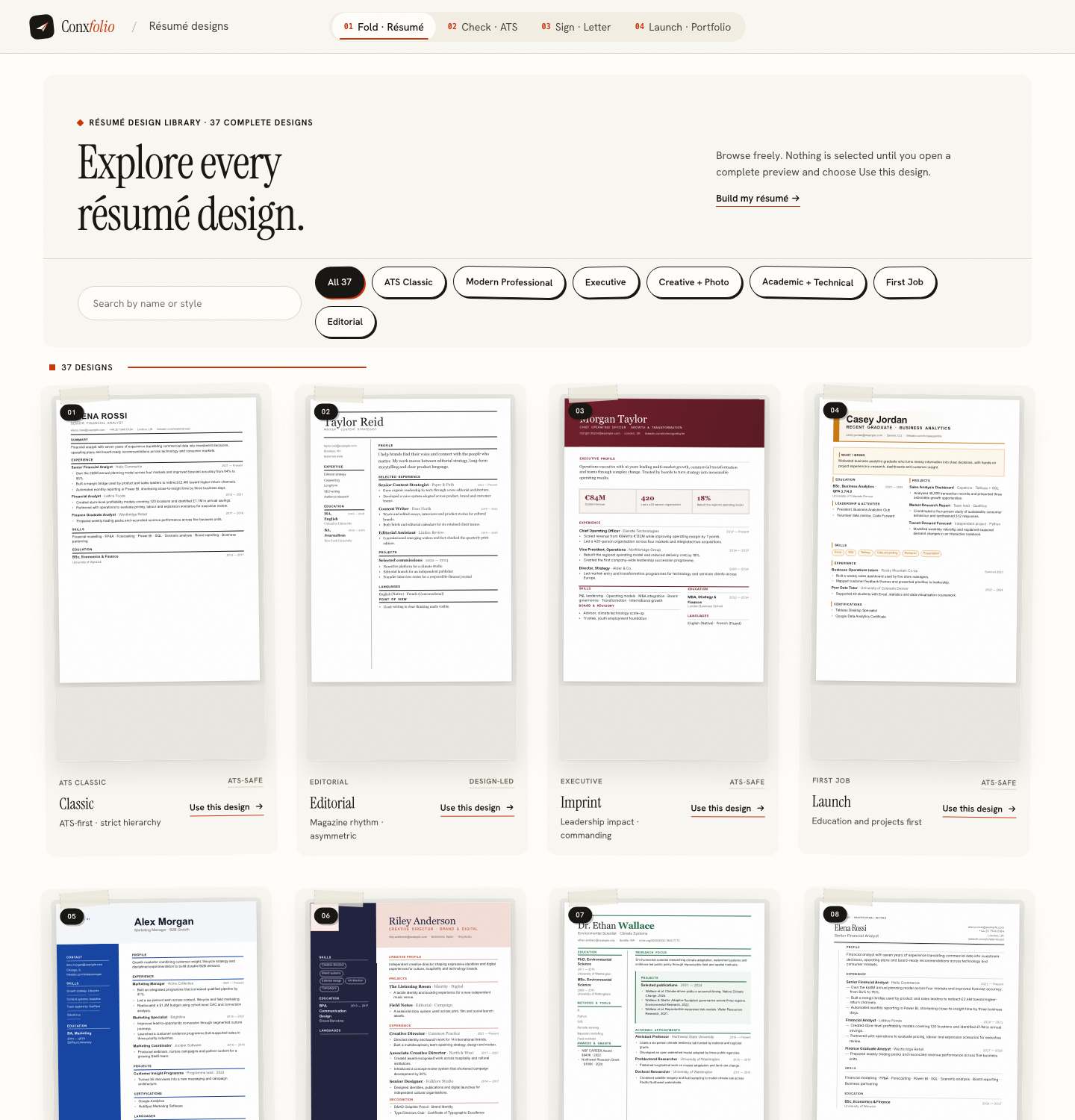
By the time two designs are in front of you the writing is done, which is the right order. What follows is a procedure rather than a taste argument.
Question one: who reads it
A public body, a hospital, a bank or an unknown employer rewards the plainer of the two. A studio, an agency or a design team is the case where the document is partly a sample of your work. If you do not know, choose as though the reader were conservative, because the downside is asymmetric.
Question two: does it stay in one column
A sidebar is the single most expensive layout decision, worth 22 points of parseability when a multi-column pattern is detected. If one of your two designs has one, the decision is already made. The 21 designs carrying the ATS-safe mark are a structural promise about this, described in what ATS-safe means on a design.
Question three: where do the pages break
The same words run to different lengths in different designs. Look at whether the second page carries evidence or three stray lines, which is a real difference to a reader holding two sheets. White space and the second page covers the lever, and why two pages is usually fine the principle.
Question four: what does the file look like
Export both PDFs from the résumé builder and read the files rather than the previews. Exports are free in every design, so this costs two clicks. The file is what an employer receives, which is the whole of the export is the document.
The tiebreak nobody uses
Run the ATS checker on both exported files. If one extracts more cleanly than the other, that is a measured difference rather than an opinion, and it decides the question. The counts to read are words, lines and recognised headings, as set out in what the checker read counts.
Two things that are not tiebreaks
Which one you like more after looking at it for twenty minutes, because familiarity is not information. And colour, which usually survives on a screen and drops on a printer, as colour on a résumé and printing a résumé both note.
What to do when you genuinely cannot decide
Send the plainer one. The reasoning is about risk rather than taste: a conservative reader meeting a plain document notices nothing, and a relaxed reader meeting a plain document also notices nothing. The distinctive design only pays where you know the reader values it, which is a small set of employers and a set you usually know you are in. An undecidable choice is by definition one where the difference is small, so the tiebreak should be the option whose downside is zero, and the other design is still there for the next application.
What this page does not claim
That either design gets you read. Nothing here measures that, and a design decision is worth less than a single rewritten achievement line. The reason to have a procedure is to stop the decision consuming an evening it does not deserve, which is time better spent on the writing that how to write experience bullets covers.
One structural point that makes all of this cheap. The words and the rendering are held separately here, so switching design never touches a sentence and never loses a field. That means the decision is reversible in both directions: you can send one design today, change your mind, and send the other tomorrow without rebuilding anything. A choice you can undo deserves five minutes, and a design is not a rewrite explains why it works that way.
A final note about consistency across documents. If you are sending a letter as well, choose a letter design that sits comfortably beside the résumé rather than one chosen independently. The two arrive together and are read together, and a formal résumé beside an expressive letter reads as an accident. Both galleries are free to browse and both decisions are reversible, so matching them costs a minute and removes a small distraction from the reader's first impression.
Try both and export both
Switching design re-renders the same words. Trying the second one costs nothing and can be undone.
Open the résumé builderOne résumé, four designsQuestions
- Does the design affect my score
- It can move parseability, because layout decides how cleanly the text extracts. It cannot move completeness or content.
- How do I compare them fairly
- Export both as PDFs and read the files. A preview in a browser is not the document somebody receives.
- Which is safer for an unknown employer
- The plainer of the two, and among the 21 designs carrying the ATS-safe mark. A conservative choice costs nothing if the reader is relaxed.
- Is a distinctive design ever right
- In fields where the document is itself a sample of your work, and where you know the reader. Elsewhere it is a risk taken for no measurable return.
- Can I change after sending
- Yes, for the next application. The words are unaffected and both exports stay free.
Conxfolio is a free set of four career tools: a résumé builder with 37 rendered layouts, an ATS résumé checker that prints its own arithmetic, a cover letter builder that traces every proof paragraph back to the line it came from, and a portfolio builder with 20 authored designs. There is no account to create, nothing is held back for a paid plan, and no language model is used anywhere in the product, so the readers, the score and the letter are deterministic code you can check.