Two pages, one page, and where the rule comes from
The one-page rule is an American convention, not a law, and public guidance elsewhere says something different. Here are the sources.
— length is a consequence of relevance, not a target.
The one-page rule is repeated as though it were universal. It is a convention, it varies by country and by employer, and public guidance says different things depending on where you look.
What public guidance actually says
In the United States, the Office of Personnel Management publishes applicant guidance on a two-page résumé limit for federal hiring under its Merit Hiring Plan (opm.gov), which is an explicit limit of two rather than one. In Northern Ireland, nidirect's CV guidance says one A4 page is preferable (nidirect.gov.uk). In Germany, the federal employment agency's Lebenslauf guidance describes a tabular document of at most two pages (arbeitsagentur.de).
Three sources, three answers
That is the useful finding. If a single correct length existed, three public bodies advising jobseekers would have converged on it. They have not, because length is a consequence of what you have to say and who you are saying it to.
What our scorer does about length
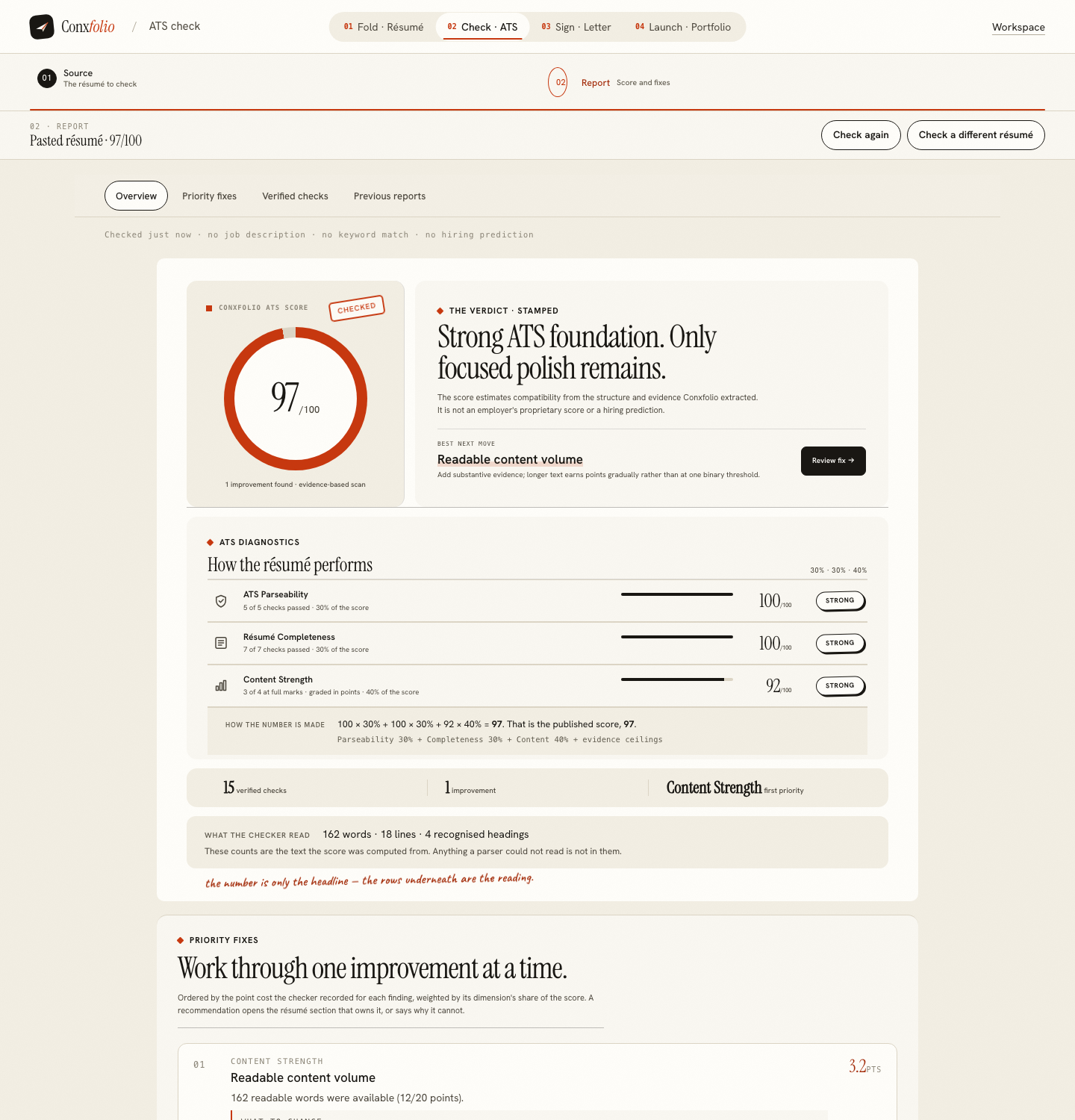
Nothing at all about pages. The ATS checker measures readable volume as one of four content rules, worth up to 20 points: 250 or more words earns the full 20, 120 or more earns 12, 60 or more earns 5. Above 250 words it stops rewarding, which is the closest thing to an opinion the engine holds, and it is a floor rather than a target.
The rule that actually matters
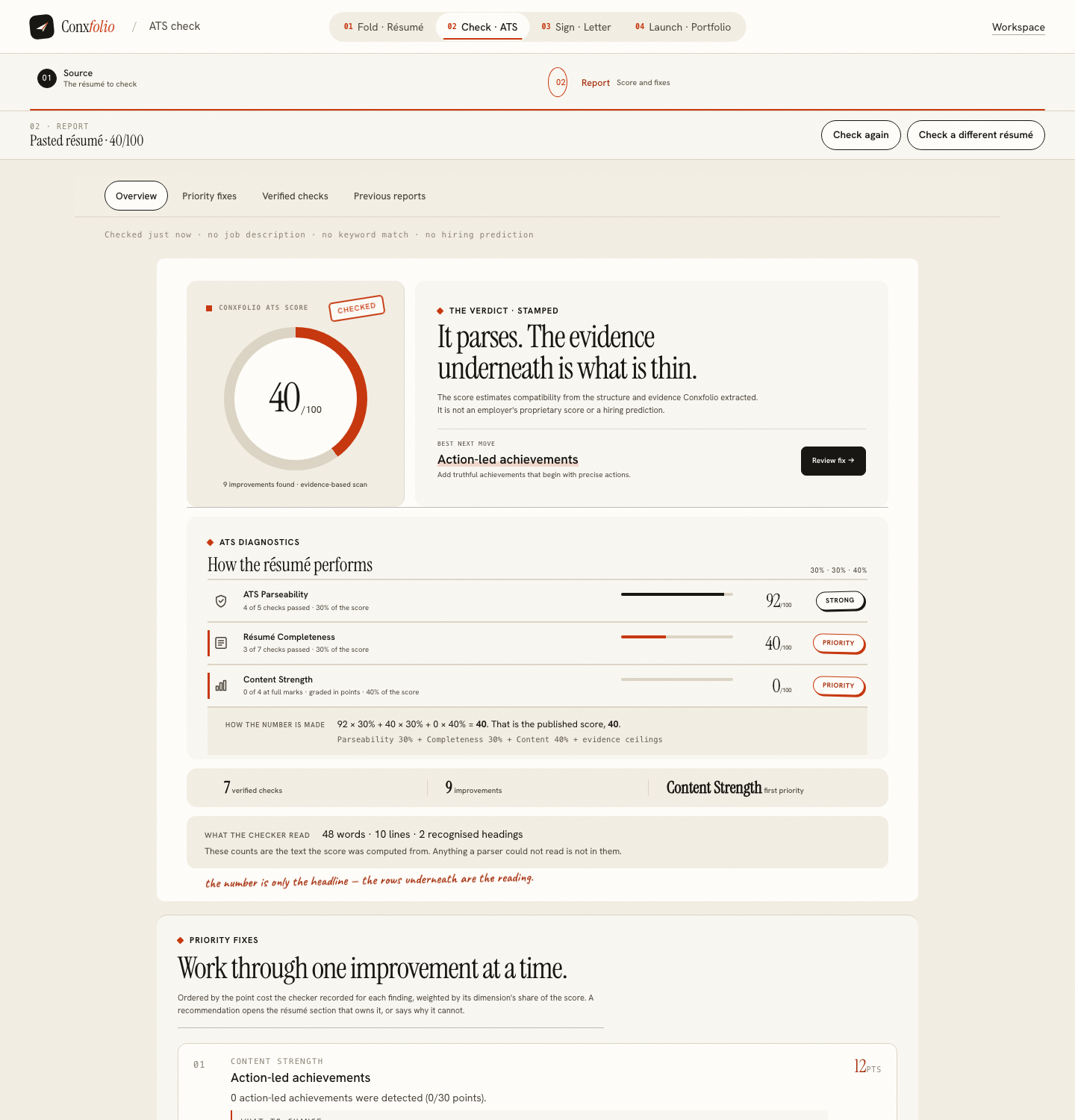
Evidence depth, worth 25 points, rewards evidenced lines across roles: five or more earns the full 25, three or four earns 18, one or two earns 10. A document with enough evidence to earn that is rarely one page, and a document padded to two pages without it earns nothing extra.
When one page is the right answer
Early careers, and any advert that asks for one. A first-job résumé usually does not have two pages of evidence, and stretching it produces exactly the filler that makes a reader sceptical. A résumé for a first job covers the shape.
When two is the right answer
When the second page carries roles and evidence rather than interests and references. Ten years of work in two columns on one page is a worse document than the same work laid out over two, because the compression is what breaks the extraction. The trade-off is in one page or two and how far back a résumé should go.
Where the one-page rule does come from
From American practice, and from a period when documents were read on paper in piles. It spread through advice written for that market and was repeated in places whose own guidance says something different, which is how a local convention becomes an international rule nobody can source. The useful response is to check the guidance for the country you are applying in, and to follow the advert when it says anything at all. An instruction in a posting beats every convention, and it is the one piece of evidence about this employer that you actually have.
What this page does not claim
That any particular employer will accept two pages. Some ask for one and mean it, and an advert's instruction beats every convention on this page. What is claimed is that no general rule exists, that three public bodies advise differently, and that our measurement counts evidence rather than paper.
The practical order of work follows from that. Write the evidence first and let the document be as long as the evidence makes it. Then, if it needs to be shorter, cut from the oldest roles rather than compressing the newest, because the oldest are the ones a reader cares least about. Margins and spacing are the last lever, and using them to rescue a stray second page is covered in white space and the second page; printing the result is in printing a résumé.
One practical consequence of the guidance disagreeing. If you apply across several countries, keep one document and adjust its length rather than maintaining separate versions, because the material is identical and only the cut differs. Trimming the oldest roles to single lines takes minutes in the builder and does not touch the evidence a reader cares about, and the design step's page format setting handles the other half of the difference between an A4 market and a US Letter one.
Measure the document rather than counting pages
Readable volume, evidence depth and completeness, each priced. Length is what falls out of getting those right.
Open the ATS checkerHow long should a résumé beQuestions
- Is one page a rule
- It is a convention, and the guidance varies. The US Office of Personnel Management applies a two-page limit to federal résumés under its Merit Hiring Plan, and nidirect in the UK says one A4 page is preferable for a CV.
- What does your scorer say about length
- Readable volume is worth up to 20 points of the content dimension: 250 or more words earns the full 20, 120 or more earns 12, and 60 or more earns 5. Above 250 it stops rewarding.
- Does a second page cost points
- No. Nothing in the score counts pages. What it counts is words, lines, recognised headings and evidence.
- When is one page right
- Early in a career, and when the advert or the employer asks for it. A first-job résumé rarely has two pages of evidence in it.
- When is two pages right
- When the second page carries evidence rather than filler. A second page of hobbies is worse than no second page.
Conxfolio is a free set of four career tools: a résumé builder with 37 rendered layouts, an ATS résumé checker that prints its own arithmetic, a cover letter builder that traces every proof paragraph back to the line it came from, and a portfolio builder with 20 authored designs. There is no account to create, nothing is held back for a paid plan, and no language model is used anywhere in the product, so the readers, the score and the letter are deterministic code you can check.