Reviewing a friend's résumé without taking it over
Helping with somebody's résumé goes wrong when the helper starts rewriting. A measurement is a better gift than an opinion.
— hand back findings, not a rewrite.
Being asked to look at somebody's résumé is a request for help that usually turns into a request to be rewritten. A measurement avoids that, because it moves the conversation from your taste to their document.
Check their file, not their text
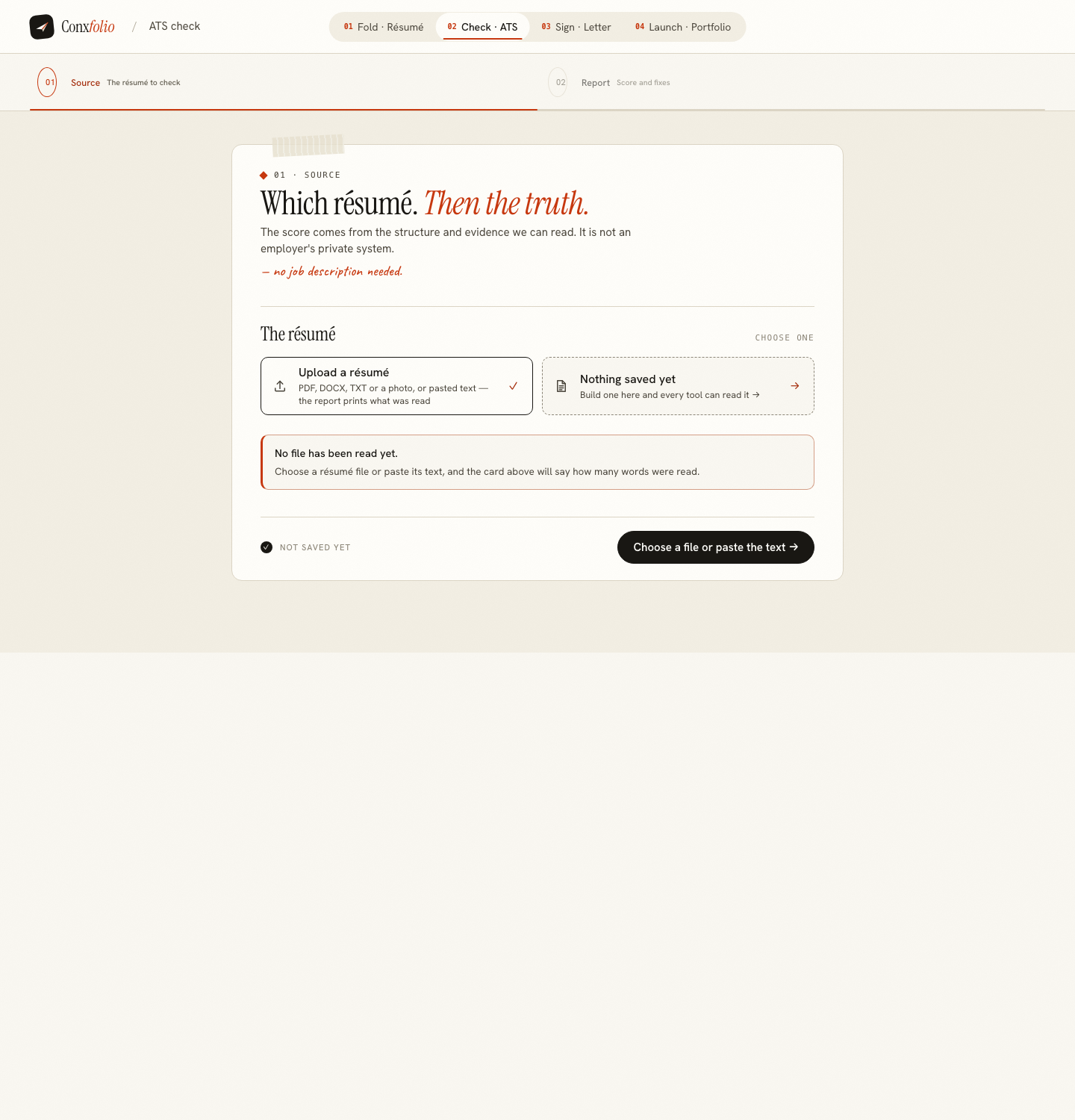
Ask for the exact file they send rather than the text, and upload it to the ATS checker. The file is where extraction failures live, and those are the faults they cannot see. The source step takes an upload for this check alone, so the résumé saved in your browser stays where it is.
Read the counts before the score
Words, lines and recognised headings. A specimen in this estate read 162 words, 18 lines and 4 headings; a broken document read 48, 10 and 2. If their two-page document reports numbers like the second set, tell them that first, because it changes what everything else means.
Then hand back the findings, priced
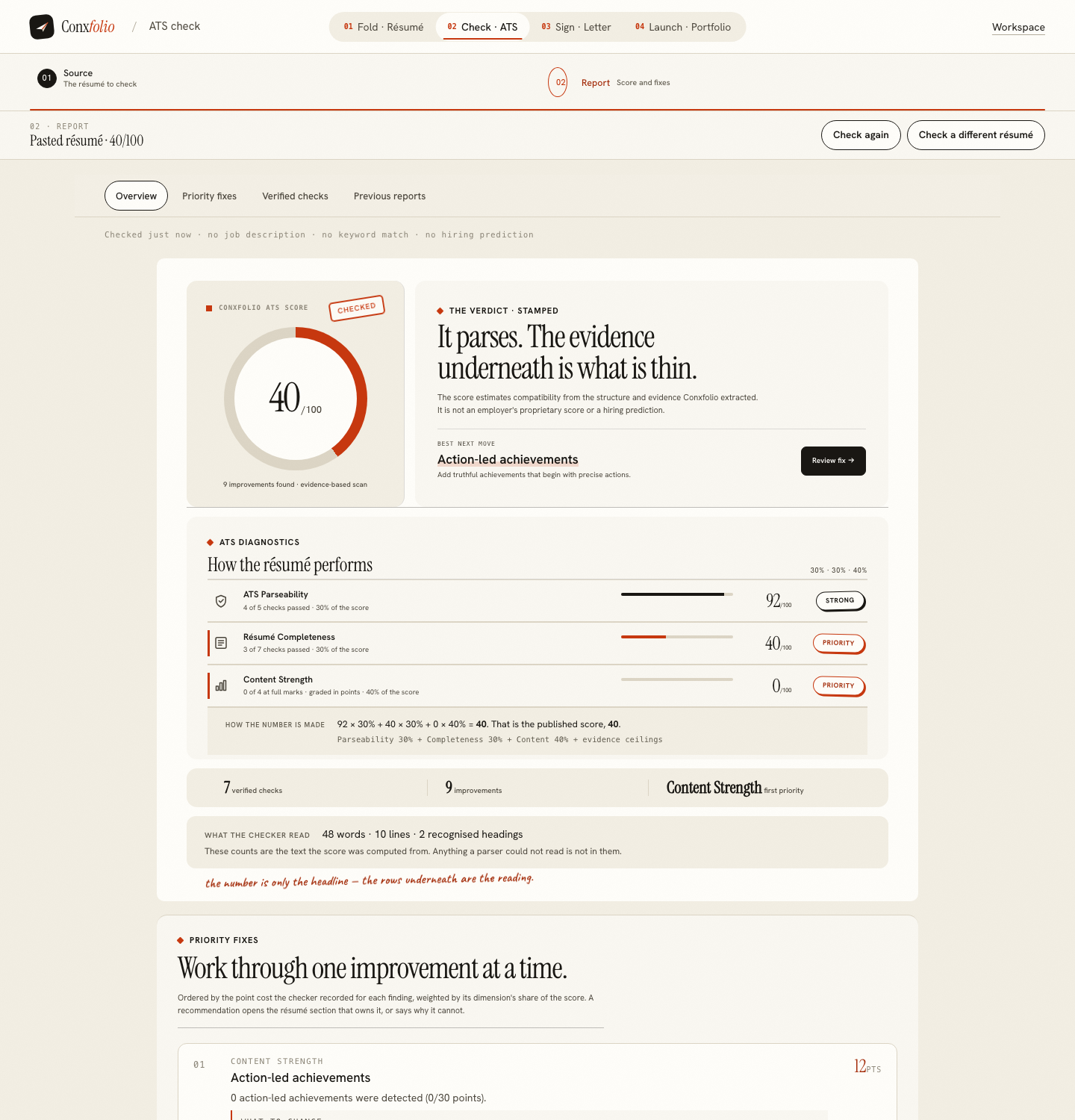
The report says which check failed, why, and what fixing it is worth. That is a list they can work through in their own words. A document returned covered in your rewrites is a document they have to defend in a room you will not be in.
The one thing worth being firm about
Structure. A sidebar, a table or contact details in a header region are not matters of taste, and they cost real points before anybody reads a word. The repair is in fixing a two-column résumé step by step, and the reasoning in why résumés get scrambled.
Where to be gentle instead
The content dimension. A low content score usually means real work has been written as responsibilities rather than as achievements, which is a writing habit rather than a shortcoming. Point them at how to write experience bullets and at evidence you forgot you had, and let them find their own numbers.
If they are on a different device
Nothing here needs an account, so they can run the same check themselves on a phone, a tablet or a Chromebook, all of which were measured at 0px of horizontal overflow. Sending them the address is often better than doing it for them, and writing a résumé on a phone is the measurement.
How to give the feedback so it is used
Lead with the measurement rather than the opinion, because a measurement is not a judgement of their writing. Tell them what the reading counts were and what that means. Give them the two or three findings the report priced highest, in the report's own words. Then stop, and offer to look again afterwards. What makes people abandon feedback is volume: a list of fourteen comments reads as a verdict on the document and produces nothing, while three priced items read as a task and usually get done that week.
What this page does not claim
That a review improves their chances. Nothing here measures outcomes, and the most useful thing you can do for somebody is usually to tell them their document is not being read properly and show them the counts that prove it. That is a fact rather than an opinion, which is the only kind of feedback that survives a disagreement.
One practical note about your own browser. There is a single saved document per address here, so importing their résumé into the builder would replace yours. For a check, use the upload-for-this-check-alone door. If you are going to do real editing work on their behalf, use a separate browser profile or a private window, which keeps the two sets of work apart, and keeping two résumés at once covers the case where both documents are yours.
A final note on scope. It is worth agreeing at the start what you are being asked for, because review and rewrite are different favours and people ask for the first while hoping for the second. Offering the measurement and the three priced findings is a bounded, useful piece of help that takes fifteen minutes. Rewriting somebody's career in your own voice takes an evening, produces a document they cannot defend, and is the version that ends with nobody mentioning it again.
Check their file, not your idea of it
Upload for this check alone. The report names every finding and prices it, which is what to hand back.
Open the ATS checkerChecking a résumé you did not writeQuestions
- Will their document overwrite mine
- The source step offers an upload for this check alone, so their file can be checked without replacing the résumé saved in your browser.
- What should I look at first
- The reading counts: words, lines and recognised headings. If those are far below what is on their page, the extraction is the story and nothing else matters yet.
- Should I rewrite their lines
- No. Show them which rule is failing and what it is worth, and let them write it. A rewritten line in your voice is a line they cannot defend.
- What if their score is low
- A low score usually means the evidence never reached the scorer. Say that, because it is both true and kinder than the number looks.
- Is there an account involved
- No. There is no account anywhere in the product, so nothing about this attaches to either of you.
Conxfolio is a free set of four career tools: a résumé builder with 37 rendered layouts, an ATS résumé checker that prints its own arithmetic, a cover letter builder that traces every proof paragraph back to the line it came from, and a portfolio builder with 20 authored designs. There is no account to create, nothing is held back for a paid plan, and no language model is used anywhere in the product, so the readers, the score and the letter are deterministic code you can check.