How to check a résumé somebody else wrote
Upload the file, read the whole report, and leave nothing behind. On the run measured for this page, the browser held no saved résumé afterwards.
— their file, not your folio.
People ask other people to look at their résumé. A friend changing career, a colleague being made redundant, a student in a mentoring scheme, a partner who has not applied for anything in nine years. The awkward part is that most feedback on a résumé is taste, and taste is hard to act on.
The ATS checker gives you something else to talk about: what a machine reading of the document actually recovers, and what each remaining problem costs.
Reading a file that is not yours
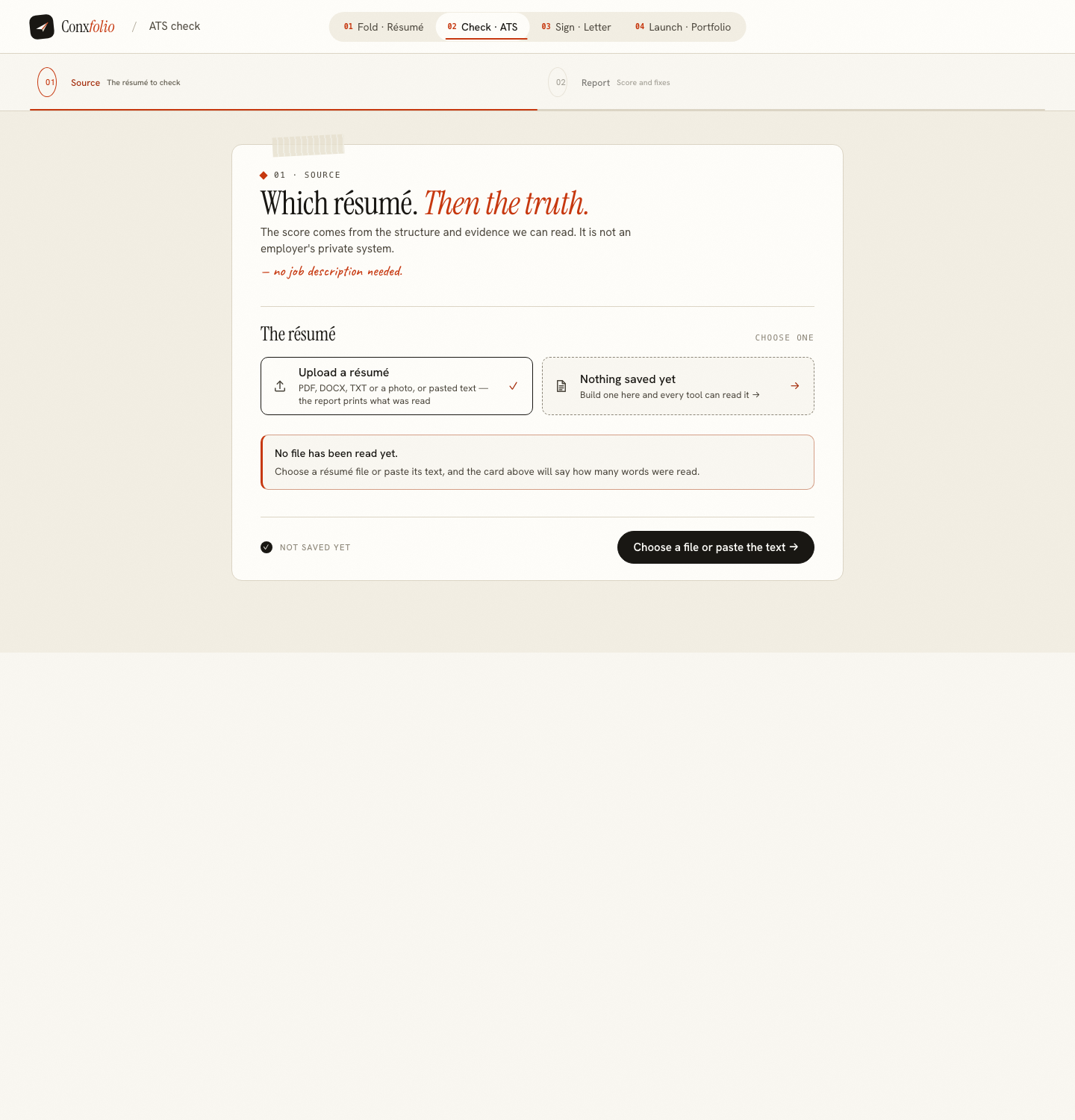
The source step offers two things: a résumé saved in this browser, or a file uploaded for this check alone. Take the second. Accepted formats are PDF, DOCX, plain text, Markdown, RTF and images, so whatever they emailed you will do, including a photograph of a printed page.
The file is read in your browser first. Only where your browser cannot read it is the file itself sent on. Then the text is scored, and the route that scores it writes nothing to disk or to a database.
Nothing is kept
This was measured rather than assumed. After uploading a PDF, running the check and reading the report, the browser's stored state held zero saved résumés. Their document did not become an entry in your folio, and you do not have to remember to clear anything afterwards.
If you do want to work on it with them, the import into the résumé builder is a separate, deliberate action, and the fixes chapter offers it explicitly rather than doing it quietly.
The number, and why it is useful in a review
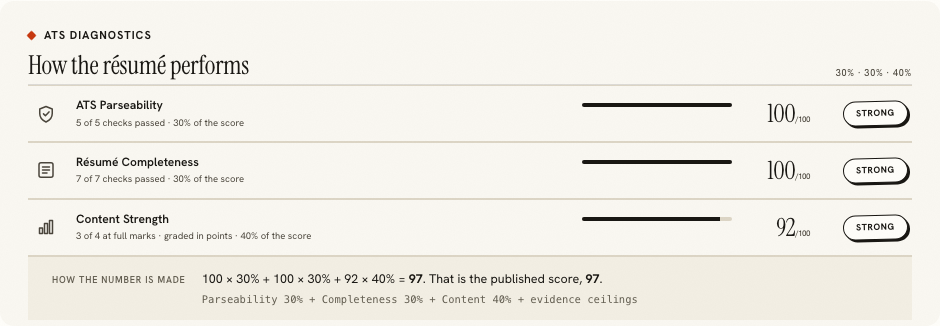
The report prints the multiplication. On the run photographed here the arithmetic read 100 times 30 per cent plus 100 times 30 per cent plus 92 times 40 per cent, published as 97, on a document that extracted to 159 words, 20 lines, 4 recognised headings, 2 roles and 9 skills. The candidate is invented for these captures and is named as invented wherever she appears.
In a review, the counts matter more than the score. If the document is two dense pages and the checker reports 60 words, the layout is destroying it, and that is a concrete, fixable finding rather than an opinion. What the checker read explains why that line is the first thing to look at.
Giving feedback from the fixes list
The fixes chapter orders findings by the points each one costs, with the change spelled out. That ordering is the single most useful thing to hand somebody, because the usual failure of résumé advice is a list of eleven equally weighted suggestions. Here two of them are worth sixteen points and the rest are worth one.
The verified checks chapter is worth reading aloud as well. Most people being helped with a résumé are braced for criticism, and the list of what already passed is honest, specific praise. Why an ATS score is low is a good companion piece for the conversation.
What you must not say
Do not tell them this predicts whether they will be filtered out. It does not. It is not an employer's applicant tracking system, it has no access to one, and it never sees a job description. It measures whether a machine reading of their document recovers their work, and how much evidence the words carry.
It says nothing about the person. A low score on a thin résumé usually means the writing is under-selling real work, not that the work is thin, which is exactly the thing a reviewer is there to notice.
Their privacy, and yours
A résumé is personal data about somebody else: a home town, an email address, a phone number, an employment history. Ask before you upload it, delete the file from your downloads afterwards, and do not paste it into anything that keeps it. The measurement above is the reason this tool is a reasonable place to put it, and it is not a reason to be casual with the file elsewhere.
If they would rather run it themselves, send them the no-account walkthrough. It takes about a minute and needs no email address, so there is nothing to set up before they can see the same report.
What to do with the report afterwards
Send them the address rather than the screenshot. The check is free, takes about a minute and needs no account, so the person whose résumé it is can run it themselves and keep the report in their own browser, where the previous reports chapter will remember it and show what a fix was worth.
That also avoids the reviewer trap, which is becoming the person who holds the good copy. A friend who has run the check once will run it again after each change, and the second run is where the value is. The one-minute version is checking a résumé without an account, and if their file is a scan or a photograph, checking a scanned résumé explains what that costs before they wonder why the score is low.
Read somebody else's file, keep nothing
Upload a PDF, DOCX, text file or photo, read the whole report, and leave no copy in this browser.
Open the ATS checkerRead what the score meansQuestions
- Does checking their file save it to my browser
- No. On the measured run the browser held zero saved résumés after the check. An uploaded file is read for that check and does not enter your own folio unless you choose to import it.
- Is their résumé sent anywhere
- The file is read in your browser first. Only the text is sent to be scored, and only if your browser cannot read the file is the file itself sent instead. Nothing is written to disk or to a database by the score route.
- Do I need their permission
- That is a matter between you and them, and it is worth asking. A résumé is personal data about somebody else.
- Will it tell me whether to hire them
- No. It measures how readable the document is and how much evidence it carries. It is not an employer's applicant tracking system, it does not use a job description, and it says nothing about a person.
- Can I show them the reasoning
- That is what the report is for. It prints the multiplication that produced the score and prices each remaining fix in points, so a review is a conversation about the document rather than about a number.
Conxfolio is a free set of four career tools: a résumé builder with 37 rendered layouts, an ATS résumé checker that prints its own arithmetic, a cover letter builder that traces every proof paragraph back to the line it came from, and a portfolio builder with 20 authored designs. There is no account to create, nothing is held back for a paid plan, and no language model is used anywhere in the product, so the readers, the score and the letter are deterministic code you can check.