How to check a scanned or photographed résumé
An image has no text layer, so recognition runs in the browser before anything is scored. A measured scan of a clean page read 157 words and scored 75, and the difference from the original is the useful part.
— a photo is not a document.
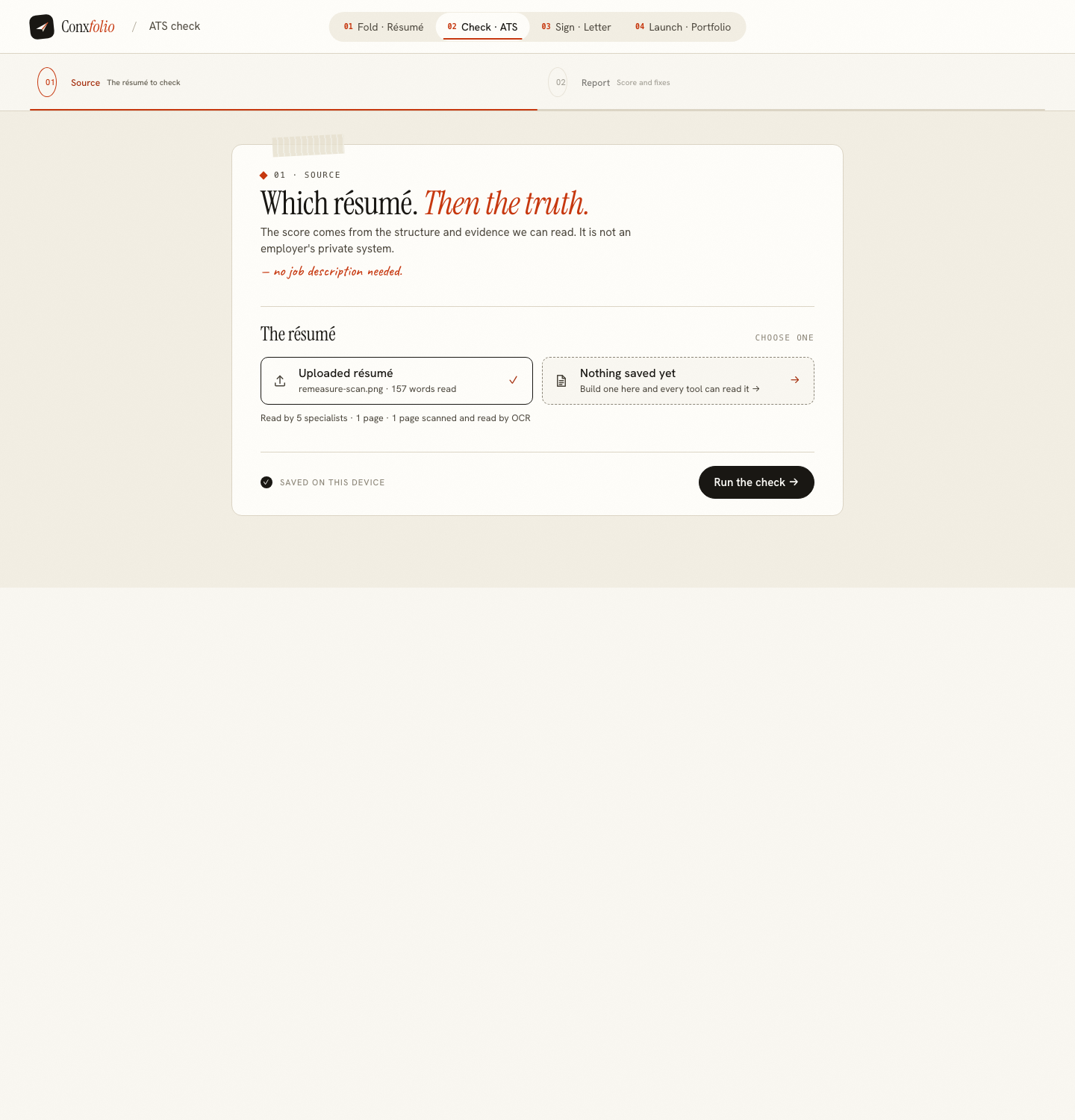
Scanned résumés exist for good reasons. A printed copy is the only one left, the original file was on a laptop that died, or somebody photographed a page and sent it from a phone. An application portal will accept the image without complaint, and then a parser will read almost nothing out of it.
The ATS checker reads images through the same path, so it can show you exactly what that costs.
What happens to the image
An image has no text layer, so text has to be recognised from the pixels. That recognition runs in this browser. The image bytes stay in the tab, and only the recovered text is sent to be scored. Seven languages are supported: English, German, French, Spanish, Italian, Portuguese and Dutch.
The same path handles a PDF whose pages are pictures, which is what a flatbed scanner produces. A PDF with a real text layer takes the direct route instead, described in pulling text back out of a PDF.
The measurement, and why it is worth printing
For this page the test was made as fair as possible. A résumé rendered by this product as a one-page A4 PDF was rasterised at 150 dpi into a PNG, which removes the text layer and leaves a clean, straight, well-lit page: a far better scan than a phone photograph of a creased sheet.
That image went through the checker. It recovered 157 words, 19 lines, 4 recognised headings, 2 roles and 9 skills, and the report printed 100 times 30 per cent plus 85 times 30 per cent plus 49 times 40 per cent, published as 75.
The same résumé as a text PDF read 159 words, 20 lines, 4 recognised headings, 2 roles and 9 skills, and scored 97. The candidate is invented for these captures and is named as invented wherever she appears.
When this page was first published on 12 September the same test published 60, with content at 12. Two things have changed since, both in the product rather than in the scan: the exporter now writes its bullet marks into the text layer, and the achievement rule's verb list went from 34 entries to 406 with a fallback for regular past-tense verbs. The fixture above was rasterised fresh from today's export for the re-measurement.
Where the twenty-two points went
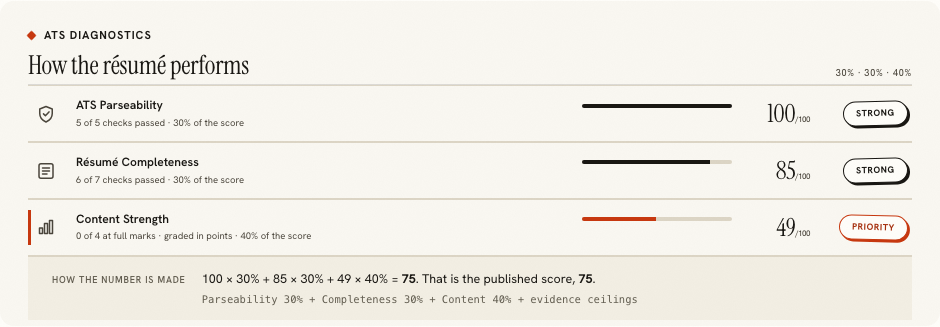
Almost all of it from one dimension. Parseability stayed at 100 and completeness only slipped to 85, because the name, the contact details and the section headings all came through. Content fell from 92 to 49: action-led achievements 15 of 30 on one recognised line, measurable evidence 12 of 25, evidence depth 10 of 25 on that same single line, readable volume 12 of 20.
The reason is mechanical rather than mysterious. The content rules reward achievement lines, and a line counts when it starts with a bullet mark or a recognised action verb. Recognition of a rendered page does not recover the bullet glyphs as characters, and it does not reliably keep one achievement to one line either, so six of the seven lines that were plainly achievements to a human reader stopped being countable. The words were all there. The shape was not.
What this tells you to do
Send a text document. That is the whole recommendation, and the measurement is why it is worth taking seriously: a clean, straight, high-resolution scan of a perfectly good résumé lost more than a fifth of its score before any employer saw it, and lost more than a third of it before we widened the verb list. A crooked phone photograph of a folded page will do worse.
If the scan is genuinely all you have, use it as a starting point rather than as the document. Import the recognised text into the résumé builder, correct it against the paper in the review, and export a real PDF and DOCX from the other side. The correcting is ten minutes and it is the only way the structure comes back.
Reading the report on a scan
Two numbers first, in this order. The word count, against the length of the page you are holding, because that tells you whether recognition worked at all. Then the recognised heading count, because headings are what let the checker find sections, and a scan that recovers text but loses headings scores badly for a reason that is easy to fix by retyping four words.
The guide on scanned and image PDFs covers the document side of this, and the headings guide covers which section names are recognised.
What the check is not saying
It is not saying an employer's system will score your scan at 75. It has no access to any employer's software and it never sees a job description. It is saying what a careful machine reading recovered from your image, and that is the quantity every parser is working from. A number that low on a document you know is good is a statement about the file, not about the work in it.
Getting a better scan, if a scan is unavoidable
Four things help, in order of effect. Flat paper, because a fold puts a shadow across a line and shadows eat characters. Even light with no glare, which usually means daylight and not a ceiling lamp directly overhead. The page square in the frame rather than at an angle. And as much resolution as the device will give you, since recognition works on pixels and there is no substitute for having more of them.
Then read the recovered word count before anything else. If the number is close to the length of the page, the scan worked and the remaining problem is structure. If it is far below, no amount of rescoring will help and the honest next step is to retype the document, which the builder makes faster than it sounds because the sections are already laid out for you.
Read a scan, and see what it cost
Upload an image or a scanned PDF. Recognition runs in this browser, and the report prints what it recovered.
Open the ATS checkerRebuild it as a documentQuestions
- Is the image uploaded
- No. Recognition runs in this browser, so the image bytes stay in the tab. Only the recovered text is sent to be scored.
- Which languages are recognised
- Seven: English, German, French, Spanish, Italian, Portuguese and Dutch.
- How much does a scan lose
- Re-measured on 13 September, a clean 150 dpi rasterisation of a one-page résumé recovered 157 words against the original's 159 and scored 75 against the original's 97. The words survived; most of the structure the content rules look for did not. On 12 September the same test scored 60, before the achievement rule's verb list was widened.
- Why does the score fall
- The content dimension does most of the falling, from 92 to 49. Of the seven achievement lines in the original, the report counted one in the scan, which costs both the action-led rule and the evidence-depth rule most of their points.
- So should I send a scan
- No. Use the check to see what a scan costs, then send a text document. A PDF with a real text layer, or a DOCX.
- What if the scan is all I have
- Recognise it here, import the result into the builder, correct it against the paper, and export a proper file. That is the fix rather than a workaround.
Conxfolio is a free set of four career tools: a résumé builder with 37 rendered layouts, an ATS résumé checker that prints its own arithmetic, a cover letter builder that traces every proof paragraph back to the line it came from, and a portfolio builder with 20 authored designs. There is no account to create, nothing is held back for a paid plan, and no language model is used anywhere in the product, so the readers, the score and the letter are deterministic code you can check.