How to check a résumé against an ATS without making an account
No email address, no card, no blurred half-report waiting behind a sign-up. Four steps, about a minute, and it works on a phone.
— no sign-up, promise.
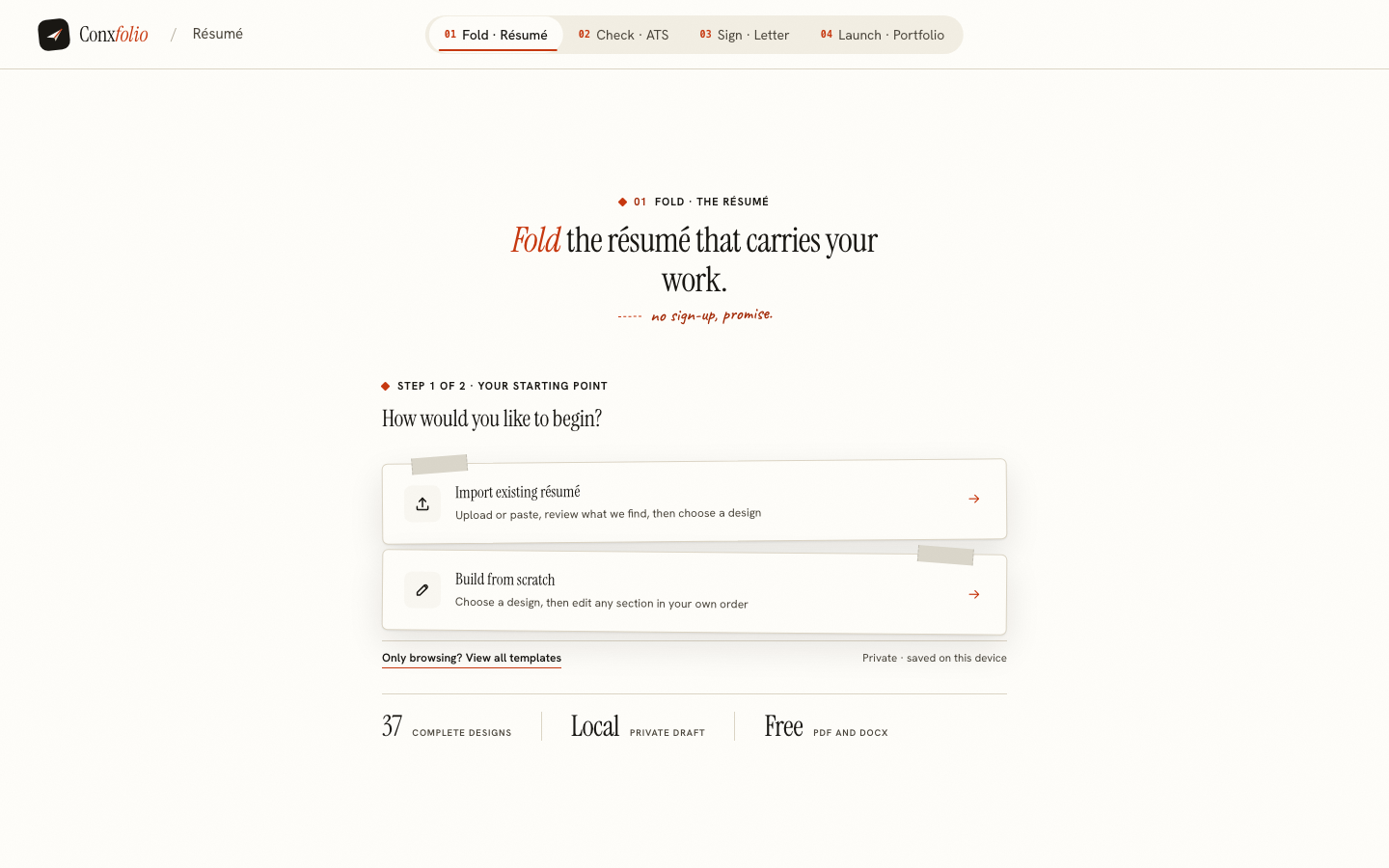
The usual shape of a free résumé check is this: you upload the file, a progress bar runs, a number appears, and then eleven findings sit behind a blur with a button that wants your email address. The check was never the product. The file was the price.
The ATS résumé checker here has no such step, so this article is short. Here is the whole of it.
Step one: open the checker
There is no landing gate, no modal and no "continue with" row of buttons. The first screen offers two sources: a résumé already saved in this browser, or a file uploaded for this check alone.
Step two: give it the résumé
Upload a PDF, DOCX or text file, or switch the dialog to Paste text and paste the résumé itself, which is the fastest route if the document is open in front of you. A file you upload is read in this browser first; only when this browser cannot read it is the file itself sent on to be read. A password-protected PDF is unlocked here after you type the password.
Whichever route you take, the card then states what it got: the file name and the number of words read. That count is the honest preview of everything that follows. If it is far below the length of your page, the extraction is losing your résumé and the score is beside the point.
Step three: run it
Press the button. No job description is asked for, because this check does not use one: it measures the structure and the evidence in your document, which are properties of the document alone.
Step four: read all of it
The report opens as one page with four chapters. The overview carries the score, the verdict, the three weighted dimensions and the arithmetic that produced the number. Priority fixes lists the findings ordered by the points each one costs, with the change spelled out. Verified checks lists what passed, which is the half most checkers hide, and it is the half that tells you what your score is made of. Previous reports keeps the ones you ran before, so you can fix something and see what the fix was worth.
It is the same report on a phone
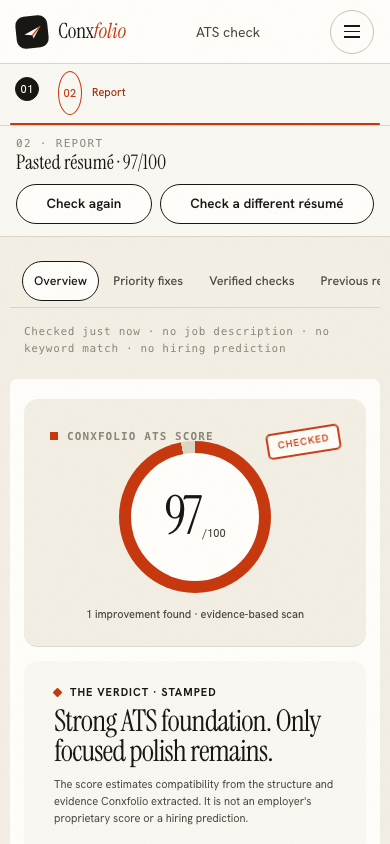
Pasting text on a phone is usually easier than finding a file on one, and the paste route accepts a résumé straight out of a notes app or an email. The four chapters become a scrolling page with the same navigation across the top.
Why there is no account
An account exists for one of two reasons: the product needs to hold something for you, or the company needs to hold something over you. Conxfolio holds your work in your own browser, so the first reason does not apply to the check, the builder, the letter or the galleries. It applies to exactly one thing, which is the public address of a published portfolio, because an address has to belong to somebody. That is the only place an email address is asked for, and it is asked for at the moment it becomes necessary.
The second reason is the ordinary one, and the honest answer to it is that the product costs little to run. No language model is called anywhere in Conxfolio. The scorer is rules in ordinary code, the readers that parse your document are deterministic functions, and the letter engine selects sentences rather than generating them. A product with no per-visitor bill has no reason to meter you.
After the check
Each finding in the fixes chapter opens the place in the résumé builder that owns it, if the résumé lives here. If you checked an uploaded file that is not saved in this folio, the row says exactly that, and offers to import it once so the fixes have somewhere to land. A button that would have done nothing says why instead of pretending.
From there the format guide covers the five layout habits that scramble extraction, and the arithmetic article covers what each dimension is actually measuring. Both are free to read and neither of them wants your email address either.
Do it now, on the file you have
Upload or paste a résumé and read the full report. No account, no email address, nothing held back for a paid tier.
Open the ATS checkerBuild a résumé insteadQuestions
- Is there any point where it asks for my email address
- Not for the check, the résumé builder, the letter or the design galleries. One place asks: claiming the public address of a portfolio you want to publish, because an address has to be held for somebody. Everything else works without it.
- Where is my résumé stored if there is no account
- In this browser. Close the tab and come back and it is still there; clear your browser data and it is gone, with no copy anywhere else. When you run the check, the text is sent to our server to be scored and the result comes back.
- Is the report cut short without paying
- No. The score, the arithmetic, every finding with its point cost and every passed check are on the page. There is no paid tier holding part of it back, and there is no watermark on the exports either.
- Does it work on a phone
- Yes. The report lays out in one column at 390 pixels wide, with the same chapters and the same numbers. The screenshot in this article is the real phone rendering.
- Do I need the job advert
- No. This check reads the résumé on its own. Matching against a particular posting is what the cover letter builder does with the posting you paste there.
- How many times can I check
- As often as you like. There is a rate limit on the endpoint so one caller cannot saturate it, and a person working on a résumé will never meet it.
Conxfolio is a free set of four career tools: a résumé builder with 37 rendered layouts, an ATS résumé checker that prints its own arithmetic, a cover letter builder that traces every proof paragraph back to the line it came from, and a portfolio builder with 20 authored designs. There is no account to create, nothing is held back for a paid plan, and no language model is used anywhere in the product, so the readers, the score and the letter are deterministic code you can check.