One structural change, measured twice: 40, then 80
We took a weak document, made exactly one change, and ran the check again. Both sums are photographed.
— same words, different section, forty points.

Advice about résumés is usually unfalsifiable, so here is a small falsifiable experiment. One document, one change, two measurements, both photographed.
The document before

An invented backend engineer's work, written up under a PROJECTS heading: two project names with three achievement lines between them, plus a skills list and an email address. The ATS checker read 48 words, 10 lines and 2 recognised headings, and scored 92 × 30% + 40 × 30% + 0 × 40% = 40.
Why it scored that way
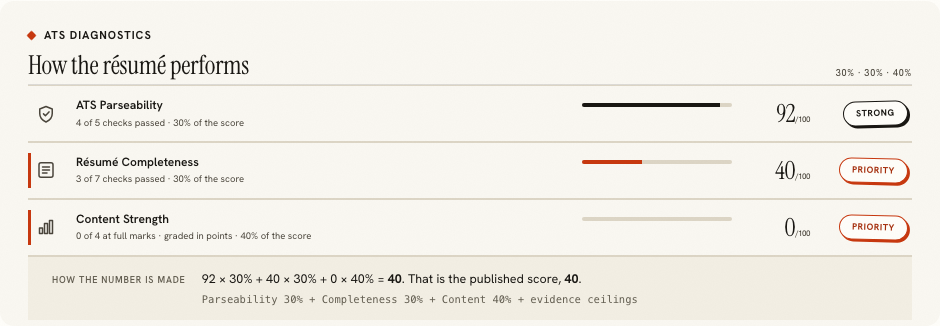
No experience section, which is the completeness check worth 30 of its 100. And no role for the achievement lines to belong to, so the content dimension had nothing its rules recognised and returned 0 out of 100 while sitting at 40% of the score.
The one change
The PROJECTS heading became EXPERIENCE, with a role title, an employer and a date range under it, and the same three achievement lines were gathered beneath that. Not one line was rewritten. Nothing was added except the role line itself.
The document after
100 × 30% + 70 × 30% + 73 × 40% = 80. Parseability went to 5 of 5, completeness from 3 of 7 to 4 of 7, and content from 0 to 73 with 2 of its 4 rules at full marks.
Where the forty points came from
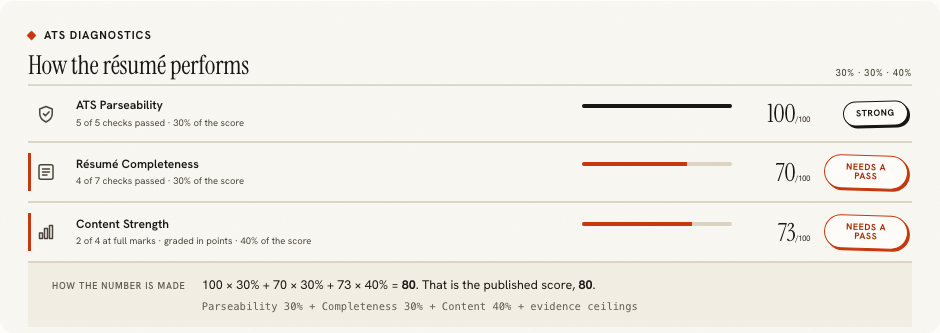
Mostly from the content dimension, which is 40% of the score and had been returning nothing. Action-led lines and measurable evidence both reached full marks, because the lines had always satisfied those rules and had never been in a place the rules looked. That is the pattern described in evidence ceilings explained.
What is still wrong at 80
Completeness is 4 of 7. There is no education section, no phone number and no summary, worth 15, 5 and 10 points of that dimension. The report names each and prices it, which is the ordering habit described in previous reports and what a fix was worth. The fully written version of the same career measures 97, as shown in taking a résumé from 40 to 97.
Why one change at a time is worth the extra minute
Because a pair of measurements tells you something about the next document as well as this one. Changing five things and re-running gives you a better résumé and no knowledge: you cannot tell which of the five mattered, so the next time you are in the same position you will do all five again and still not know. Changing one thing costs a second run of the check, which takes a minute, and buys a fact you keep. On a weak document the fact is usually the same one this page found, and it is worth learning once.
What this page does not claim
That every document has forty points in it, or that a score changes an outcome. The candidate is invented and nobody was hired. What the pair shows is a mechanism worth trusting: the scorer measures what it can see, real work filed in the wrong section is invisible to it, and moving it is a ten-minute edit rather than a career change.
The habit this supports is the useful part. Run the check, take the single improvement the report prices highest, do only that, and run it again. Reports are kept in this browser, so the two sit side by side and you can see what the change bought rather than guessing. Doing five things at once and re-running produces one number and no information, which is the difference between measuring and hoping.
One last thing this pair demonstrates about advice in general. A claim of the form fix this and your score improves is testable in about three minutes here, because the rules are published and the reports are kept. That is a rare property in this category, and it is worth using on anything you read, including the pages on this site. If a piece of advice cannot be shown to move a named row, it is a preference rather than a finding, and it should be read that way.
Run it, change one thing, run it again
Previous reports are kept, so the pair sits side by side and the difference is what the change was worth.
Open the ATS checkerPrevious reports and what a fix was worthQuestions
- What exactly was changed
- A PROJECTS heading became an EXPERIENCE heading with a role title, an employer and a date range, and the three achievement lines were gathered under it. No line was rewritten and nothing was added.
- What were the two scores
- 92 × 30% + 40 × 30% + 0 × 40% = 40 before, and 100 × 30% + 70 × 30% + 73 × 40% = 80 after.
- Why did the content dimension move so much
- It went from 0 to 73. Its four rules grade achievement lines inside a role, and before the change there was no role for them to sit in.
- Is the document finished at 80
- No. Completeness is still 4 of 7 checks, because there is no education section, no phone number and no summary. Those are the next fixes and the report prices them.
- Does my document have forty points in it
- That depends where it starts. The mechanism is general: find what the scorer could not see, and put it where it can.
Conxfolio is a free set of four career tools: a résumé builder with 37 rendered layouts, an ATS résumé checker that prints its own arithmetic, a cover letter builder that traces every proof paragraph back to the line it came from, and a portfolio builder with 20 authored designs. There is no account to create, nothing is held back for a paid plan, and no language model is used anywhere in the product, so the readers, the score and the letter are deterministic code you can check.