The same work, written twice: 40 and then 97
The distance between a weak score and a strong one is usually not more work. It is the same work, written where the scorer can see it.
— the career did not change; the document did.

Two documents were measured for this page. They describe the same invented career: a backend engineer, the same settlement pipeline, the same database cost, the same invoicing API. One measured 40 and the other 97. Nothing about the work changed.
The before, and its sum
92 × 30% + 40 × 30% + 0 × 40% = 40. The reading counts were 48 words, 10 lines and 2 recognised headings. The verdict block read that it parses and the evidence underneath is what is thin, and the best next move named action-led achievements.
Why the number was that low
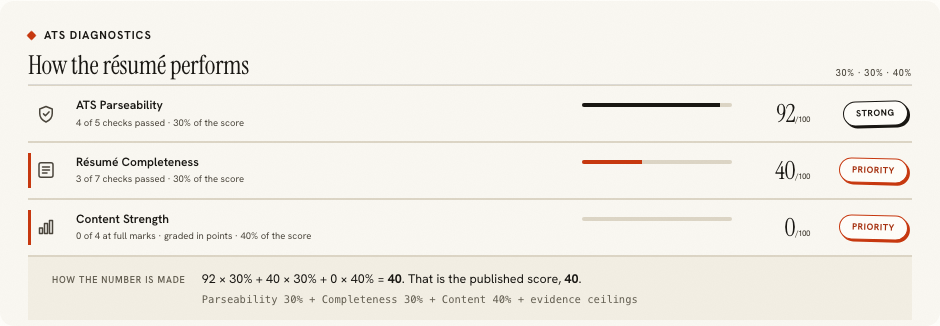
The work was written up as a list of project names with two sentences under each. There was no Experience heading, so the check that is worth 30 of the completeness 100 failed. There was no education section, worth 15. And the content dimension had no achievement lines to grade, so all four of its rules paid nothing.
What was done about it
The same facts were rewritten into a real experience section: two roles with employers and date ranges, four and three achievement lines under them, each beginning with what was done. An education line was added. Contact details went into the body. No new work was invented, because there was none to invent.
The after

100 × 30% + 100 × 30% + 92 × 40% = 97. Parseability 5 of 5 checks, completeness 7 of 7, content 3 of 4 rules at full marks. The remaining improvement is readable volume, which is worth a few points and is the honest last thing.
The lesson, which is not about the number
Most of the 57 points came from two structural facts: the work was in the wrong section, and it was not written as achievements. Both are writing decisions rather than career ones. That is the general case, and it is why a low score is a document diagnosis rather than a verdict, as what a score cannot tell you argues.
The general pattern behind both numbers
Three dimensions with different failure modes. Parseability fails on layout and is repaired with structure. Completeness fails on missing sections and is repaired by adding them. Content fails on how lines are written and is repaired by rewriting. The weak document failed the second and third at once, because the missing experience section took the content rules down with it, and one change repaired both. That is the usual shape: the largest single gain available on a weak document is almost never a rewrite of the prose, and almost always a section that the rules could not find.
What this page does not claim
That every document has 57 points in it, or that a high score changes an outcome. The candidate is invented, the résumé took four minutes, and nobody was hired because nobody exists. What the pair demonstrates is mechanical: the scorer measures what it can see, and the commonest reason it sees very little is that real work was filed somewhere the rules do not look.
If you want the cheapest version of this experiment on your own document, it is two runs and one change. Run the checker, take the single improvement the report prices highest, do only that, and run it again. The report keeps the earlier run, so the two sit side by side and the difference is exactly what the change was worth. That habit is described in previous reports and what a fix was worth, and the underlying rules in evidence ceilings explained.
A final word on what these two numbers are for. Neither is a target. The useful quantity is the distance between them, because it demonstrates that a score measures a document rather than a person, and that a low one is a diagnosis with an address. Anybody looking at 40 on their own report is looking at a document whose evidence did not reach the rules, and the report names which rules and prices the repairs. That is a much better position than it feels like at the moment the number appears.
Run it, fix one thing, run it again
Reports are kept, so the second run can be compared with the first. That difference is what the fix was worth.
Open the ATS checkerWhat changed after one fixQuestions
- Is this the same person
- It is the same invented candidate, Ada Fennimore, who does not exist. The same work is described in both documents, written two different ways.
- What were the two numbers
- 92 × 30% + 40 × 30% + 0 × 40% = 40 for the weak version, and 100 × 30% + 100 × 30% + 92 × 40% = 97 for the rewritten one.
- What actually changed
- The work was moved out of a projects list into a real experience section with roles, dates and achievement lines, and an education section and contact details were added.
- Is 97 a good career
- No. It is a legible, complete, evidenced document. The specimen took four minutes to write.
- Will my document move that far
- That depends entirely on where it starts. The mechanism is the same: find what the scorer could not see, and put it where it can.
Conxfolio is a free set of four career tools: a résumé builder with 37 rendered layouts, an ATS résumé checker that prints its own arithmetic, a cover letter builder that traces every proof paragraph back to the line it came from, and a portfolio builder with 20 authored designs. There is no account to create, nothing is held back for a paid plan, and no language model is used anywhere in the product, so the readers, the score and the letter are deterministic code you can check.